Recent discussions on the roles of oral language, fire, stone tools, horticulture, agriculture, metal use, and written language in shaping the road to a sixth mass extinction motivated an attempt to capture key elements influencing the ecological impact of deviations from well-worn paths.
The idea is that living beings try new stuff all the time—and not mostly by cognitive eureka moments, but by stumbling onto new genetic or behavioral tweaks. No conductor needs to sit at the helm for this to just happen. The process is impossible to stop, in fact. Obviously many—or most—ideas/mutations/novelties fail. Usually, any harm is suffered primarily by the species itself. Occasionally, the deviation has a serious impact on many other species.
Ecology can take a very long time to pronounce a verdict. Evolutionary adaptation (speciation) tends to operate over (sometimes many) thousands of generations, and all the interactive ripple effects can reverberate for far longer. As a measure of relevant timescales, the age of Homo sapiens is (logarithmically) halfway between 100,000 and 1 million years old (∼300,000). Typical species longevity is in the range of 1–10 million years, also indicating the pace of ecological adjustment through evolution. Climate varies on faster scales, but life has an answer to that: phenotypic variation. Pre-vetted modalities can be activated and de-activated. Most species have been around long enough to possess a library of adjustments that can be accessed as conditions demand, so-long as the changes are part of their historical cycles—or even those of their ancestral species. Truly novel conditions are another story: no library entry for coping.
Because many of the human deviations from ecological norms are indeed novel and operate on a much faster scale than evolutionary adaptation (e.g., cultural/cognitive rather than genetic mechanisms), it sure would be handy to have a sneak peek on what ecological judgment is likely to say on the matter in the fullness of time. So: introducing the Ecological Deviation Application.
Application Flowchart
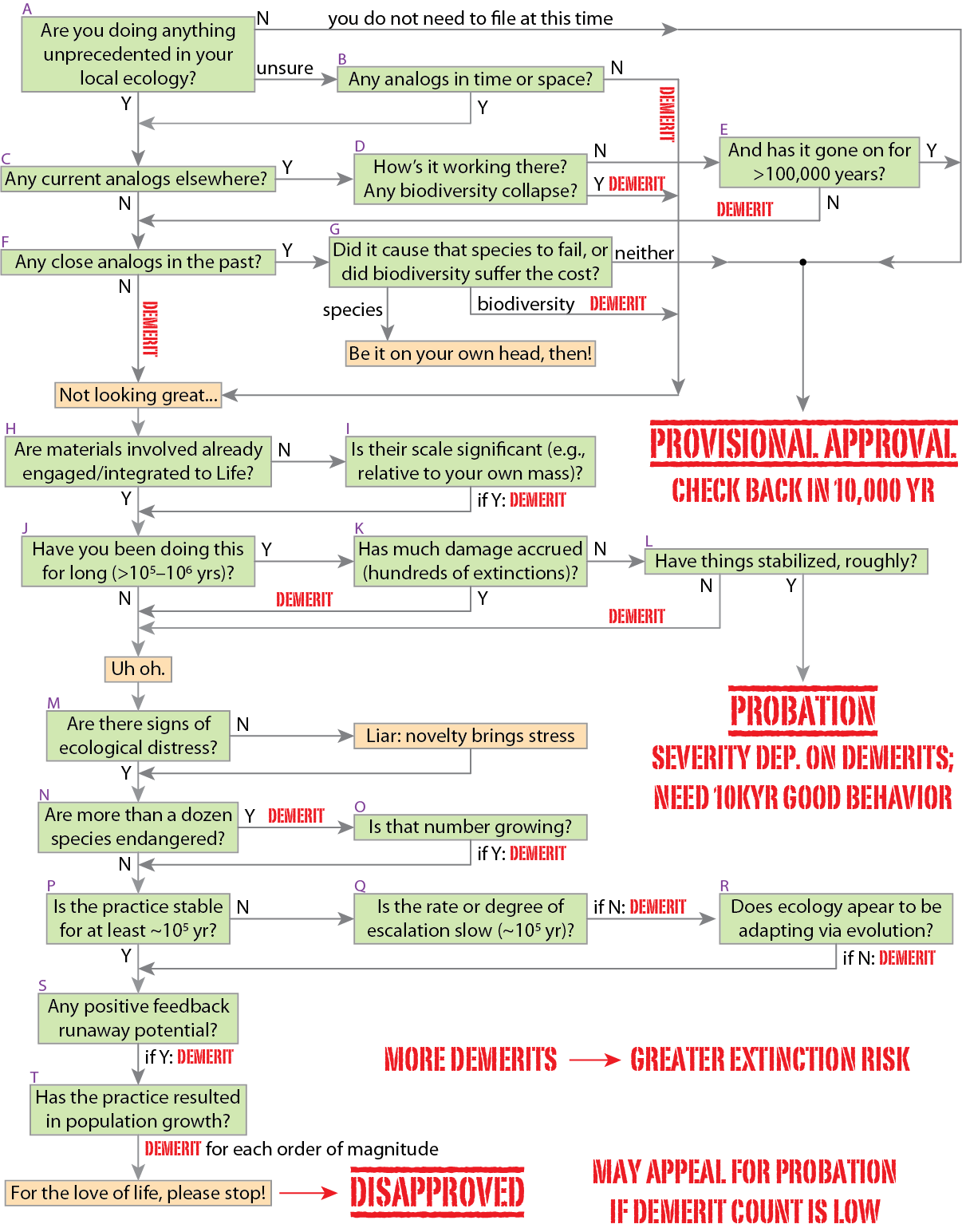
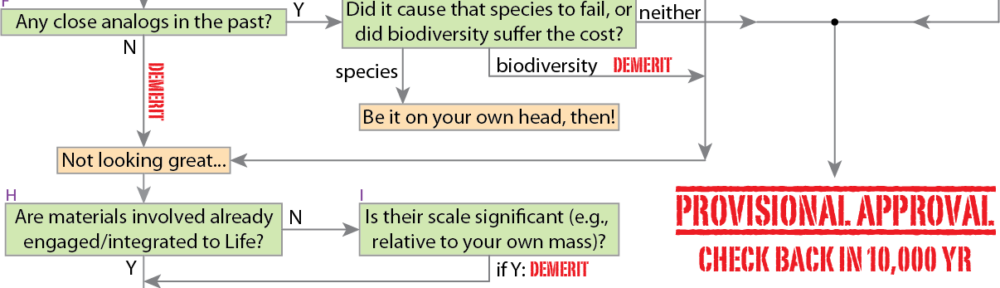
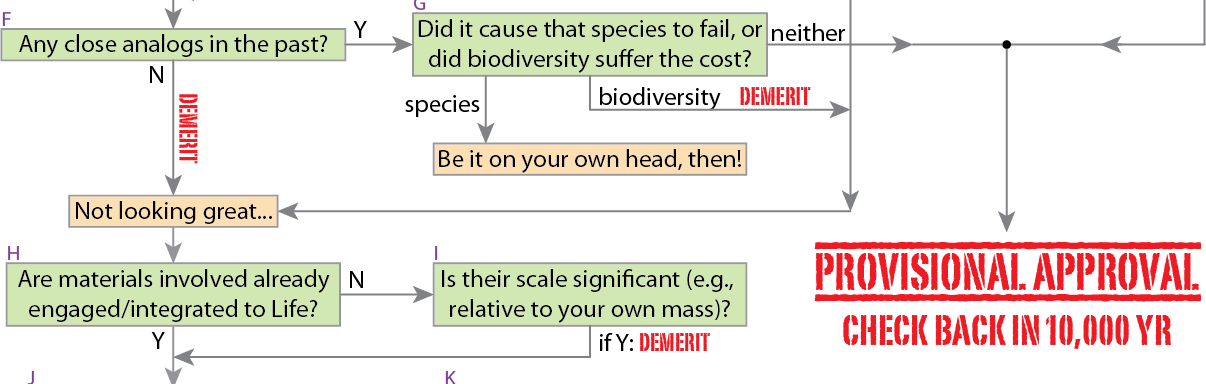
The flowchart is not a perfect or precise tool: just something pulled together over a day or two. Maybe in a way similar to the Limits to Growth models, it is best not to take the model literally, but rather appreciate the overall thrust, timescales, and areas of concern. In fact, instead of viewing the flowchart as trying to algorithmize ecological decision-making (a futile task), think of this flowchart as a poor translator: trying to land a point for brains attracted to and conditioned on algorithmic thinking—perhaps providing a glimmer of insight otherwise unavailable in our ecologically-disconnected lives. Just as language is a crude tool leading to artificial categorization and (mental) boundaries, this flowchart only hints at a far more nuanced process.
Each question box has a green tint and a letter/label at top left (flowchart conventions stipulate that questions/decisions be placed in diamond-shaped boxes, but what a pain to try to fit text into such shapes!). Most answers are of the yes/no (Y/N) variety, but spelled out for other cases. A demerit system tracks worrisome “violations.” The more demerits racked up, the greater the chances of ecological disaster—like a mass-extinction event.
Three basic outcomes obtain in this flowchart:
- Provisional Approval: a pass to keep doing what you’re doing, understanding that nothing is ever guaranteed. The guideline is to check in every 10,000 years to make sure you’re still operating in the safe zone.
- Probation: The warning signs are worrisome, and your actions deserve close monitoring. You may surprise the world and prove out in time, but are running a big risk.
- Disapproved: Your actions are very likely problematic, and could potentially trip mass extinction. Greatest concern.
No Lawyers!
Cases are adjudicated by the universe/ecology/evolution. Words and arguments have no bearing. A lawyer, for instance, might argue that agriculture is not unprecedented because ants and termites and damselfish engage in related activities. The lawyer would move for acquittal straight away in Box A.
The universe is not so easily fooled by twists, distortions, or word play—looking instead at the complete context in terms of what is actually going on. There is no rigid, codified, legal framework pretending to represent truth: it’s not a game. Every situation is evaluated on a case-by-case basis, considering biophysical merits and demerits. Subtleties matter. There’s no hiding. Words are wind.
Keep this in mind if running scenarios through the flowchart. Efforts to put a thumb on the scale won’t fool Mother Nature. What is our best, honest guess as to how she would answer each question (keeping in mind that the questions themselves are only best-guesses as to what’s important). At the very least, this exercise can serve to stimulate conversation about what’s important, ecologically. We shouldn’t expect to ever really understand in full, but might at least develop a “spidey sense” for when things seem worrisome.
Various specific cases are briefly covered later, but first it may be worth a few words on each of the three “stages” in the flowchart/application, leading to the three outcomes.
Provisional Approval
The thrust of the questions in this section tries to get at whether the “deviation” is already vetted in time or space by having proven itself in similar form. Even so, approval can only ever be provisional. Each modality in life can only answer for itself, in the end.
Many deviations (mutations) result in failure of the individual or species, as in Box G. If the perpetrating species fails, that’s no longer so much an ecological concern and terminates the flowchart in removal of a single species. It’s still a form of disapproval: do this thing and you may suffer extinction—based on analog situations from the past. But the damage is isolated.
Probation
If the deviation in question has no proven precedent, probation or disapproval are the only outcomes remaining. To avoid outright disapproval, the criterion is simply that your own deviation has been going on long enough without causing a significant extinction event and has become a stable practice.
Fire is a decent example of this. It can be important to specify the place and time of the application process. In the case of fire, we might say Africa about 200,000 years ago: prior to migration and to the quaternary megafauna extinction (QME) event. Fire had been in use for 1.5–2 million years, and its use had stabilized. It still could be dangerous, though: might lead to something more damaging (and guess what…). So, probation is appropriate.
Disapproval
Any deviation that has no close-but-successful analog, and has not been around for long will end up being disapproved. The only remaining issue to be resolved is how many demerits are accumulated before the verdict is announced. Disapproval may not seem fair—whatever fair might mean. If the demerit count is low enough, an appeal may be reasonable, at least landing in probationary status. What is low enough? That’s not our decision. There is no hard-and-fast rule. It’s not codified law, remember? Unsustainable fails, and sustainable has a shot at success. The universe is the court, and this flowchart only serves to provide warnings that would be foolish to wave off—pretending we know better, somehow.
A chief concern in this section is the potential for ecological calamity. Signs include a number of endangered (or already extinct) species as a consequence of the deviation. At least as important is whether the list of impacted species is growing (what’s to stop it from continuing to escalate?).
A reasonable degree of stability on relevant evolutionary timescales counts for a lot. In the absence of reasonable stability—true stability doesn’t exist, in any case—the rate of change is of critical importance: whether changes are modest on the timescales that count. Especially important is whether the local ecology is adapting along with the changes. The survival of megafauna in Africa suggests that fire, stone tools, and spears developed/spread slowly enough to allow widespread adaptation/accommodation.
The post a few years back on deer crossing roadways—or roadkill in general—offers a contrast. Springing up in less than a century, animals have no evolutionary exposure to massive metal boxes hurtling down the road faster than anything they’ve ever seen move. It’s not part of their context. They don’t have a chance to adapt: they’re just wiped out. Sure, it’s possible that those who survive pass on some instinct to avoid the peril, but not if the rate is too high for this slow process to establish frequency within the gene pool.
Positive feedback is another key factor. Does the practice make it easier to do more of the practice? Using agriculture as an example: plowing fields, storing grains, and selective breeding all act to promote an increase in those activities as a function of their “success.” Lawyers could have a field day contesting the qualifications, here. But again, the universe does not abide lawyer games. You can’t fool Mother Nature: she knows bad news when she sees it.
Finally, substantial population growth is a key marker of ecological imbalance. This can be considered on the bases of either absolute numbers or rate. For instance, the annual rate of human population growth went from 0.0035% (20,000 year doubling time) before agriculture to 0.035% (2,000 year doubling) after. It took about three doublings (so about 6,000 years) for the absolute scale (population number) to increase by an order-of-magnitude, but the writing was on the wall at the start of this period.
Appeal?
The flowchart notes the possibility for appealing a “disapproved” result, if the demerit count is low. What does “low” mean? Nothing, really. The universe does not follow a rigid rule-based system as suggested by this flowchart. The appeal mechanism is part of the overall “provisional” nature of all outcomes. What really counts is the actual outcome in its full context. Because a negative answer to Box J trips disapproval, it’s worth making a distinction between merely disturbing and outright egregious—which demerits aim to reflect, crudely. Ecologies notice the difference, too.
Case Studies
Below is a summary table showing my own attempt to run scenarios through the flowchart. Just after is a full-account version (click to expand; also a PDF version is available for viewing side-by-side with the flowchart or post). The path through the flowchart is indicated by answers according to box label. Lower-case entries are “normal,” while upper-case indicates the earning of a demerit. It can be important to consider the time and place of the application submission. An asterisk indicates Africa something like 100–200,000 years ago.
| Number | Case | Demerits | Outcome |
| 1 | Newt, Squirrel, Tick | Prov. Approval | |
| 2 | Crow Sticks | Prov. Approval | |
| 3 | First Firefly | 2 | disapproved |
| 4 | Oral Language | Prov. Approval | |
| 5 | Fire* | 1 | Probation |
| 6 | Early Stone Tools | Prov. Approval | |
| 7 | Stone Tools* | 1 | Probation |
| 8 | HS Migration from Afr. | 7 | Disapproved |
| 9 | Horticulture (general) | Prov. Approval | |
| 10 | Horticulture (human) | 1 | Probation |
| 11 | Spear* | 1 | Probation |
| 12 | Bow & Arrow; 20 kya | 3 | Disapproved |
| 13 | Early Agriculture | 6 | Disapproved |
| 14 | Bronze Age Ag. | 8 | Disapproved |
| 15 | Modernity | 15 | DISAPPROVED |
| 16 | Cyanobacteria | 6 | Disapproved |
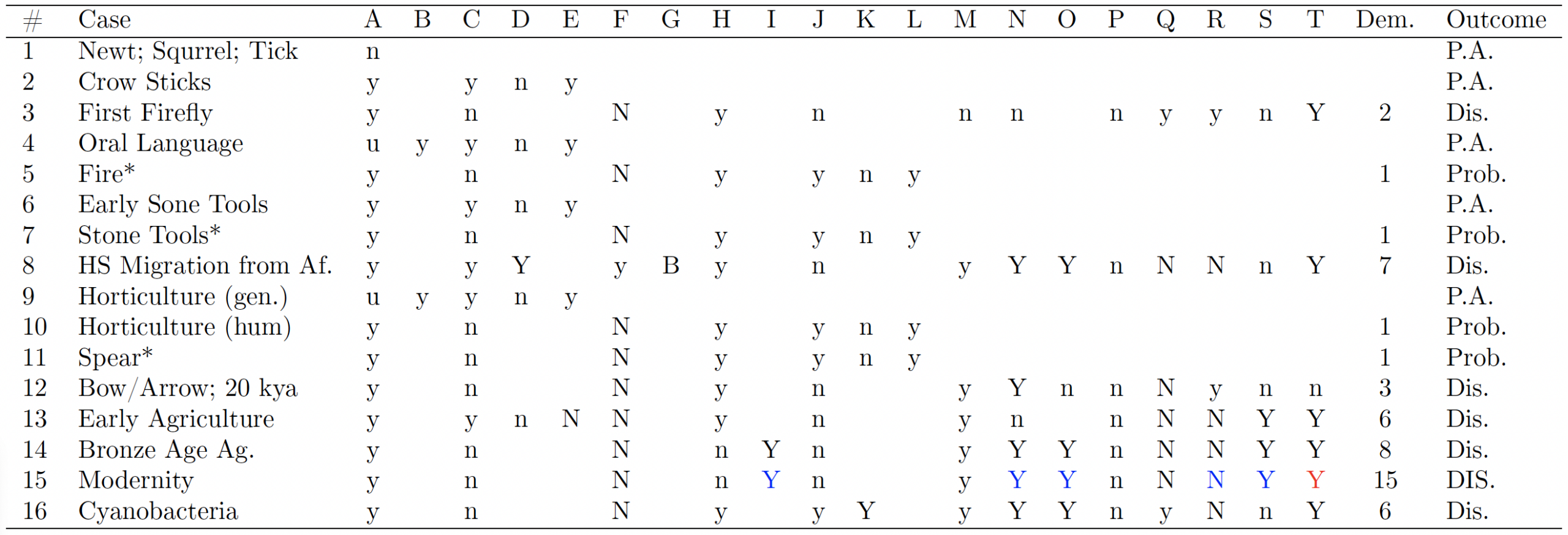
The scale of modernity’s deviation is so enormous that a simple demerit count doesn’t capture the severity of the practice. To somewhat account for this, blue demerits count double, and red triple. Unfair? Remember, this extremely crude model is not binding: the universe will ignore it and might well effectively apply much harsher penalties. The scheme here simply tries to capture elements of how ecological decisions might be based.
Case Clarifications
The first column gives a case number, which will be useful for shorthand referrals.
Case 1 applies to just about every species/behavior found in the Community of Life, but space was limited in the description field. Most plants and animals occupy proven niches using proven techniques that have loads of precedent in both space and time.
Case 2 refers to New Caledonian Crows, who fashion tools out of sticks to access food. Similar practices are used by other creatures (many primates) as well, without bringing the Community of Life down.
Case 3 (firefly) is just trying to get at some novel provision that the world hasn’t seen before. Lack of precedent earns a demerit and sends into at least probationary territory. But, being new to the world, absence of track record flips into Disapproval Land at Box J, after which another demerit is incurred on the presumption that a newly-established species has seen significant population increase (from a necessarily small start). This is a good candidate for appeal to probationary status, ultimately proving out toward acceptance. Of critical concern is: how intrinsically harmful is a flashing butt to the Community of Life? Compare that to a bow and arrow (Case 12), for example.
Case 4 (oral language) is inspired by human language: was that the crossing of the Rubicon? Well, everything is provisional, here. But loads of other animals (and plants!) employ audio communication using a large vocabulary and even grammar. Language capability is not obviously in itself a deal-breaker.
Case 5 (fire), evaluated before migration from Africa, trips our first probation. It is saved from disapproval on the grounds that its practice had been going on for over a million years without creating a significant extinction event. That’s not nothing. Still, it’s in the doghouse as a potential problem—possibly laying tracks for more obviously problematic behaviors. One can easily argue that this is precisely what happened.
Case 6 grants provisional approval to early stone tools, since lots of animals use stones as tools in primitive fashion.
Case 7 takes us to stones with modified (sharp) edges used as scrapers, knives, hatchets, etc. Like fire, lack of analog earns at least probation, but length of usage without an extinction event keeps it clear of disapproval. It’s worth a close eye, however—principally because it could develop into something of greater impact.
Case 8 deals with migration of Home sapiens from Africa. Now, migration of plants and animals to new environments happens all the time. Disruption is expected. It’s a matter of scale: some are more impactful than others. The spread of a highly versatile and successful hunter did put many species on their back heels in a rapid process that left no time for evolutionary adaptation—indeed precipitating the Quaternary megafauna extinction as a very real and outsized consequence. Box S (positive feedback potential) could go either way, but finite continental opportunities squelch runaway in a time that is relatively short compared to evolutionary processes. All the same, human population no-doubt surged as a result of increased domain.
Case 9 gets at the generalized practice of plant tending. Since countless mutualistic arrangements exist between plants and animals (e.g., pollinators), as do numerous examples of more active tending of plants and fungi (e.g., ants, termites, damselfish), the practice in itself is not a planet-killer—thus getting provisional approval.
Case 10 narrows the horticultural focus to human practices, as often employed in places like the Amazon. Favored plants are tended, encouraged, and seeded in suitable spots surrounded by compatible species. Though lacking a close analog (the scope/scale differs significantly from ant horticulture, for instance), longstanding practice at least allows probationary status. As with many human practices on probation, horticulture could act as a gateway drug toward more destructive practices, when conditions (like the Holocene?) permit.
Case 11 (the spear) is closely associated with Case 7 (stone tools), but is made explicit for contrast with the next case (bow and arrow). Scoring runs identically to the cases for fire, stone tools, and horticulture—saved from disapproval by long practice, which means a lot.
Case 12 looks at the bow and arrow revolution that swept the world, evaluated 20,000 years ago. In contrast to the spear, this more recent development in human weaponry is no longer protected by longstanding integration and thus lands in the “disapproved” camp. A few more demerits are picked up on the notion that the technology puts more species at risk, and because escalation/adoption has been swift.
Case 13 looks at the first few-thousand years of agriculture. Many parallel starts around the world—all unproven modalities—lead to Boxes D and E. Demerits are picked up on the basis that the growth rate (spread) is too swift for biological/genetic evolution to track, and for the combination of many positive feedback mechanisms opening up while stepping up the rate of population growth by an order-of-magnitude.
Case 14 now includes metallic contributions to both agricultural tools and weaponry, serving to amplify the perils of novel human practices. New demerits are picked up for using materials not in biological circulation at a significant scale, and exposure of more life to extinction threat.
Case 15 is the full show of modernity. It’s ecological madness out there, with many measures indicating the initiation of a sixth mass extinction. As mentioned before, the scale is so far beyond what previous cases involved, that at least doubling some of the demerit weights seems justified. After all, destructive potential is more analog than digital/Boolean. This is no mere game.
Case 16 is motivated by seeking comparison to another biologically-induced mass extinction, in the form of the Great Oxidation Event perpetrated by cyanobacteria just over two billion years ago. The “application” is set in the first few-million years of the affair, when the phenomenon was gaining speed.
Demerits, Contextualized
The “score” as tracked by demerit count ought not be treated pedantically. Accumulating one, two, or three might in actuality relate to similar levels of ecological peril. Through blurry glasses, one might roughly recognize four regimes for demerit count: none; low; middling; and high.
The cyanobacteria example suggests that even middling demerit accumulation trespasses into mass-extinction territory. That means humans migrating from Africa and both forms of agriculture could represent extreme danger. Indeed, the migration from Africa did perpetrate the Quaternary megafauna extinction event. It was serious! Maybe that alone laid the foundation for a mass extinction that would unfold over the next few-hundred-thousand years. But since tens of thousands of years elapsed before agriculture without obvious continued fallout, maybe it played itself out. Agriculture, on the other hand, did quick work in terms of positive feedback, population growth, and ecological impact. It acts far faster than cyanobacteria, by three or four orders-of-magnitude!
Note that modernity, as crudely scored here, may be far more impactful than even the cyanobacteria as an extinction-machine. Indeed, this entire exercise was stimulated by modernity’s egregious ecological performance. It could be that a number of our practices from the past millennia put us on the road to mass extinction, but it took the over-the-top display of modernity for us to finally notice: we’re not subtle creatures. Some have argued that the trauma of megafauna extinctions instilled a more respectful ethos among tribal cultures living in the aftermath. Maybe the slap of modernity will carry profound and lasting lessons that we’re only now starting to contemplate, with this flowchart effort being one faint reflection of that story.
Flight Risk
This exercise carries the hazard that it may get wheels turning as to how one might improve, expand, and add nuance to the flowchart. It has probably already gone too far down a deceptively algorithmic path as it is. The more sophisticated the model, the more suspect its interacting mental fabrications become. The utility is in raising a general awareness of important questions and emergent modes—much as Limits to Growth highlighted the danger of delays in negative feedback as a general trigger of overshoot.
In other words, don’t get too excited by this flowchart approach (and maybe you aren’t even a little excited). It has probably delivered as much insight as it can. All the same, those insights might well aid understanding as to how we might react, now that modernity’s overt failure has caught our attention.
Future vs. Past
How might one square probationary practices that indeed appear to have led to something far more dangerous? Fire, stone tools/weapons, and horticulture did indeed lead to our present condition. Probation was perhaps too lenient a sentence. Does this mean that fire, stone tools, and horticulture are demonstrably problematic, given enough time?
Yes and no. Yes, there’s no denying what unfolded. But no, the future does not have to exactly mirror the past (and can’t). It still might have enough similarity that something like fire is always beyond the pale, but we aren’t smart enough to say for sure. In other words, should humans find themselves living in ways of old several millennia hence, using fire, stone, and horticulture, is the pattern destined to repeat? One reason for skepticism is that conditions will not be the same. The climate stability of the Holocene—which might account for agricultural initiation—may not repeat for the duration that humans remain on the planet (perhaps another few million years?). The low-hanging fruit of surface ores and fossil fuels won’t come back in relevant timescales. A bruised Earth won’t be as capable of supporting a similar surge in the intermediate-term.
These risky practices (fire, etc.) still earn probationary status, in my view, but that’s not an outright, blanket, categorical condemnation. Practices that can last for hundreds of thousands of years without in themselves triggering mass extinction may be fine—if kept to themselves by whatever constraints. How might the slippery-slope peril to more problematic practices be prevented from manifesting? Maybe they won’t be, but if they are then it’s probably not by intentional practice as much as by biophysical constraint. It’s certainly possible that humans are an evolutionary mistake: bound to think their way into non-viability by having a maladaptive form of intelligence (equating to ecological stupidity). But at least we know that some modes can persist for appreciable times, as long as the deadly elaborations don’t crop back up. All we can do now is stop being dumb enough to think our brains are capable of outsmarting ecology, and aim for lifestyles that are less obviously catastrophic—relying heavily on proven examples from the distant past.
Views: 2579
What timescales are you talking about here? I did a little calculation for your “low hanging-surface ores” (theyre even more low hanging now, future humans won’t even have to mine them, they’re in cities) and they can last ar medieval levels with a population of 400 million 100 thousand years at least, so… maybe disapproved on an ecological court, but the logisticians can give a thumbs up
The climate stability of the Holocene—which might account for agricultural initiation—may not repeat for the duration that humans remain on the planet (perhaps another few million years?).
– interglacials do indeed repeat once every hundred thousand years or so(as far as we know). Plus, climate change funny enough has lengthened the Holocene, after ~10k years for the negative effects to go away. Then ~90k more into the next glaciation
I also feel you’re discounting the negative feedbacks on expansion here. We are not the Siberian traps, able to keep spewing out carbon for 20 thousand years, nor are we intractable chixculub. At one point the damage we do to ourselves causes us to collapse to, acting as a limited to collapse. EG, your earlier post on how long to reach modernity populations just forgets Malthus exists, even though you’ve mentioned him before…? Basically, whay im saying is our damage post fossil fuels simply cannot ramp up without destroying our ability to damage.
Your Cyanobacteria point holds, but it’s also worth noting that they themselves didnt gi extinct-so it may not be a given that we will either. Another event I’d like to bring up that rivals that agricukture in demerits is the advent of burrowing in the animal kingdom. By your framework:
Novelty: yes. First recorded instance of an animal engineering sediment
Rate of change: Geologically rapid (tens of millions of years for bioturbation to become dominant), too fast for many sessile Ediacaran forms to adapt. → Demerit(s) (granted way slower than ours though)
Positive feedback: Yes — burrowing better oxygenation/nutrient cycling led to more burrowing animals further substrate change ,advantage for mobile/burrowers. Success surge in Cambrian diversity.
Extinction impact: Growing list of impacted species (Ediacaran biota largely wiped out; some Cambrian groups hit in Sinsk).
So:5-7 demerits . Maybe you should go after Gophers next? They did cause a mass extinction actually , but not one of the big 5. Hopefully thats all ours are limited to, and we can continue our 7-demerit activities for a few million more years.
Who knows. No amount of wishful slant will alter the actual judgment in its full context. I don't trust us to figure it all out. The main point is to be highly suspicious of untested novelty: especially when damage is demonstrable and fast. Waving (litigating) it away is bound to happen though—in fact a default response within our culture (part of why we're in this predicament). The universe isn't easily persuaded.
God (nature?) I hope you’re not accusing me of litigating here. I just felt like bringing up some relevant counterpoints is all. Im saddened that you didn’t see it that way or feel the need to engage.
Also, on second thought, this feels more of new information presented to the court than litigation…
That low-hanging surface ore is not ore and will probably need complicated machinery and lots of energy to separate and refine.
An interesting thought experiment, thanks Tom. I wonder if you can place things that exist but cross a certain boundary before causing problems into this? For example, is a brain absolutely fine, but when it reaches a certain size it becomes problematic? The limitation of the flowchart (and you point out its limitations) is really how you prevent the inputs becoming a little ridiculous! If god hadn't invented carbon dioxide, then we wouldn't be having any of these problems!
The spear Vs bow and arrow is an interesting one. I often go to "abstraction" as the issue that causes us the most harm. But really I mean indirectness, or not being able to feel something first hand. If you can't feel the pressure of animal hide upon spear, vibrating through you, then you become more likely to use without thought, or with impunity. Of course, my focus has always been on modern phenomena such as language, money, charity (I tackle the distant famine in Sudan with a charitable donation for example). As soon as you create a layer between you and the thing in itself, you lose connection and empathy doesn't quite bridge. If I can't feel my destructive practice and its outcomes, then I've opened the potential for it to runaway.
I can't argue that large brains are not potentially problematic, in which case small brains could lead there, in which case neurons…
On the other hand, such material arrangements have hitherto remained within bounds. Does it take a "perfect storm" of conditions before one (of hundreds of thousands) brain design jumps the rails? Another thing we can't know—except that it really very did.
Your disconnection line of thinking is definitely worth considering.
I am somewhat confused about this latest article; it seems to be the culmination of a "deep green resistance" adjacent trend that's been here for a few posts.
Yes, contemporary authoritarian-corpocratic modernity is a terrible way to structure a society on all fronts; what is the proposal then to fix the problem?
No plant or animal (including humans, of course) who have ever lived successfully in long-term ecological equanimity have done so according to a proposal. That very framing exposes the roots of the belief that we can "intellectual" our way into a design for living, which is never how it's gone, and the one time (last 10,000 years) it has been tried is proving to be disastrous.
But we can't shut off brains or intellect. My vote would be that we use these tools to recognize their own limitations and dangers, morphing into a culture that no longer tries to be in control (shuns such hubris), and instead listens with humility to the rest of the Community of Life for inspirations on how to live in right relationship on the planet. Gizmos or constitutions or legal systems or economic schemes have already missed the point entirely, and are part of the overall failure mode.
That's my take, anyway. Most people alive today—wholly acculturated to a flawed existence—will wholly reject such a notion. The question for me is whether the "blank slates" of 300 or 1,000 years hence will get it. If humans are around in 10,000 or 100,000 years, I'd say it's probably *only* because those ones get it and live in ways our culture would characterize as "failure." This raises the interesting irony that our culture's "success" manufactures colossal failure, while actual ecological success is seen as a failure. Something is very wrong with that, and will (can) not stand for very long.
Yes, we can't intentionally (as a species, anyway) change our behaviour. That would require everyone's brains to have changed to support that changed behaviour. Even if every person in the world were aware of the predicament we've caused, it's likely nothing would change. We can't stop acting like a species.
If humans are around in 10,000 or 100,000 years, I'd say it's probably *only* because those ones get it and live in ways our culture would characterize as "failure."
I think you underestimate the power of negative feedbacks. If we don’t willingly limit ourselves in the next 10/100k years, nature will do it for us. From what I’ve read, thats your opinion too. But what about that precludes the continuation of your so-called failure? You can have a collapse without a total wipeout, again shown in thr past 10 thousand years.
I think you might be looking at a false binary here, of “fully sustainable population controlling Hunter gatherers” and “baby making forest destroying topsoil churning agriculturalists”. The Inca people’s agriculture decreased soil erosion below baseline levels for example.
And during the Black Death, plant diversity decreased.
Funny that I just wrote a line for an upcoming post (on the power of feedback) about the "protective embrace of negative feedback." In the long run, only those modes wrapped in negative feedback as the dominant/determinant process have staying power. Indeed, nature finds a way, or does away.
Well, it seems we both have the same base but branch off into different conclusions. Agriculture is snuggled into bed with negative feedbacks; literally every agricultural civilisation has fallen.
To me, that's a good sign for its staying power as a paradigm, if not for individual agrarian civilisations.
I think nature will be doing significant population reduction this century, we won't be waiting ten thousand years.
I agree with that. My only point was that future agrarian civilisations, if that is to come, might be sustainable (till the climate makes it impossible) due to this negative feedback causing collapses and regeneration
This. One of the most astounding tricks modernity has managed to pull off is to make intelligemce out as a divine gift, complete with a mythology ("from the caves, to the stars!").
Its a deeply delusional way of thinking that has done tremendous harm irl.
Thank you for your reply! I'd also like to ask about cyanobacteria– it's strange to me that it ranks even ABOVE contemparary modernity; it is a part of nature and natural evolution, unlike our profoundly UNnatural modernity.
What would you rank, say, the big space rock* that took out the dinosaurs I wonder?
*ie the one that will certainly write finis to the entire "human experiment" if (when?) it comes again
I don't understand. Oh: maybe you took the order in the table as a ranking. Look at the demerit count. I "threw in" cyanobacteria as comparison to modernity. Both appear to be mass-extinction causes, but modernity looks more dangerous by this scoring.
Modernity is unusual but it's not unnatural. Nothing in the Universe is unnatural.
Picky, I know, but relevant. Thinking of human activities as unnatural just adds to the human supremacy meme, if unintentionally.
In the spirit of this post, I suggest replacing "unnatural" with "not ecologically-vetted" so that the described activity operates outside of established "natural orders" as an un-integrated offshoot.
Whenever I see a label: "all natural ingredients," I substitute: "made with real atoms." In this sense, nothing, indeed, is outside of (apart from) nature.
modernity IS unnatural by definition
Definitions may differ. Words don't contain answers. I am sympathetic to the notion that nothing in the universe can be unnatural (that everything in the universe is part of it). But I am also sympathetic to the enormous mismatch between modernity and the surrounding (ecological) world. Thus, rather than even use the fraught term "unnatural," I think it helps clarify to say that modernity is un-ecological. Anything artificial is still constructed of the same matter (atoms) as anything else, but not part of closed-loop ecological reality.
My post coming out tomorrow is about feedback loops, so in these terms, ecological constructs are wrapped in negative feedback loops (stable, integrated), while modernity is open-loop or worse: positive feedback. Such constructs don't last, and unless subsumed by negative feedback loops will be temporary aberrations, like modernity (though still "natural" in the sense that the universe *can* churn out such anomalies on occasion).
I had an irreverent reaction – this is very funny, in a terribly dark, doomer way – as well as a neat layout of our predicament. Thanks.
I know you've expressed a preference to view entropy in a strict thermodynamic / quantum physical sense – but I am wondering if you still feel strongly about that. Apparently even Schroedinger took an interest (https://en.wikipedia.org/wiki/Entropy_and_life).
I would postulate that life could be defined as a process that in aggregate reduces entropy within an open system (I'd argue this extends to entropy as order and information but is also valid for the strict sense of creating chemical energy stores and sequestering them). This is balanced by death and other outside influences (e.g. if plants are too successful at sequestering carbon to the point of runaway global cooling, volcanoes might eventually be needed to kick-start things again). I would argue life must decrease entropy in order to be sustainable – otherwise it would burn out. I'm not sure if large scale entropy decreases have some inherent co-evolutionary advantage – but looking at natural history I think a case could be made. For example, the great oxygenation event (Cyanobacteria – #16) was perhaps the greatest geo-engineering experiment to date – it certainly massively changed the chemistry of the planet and altered the balance of life for countless species – but also led to greater complexity and so many new chemical pathways for the survivors and their descendants. And besides, plenty of anaerobic organisms are still will us – they just have to share the biosphere with all us oxygen burners.
I am somewhat more agnostic about modernity and our chances – agree that something will happen and our present arrangement is hopelessly unsustainable. I do feel that entropy might be a reasonable and more easily definable metric for guidance. So agriculture: planting and harvesting and recycling nutrients and keeping our own population in check – cautiously optimistic. Modern agriculture that mines concentrated resources and dumps outputs into landfills and ocean dead-zones – hard no. Limited mining towards high-quality products that are maintained – i.e. decreasing entropy – maybe doable. Blasting mountainsides, washing out thousands of years of soil buildup and resurrecting toxic minerals – all to create massive waste streams dispersed at uneconomic concentrations back into landfills and the environment – definitely not something to be entertained at scale.