
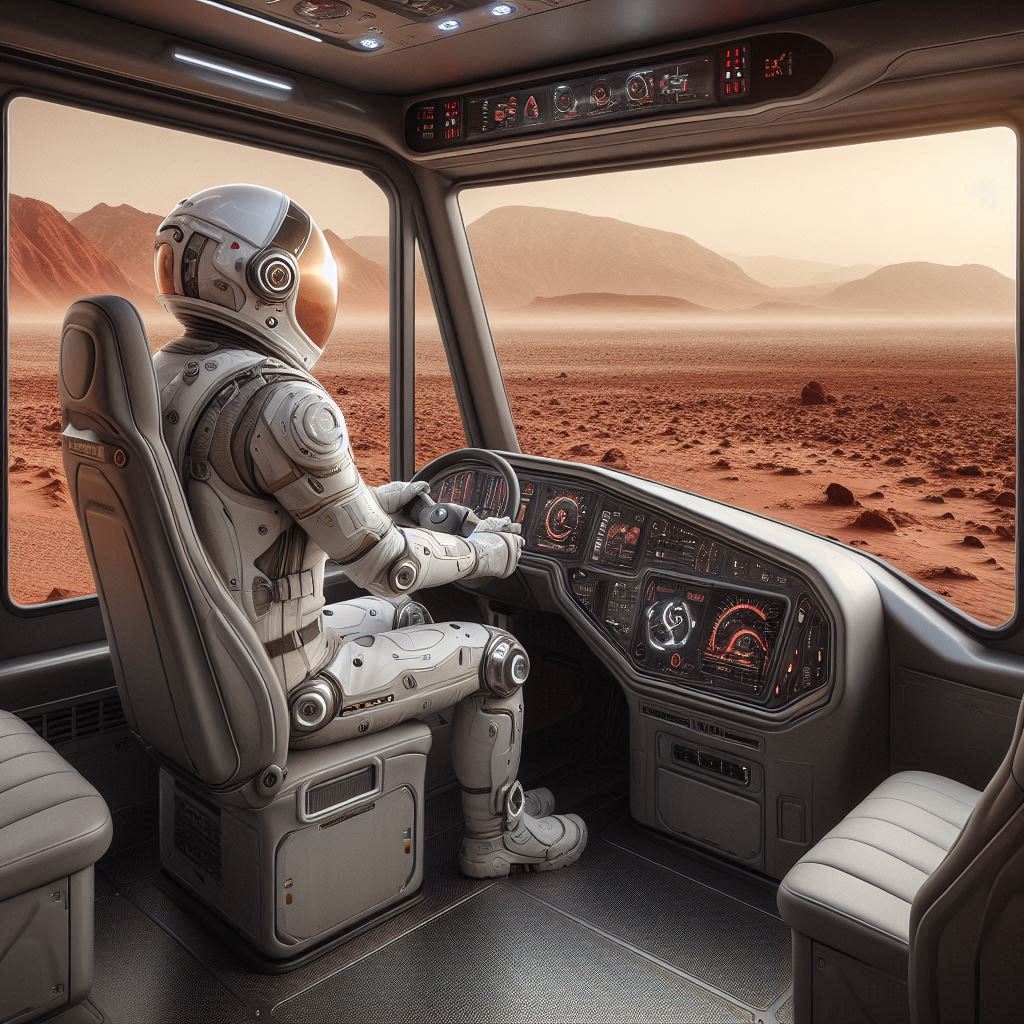
I was recently on a medium-haul bus ride, sitting within earshot of the driver—but not the closest passenger to him. I’d encountered him a few times before: a somewhat chatty middle-aged fellow given to telling the occasional joke into the microphone for the whole bus. He is, on the whole, a friendly and likable guy, who does his job well.
The passenger sitting in front of me obviously had talked with him before, because at one point he asked the driver for an update on his ion drive. It took three tries to have his question heard correctly: “eye-on drive?” But once clear, ho boy did the conversation take off!
This post is partly for entertainment value, but also serves to highlight delusions about space. Granted, some people might judge this character to be a little “out there,” but to my ears all space talk is at a similar level of crazy.
Game Changer!
The floodgates were open for the driver to talk about his game-changing idea. According to him, NASA knows a little bit about ion drive but they’re not apparently aware of the benefit of repulsive ion drive: pushing against the ejected charge electromagnetically (not just its chump inertia). Do that, and you’re really cooking! Acceleration becomes exponential, the driver claimed.
Apparently, he was really close to being done with the prototype. He had finally figured out how to keep the coils cool enough to prevent melting the plastic on which they were wrapped. Seems important. Or maybe try a different material? Anyway, it basically works now, but he still needs to solve the control issue. He said he was making progress on driving the coil by stepping up the voltage from an electronic speed controller of the sort one would use for a drone’s rotor motor.
“So, yup: I’ll be taking a trip to California soon.” This was the first of several hints as to his target audience. “After all, he’s the richest man on Earth and seems to be open to radical new innovations.” An additional reference in praise of Tesla cars eliminated any further ambiguity as to who he intended to wow with his technology—even though never called by name.
“I simply refuse to sell it to China. I don’t care how much they’d offer. At least if I sell it to my guy, it’ll take a while before anyone uses it for weapons.” He explained that a rocket with no heat signature would be ideal for stealth attacks that would render defense systems useless. “No one will see them coming.”
His goal is to have his ion drive be implemented for space travel first, “so that I’ll have a way off this rock before they make it glow in the dark.” He’s only slightly concerned about this fate, because, as he gibed: “Oh heck, at least I’ll be rich. Nuke ’em all—I’ve got caviar!”
At this point, he switched gears to express enthusiasm for a zero-combustion engine—explaining how a rail gun uses electromagnetism to accelerate a projectile to high speeds. Well, you can also contrive to move something back and forth—like a piston, in fact. So, imagine a car engine whose pistons are moved not by little combustion explosions, but by an electromagnet sheathing around each cylinder. One question: why bother retrofitting a combustion engine architecture and have to mess with pistons (and crankshaft and transmission) if you can reconfigure the geometry to just move the damn wheel directly with, you know, a rotary motor like an electric car already does? I must be missing something rather big. Anyway, no carbon, no oxygen. It won’t require cleaning like a solar panel would. Set one up on Mars and you’d have safe, reliable power. “Just something I came up with in the bathtub,” he noted—joking that “I may not be an actual genius, but I can play one on TV.” He focuses on “making something that would change the world, sometimes coming up with a good one, and other times not so much”—modestly. It almost made me believe his good ideas must actually be good, if he is discerning enough to tell the difference…
Back to the ion drive, it would apparently also solve the thorny problem of landing on Mars without a thick atmosphere to slow down the lander, and without wasting billions of dollars on the sky-crane approach, in which the rocket workhorse destroys itself after lowering its cargo. It’s a technology of many talents.
Let’s jump back to the zero-combustion engine (the driver kept bouncing, so you’re getting the same experience, here). He thinks maybe the smart move is to draw that up first to float in front of the big guy to pique his interest. Then he can ice the cake with an ion-core performance (groan). Apparently, this electromagnetic engine will never go dead, as long as it stays running. Did I hear that right? The next part was unambiguous and eye-popping: it takes less power to operate than it can produce. My thought is that as long as Mars is equipped with power outlets and a power plant somewhere that can be ignored in the calculation, he might be right.
An Exception?
I don’t think this guy is really that unusual in both his assuredness of a space future, and a confidence that he can do something big as an unappreciated underdog. That’s how it works in the movies, so our culture is saturated with this notion of the lone underestimated genius who changes the world with insight and grit—doubted by elite jerks like me at every turn. Our culture irresponsibly manufactures loads of folks like this all the time. Then failure eventually makes them bitter and they vote their anger so that our culture reaps what it sows.
Now, the more serious and technically experienced space enthusiasts would doubtless roll their eyes at this guy—while others like me roll eyes at them—and they roll eyes back at me (mutually-assured eye fatigue). Just as our bus driver lacks some basic awareness of conservation laws and other physics, the space enthusiasts are wholly ignorant in ecological terms. What’s more, they don’t see what that has to do with anything. And even if it was important, how hard can it be, compared to rocket science and robot sidekicks? Ecology is more of a “soft” science, after all, right? Nothing “hard” about it? Ecology, in this sense, is similar to a Prime Directive that can be drafted by any teenager or LLM: an easy detail requiring little actual work.
The Cost of Ignorance
I think of it in terms of this analogy. Let’s say you approached a 25-year-old average Joe and said: “We are holding open a position for you at the prestigious Mayo Clinic as Chief Neurosurgeon. The job starts in ten years. Your mission is to get yourself ready by then, and if you can do so, the high-paying job is yours for life.” How does Joe react?
“Hot damn! Okay. Let’s roll up our sleeves and get started. The first thing I need to focus on is what sweet ride I’ll use to commute to work. No ordinary car will do: I have to design something from the ground up. I’m thinking either ion drive or zero-combustion electromagnetic pistons. Hey: maybe I can finally put my 3-D printer to some actual use! This will take a while, but I think in ten years’ time I’ll be prepared for the commute.”
What is our guy missing? Medical training, perhaps? You know: preparing for actually doing the job?
If someone wants to live on Mars, don’t skip over the word “live.” What is it to live? What is Life? Life is ecology. Life does not exist in a vacuum—as individually-wrapped separable units—but in a contextually-rich, interlocking web with a loooong evolutionary heritage that has proven itself over deep time. Trying to live on Mars without the first clue about how Life lives is very much like aiming to be chief neurosurgeon without the first clue about the actual job: instead focused only on how we might get there.
To live outside of one’s ecological context—and in fact where no ecology of any relevance exists—would require somehow creating a suitable ecology, or borrowing a sufficiently-complete subset of an existing one that can tolerate a completely novel setting for which the beings are not adapted. We have zero idea how to do either (upcoming post), and much less to show in terms of demonstration.
My guess is that if I had piped up on the bus to point out conservation of energy or charge (what are the ions to repel against?), the driver wouldn’t say: “Oh, I was not aware and will need to go back to the drawing board—maybe I’m totally on the wrong track.” Likewise, space enthusiasts confronted with warnings of ecological deal-breakers are not likely to accept that they have any critical-failure-relevance to their dreams. Something in their brains will shut down the threat before it can destroy anything precious and even challenge their core identity. It won’t matter too much in the end, though, as these fantasy enthusiasts won’t get any closer to Mars than the bus driver will get to “the big guy.” It’s just a little sad, is all.
Views: 3042
I'm not sure who I stole it from (perhaps you), but a thing I tell people is that living on Mars is like living in Antarctica … except Mars is hostile: no air, very little water, an unpleasant radiation environment, the soil is toxic and who knows what the lower gravity will do to you long term. Oh, and if something goes wrong you don't get airlifted home or a supply drop: you die.
And it cuts the other way: if you want to build a 'lifeboat' for Earth (you don't), build it here: almost certainly it is far cheaper to build a bunch (you need a bunch because you will need to be far away from epicentres) such things which are, between them, robust enough to survive anything up to and including a Chicxulub-level impact than to build anything on Mars.
It's a great point that too few make. I tend to lean toward Mt. Everest or the ocean floor (Antarctica is far cushier). Even these are orders-of-magnitude more benevolent than Moon or Mars. And as you say, access and rescue are FAR easier. The idea of living in space is SO dumb.
Wow, what an astounding man! I am used to such displays of blowhard hubris from such delusionaries as Dave Brin and Micho Kaku, but I am surprised to see that the laypeople of America still harbour such wrong-headed beliefs!
Funnily enough the ecological question is actually what fascinates me about Mars Colonization. I remember reading KSR's Mars Trilogy when I was a teenager and nerding out not over the rockets and orbital mechanics, but the terraforming efforts that were centered on extremophiles and cyanobacteria. I had gone to MIT to try and be an astronaut, but I ended up switching my major to biology after I realized where my passion for space really came from, which was understanding and generating novel ecology.
I'm now almost done with my PhD in biology, and have realized how impossible a task that this really is. We can't control the structure of an ecological community in a sealed test tube, much less in any environment on earth. And this is just microbial life, which is comparatively simple, at least metabolically, compared to what would be required to support even plant growth, much less animal life. There is still appeal in the dream of bringing life to other planets to me (which perhaps makes me different from other space colonization supporters who are primarily concerned with human colonization), but our understanding of biology is not at this point yet, and the resources we would spend on a such a task would be much better suited to preserving the diversity of life that we already have here. Even if we could do such a thing, the best we could probably do would be to seed the surface of Mars with microbes, which is an ethically tricky proposition.
All this is to say, I certainly don't believe in space colonization anymore, but I also never came at it from the point of view that your bus driver takes: I've also been more interested in the new ecologies we would help to create on other planets. I certainly think this is not a unique position, KSR seems to hold it as well, but I wonder how many other humans who believe in space colonization are coming at it from this angle, rather than from the point of view of cold hard physics.
Yours is a great story of "growing out of" space fantasy, and via committed, "real," advanced work relevant to the matter. If only other enthusiasts could be educated as you have been!
Next week's post is actually closely aligned to this topic: our failure to create even the simplest closed ecologies that have any longevity to speak of.
The topic of the next post is incidentally why bunkerism is stupid.
> Our culture irresponsibly manufactures loads of folks like this all the time. Then failure eventually makes them bitter and they vote their anger so that our culture reaps what it sows.
Spot on, Tom. Here's a thing I wrote down after the 2016 election:
"This is the result of 50+ years of a completely broken education system. Our society since the baby boomers has glorified laziness, ignorance, and privilege. The chickens have come home to roost. Trump is just a symptom, not the cause."
I don't know how breathing on Mars would even be solved. I guess if one had the energy they could split CO2 out of the ~95% CO2 atmosphere of Mars and get oxygen, though I understand that CO2 generally splits to oxygen and carbon monoxide, so one would need to safely separate the poisonous gas from the precious oxygen. But then, one can't breathe pure oxygen for very long without suffering lung damage, so where do the other atmospheric constituents come from? In our atmosphere we get that nice inert N2 (78%) which prevents the lung damage, free radicals, and explosion risks that come along with pure oxygen. I get that this only one technical problem among a myriad of them, but it seems too important an issue to merely hand-wave off. I don't know what Mars enthusiasts propose here, but going some place that you can't safely breathe would seem to squash the endeavor quite quickly.
A few years ago I worked briefly with a company where the owner had a hydroponic greenhouse and at some point I was asked to help out with it. The person who set this expensive greenhouse up with probably $100k+ battery bank and solar panels to keep pumps going to aerate water to keep the fish alive (which sadly often went wrong) was their "mad scientist" who saw this greenhouse as a prototype for his spaceship creating ambitions. The beets were taking months longer to grow than they should however and the brassica were limp and dying. The first thing that I noticed was that the humidity was off the charts, they were using some captured flow from nearby hot springs to help warm the place up, there was mold forming on the walls. I had them get a VPD tester, and sure enough, the VPD was in a range where the plants were suffocating from not being able to transpire correctly due to excessive humidity. The "mad scientist" had been operating this meagerly producing very expensive and unnecessarily complex greenhouse for years and had never considered the impact of humidity on plant transpiration. – He had ambitions to build a spaceship but was overlooking the very basics, but then, overlooking the basics is perhaps a prerequisite for having spaceship ambitions in the first place. Last I heard, they were installing a bunch of fans.
I think it is more than a little sad. I don't think any of us (bar uncontacted tribespeople) live in our ecological niche any more, even on this planet. We're all lost in some driving seat or other. Stop the bus?
Tom, I Think an interesting topic for you to consider is the currently popular idea of data centers in space. I would be extremely interested in your thoughts on the physics and economics of this proposition, as well as potential implications on energy use and climate change etc from moving this energy-intensive and fast-growing industry away from Earth’s surface.
I hope you will consider it.
This post immediately reminded me of Sam Altmans recent comment that training humans is expensive. Fascinating how the same blind spot shows up at completely different scales.Tunnel vision toward the destination while completely skipping over the word live in what it actually means to get there.
It may be of some interest to you that my friends have labeled you a "fascist" after reading your posts on space and progress.
In particular, they deemed your notes on social progress and its rollback as "fascist propaganda" and your opinion on space as a "infuriating ode to despair."
Hey, I promised I'd pass it on!
That's hilarious, and embarrassing for them. I guess I wouldn't expect them to get it.
Anyways, re the actual post title, I'd certainly read that middle-grade book series!
Reminds me of a line from 'Frasier': So do you think there's intelligent life on other planets? I'm not sure there's intelligent life on this planet. ('The Candidate', Season 2, Disc 2 of box set).
Self-aware intelligent AI will be accomplished by lowering the bar for self-awareness and intelligence to the bottom of the sea
"it takes less power to operate than it can produce": I guess this guy won't let the 1st and 2nd laws of thermodynamics rain on his parade.
When I was about ten years old I got a thing about making a helicopter, and set up an old pallet as the floor, found a bit of scaffold pipe for the drive shaft, and was working on the rotor when I stopped for lunch. My mum was interested. How are you going to power it? She asked. I remember very clearly seeing that yes, it was a valid question, but that I had deliberately not given any attention to it for fear of spoiling the whole project. "I'll get onto that next week." I replied.