
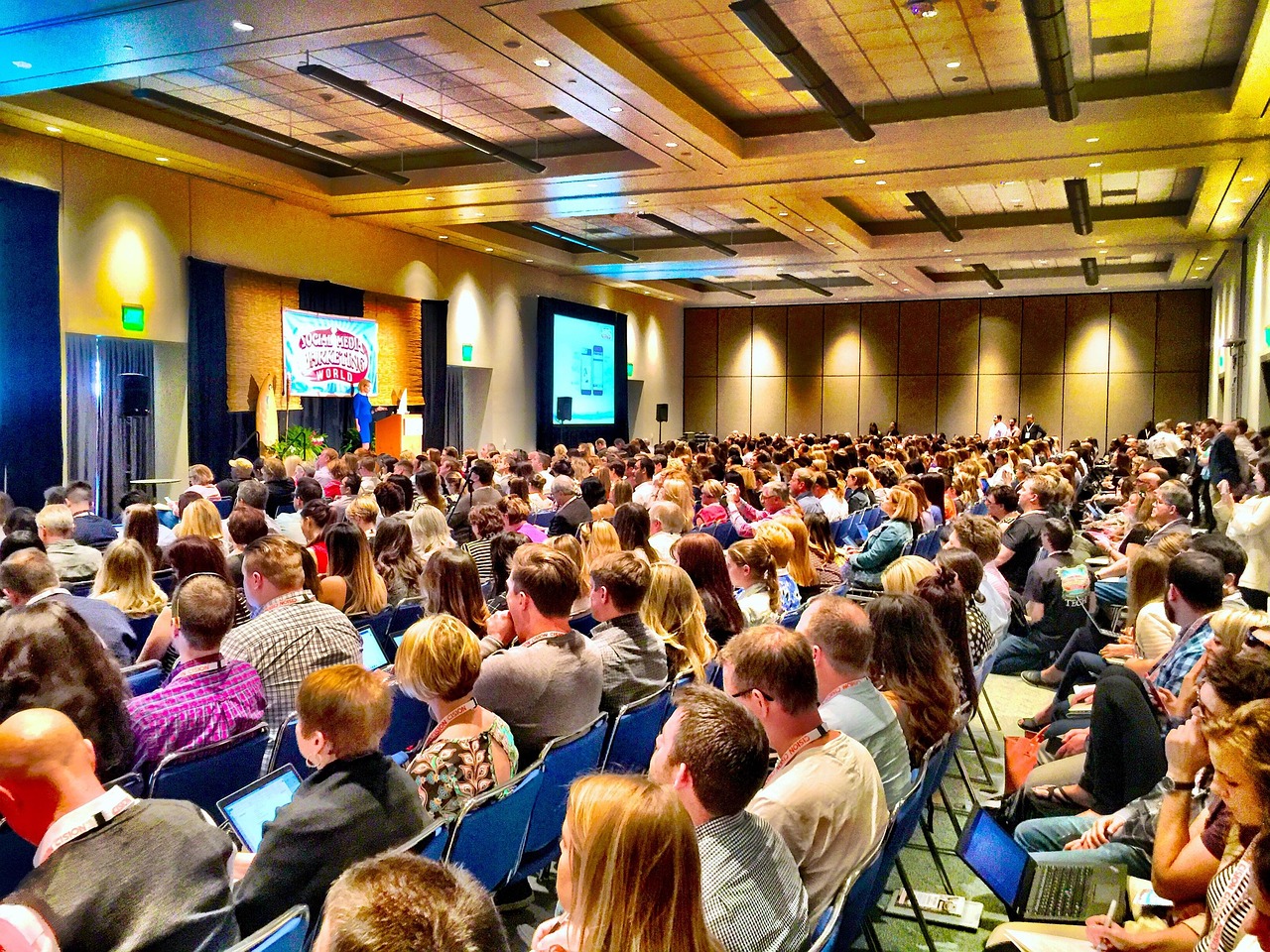
I found myself having agreed to travel to a technical/astronomical conference on Maui—the same one I attended during the passenger-jet attacks of 9/11 decades ago. This time my wife traveled with me. When initially invited, I begged off: my interests now are very much misaligned to the type of audience at such a conference. But the organizer seemed to be a follower of my work, and said, “Nah: come anyway: give it your best shot. Many of us could use a shock.”
The trip itself was long and tiring, involving many strange twists that aren’t worth the burden to elaborate. Other exhausted people—many familiar faces from my astronomy days—trickled into the venue in time for the conference to start.
My talk was scheduled for 10:25 on the first morning of the five-day conference: the second substantive talk, after introductions and preliminaries. My wife and I found seats in the auditorium along the back wall, but the air conditioning unit was dripping water on us at an accelerating rate, so we moved to the side near the front, where the angle to the screen wasn’t great. During an intro video that showed many photos of past scientists and engineers at blackboards and the like, my wife turned around (we were not able to sit side-by-side) to excitedly say that she saw her father in one of those photos (which I had missed).
Around that time, the organizer who had invited me started introducing the conference goals to the audience—throwing in a mention of the challenging talk coming up by Tom Murphy. Enough heads tilted my way to alert the guy next to me that I must be this Tom Murphy character. Intrigued, he asked in a whisper if I could give him a one-sentence synopsis of my talk. I won’t spoil the rest of this post by repeating what I said, but his response was a bit of a chortle and something about how impressive software was. Irked by the confident but—in my view—ignorant dismissal, I muttered that my message would probably sail right by most people in the audience.
At this point, my wife picked up on the tension and asked what I meant by the synopsis sentence I had offered. My clarification made her squirm as well, essentially saying that I was being ridiculous. At this point, I realized I shouldn’t let these local interactions derail my focus, and that I really ought to polish up the talk slides in the short time remaining. Reaching into my backpack to pull out the laptop, I worried about how much charge remained, and had to dig past all kinds of highly-uncharacteristic junk-food wrappers accumulated during my travels to finally retrieve the computer. Then I woke up.
That’s right: the story above never happened. This post is being drafted within an hour of waking up. What compels me to hit the keyboard is that in the semi-wakeful but dozing state that followed, I fleshed out enough of what the talk would have contained that it seemed worth capturing and sharing. One feature of my semi-dream-state presentation was an imagined reaction at every stage, which I will also share here as italicized thoughts that I—as the speaker—can’t actually hear. Sporadically, editorial comments/corrections are inserted into the imagined responses [in square brackets].
The Talk That Never Was
How might you react if I say that people are dumb? I suspect most would chuckle and admit that sometimes, yes, people can truly be dumb. But what if I say I’m dumb.
Well, your show of modesty—surely feigned—elicits a smile, and point taken, but no: you’re not in the dumb club, obviously.
What if I go on to say that you’re dumb?
Now you’re just being offensive. True, I have my “off” moments, but I’m no slouch on the whole.
To be clear, even icons of genius are dumb: Einstein was dumb.
Okay, so you’re making some ridiculous point, because Einstein was most definitely not dumb by any [culturally] accepted definition.
As I say, humans are dumb, to a person.
Ah: so that’s your ridiculous point. It’s obviously untrue, because look at the evidence to the contrary all around—even in this room. I mean, you’re projecting slides from a computer, for goodness’ sake!
What I mean by this is that humans, individually or collectively, are not remotely capable of designing a fully-functioning ecology.
What an irrelevant criterion! Firstly, I doubt it’s true, but secondly why would it even be important?
Not only are we unable to create ecology, but what we call evidence of “smart” is rapidly destroying the Community of Life upon which we utterly depend. As such, those forms of “evidence” are actually kinda dumb. Now, think for a moment about your own ecology: where you, personally, obtain food; the materials you use; disposal practices; re-uptake by Life.
I don’t get it.
Presumably, your direct access to food is from grocery store shelves, restaurants, door delivery, and the like. Your life is full of plastic and metal and concrete and asphalt and glass, most of which plays little or no integrated role for life on this planet and thus is not part of its set of ecological relationships. They are “invented” components, traced to cognitive contributions.
Damn straight! We made this world. Even the grocery store shelves are stocked by a method of our invention: agriculture. They’re not laden with hunted animals or gathered roots. So, I would say, we have invented a fully-functioning ecology, by your definition of the term. It functions magnificently, in fact.
We fool ourselves into believing that we’ve invented the world we live in, having transcended an embarrassing and long phase of nasty, brutish existence at the mercy of ecological forces once greater than ourselves (a severely flawed and ignorant perspective). We are now masters of the planet. We are in control. We don’t listen to nature: nature increasingly must listen to us.
Now everything you say makes total sense, except framing it as fooling ourselves, or that we possess a flawed perspective. We are not deceived: this is the obvious way of things: a reality, not a chimera. Again, just look around.
The fooling has to do with timescales, appearances, and temporary stunts. In a snapshot or short video of a rock tossed into the air, the rock appears to hover or fly—momentarily. How is our “magnificent” artificial ecology actually working out? Our economic system is predicated on a temporary fantasy (indefinite growth) that must manifestly fail in the not-too-distant future. The surge of the last few centuries—since the Industrial Revolution—has been wholly driven by access to finite and ancient stores of incredible energy density whose end is closer than its beginning. Burning of said fuels has kicked Earth’s climate into a dangerous new Holocene-ending state that threatens to upend everything. But even more catastrophic (and less appreciated—not tracing primarily to climate change) is that we’ve initiated a sixth mass extinction that was gaining speed even before fossil fuels achieved prominence. Solar panels and wind farms address only one small corner of our problem-space, while chiefly aiming to preserve a way of life that is killing the planet simply by its material exploitation, habitat destruction, and enormous scale.
Playing into the flawed perspective for a moment: if asked to identify a time when we finally freed ourselves from being at the mercy of tooth and claw, I suspect many would identify the Agricultural Revolution. Indeed, the road to our current predicament took a sharp turn 10,000 years ago: the rate of human population growth shot up an order-of-magnitude putting us on a trajectory to reach billions in ecologically-short order. Thus, even agriculture deserves a place on the list of inventions that are not ultimately sound. 10,000 years is almost nothing on evolutionary timescales, so that this ecologically-crippling aberration might as well be an asteroid impact in geological time.
I won’t even touch your monstrous assault on agriculture, whose removal would amount to a misanthropic death sentence of almost 8 billion people. You probably don’t know how crazy you sound, here. Aside from that, your list is certainly discomforting, and I don’t have immediate answers for why we needn’t worry. But isn’t that just the point? Because we [actually, far too few] are worried, we’re on the case—so we needn’t worry! We’ll figure it out. We’ll innovate. There are no limits to human ingenuity.
Now, as an Italian might say, I know my chickens. Many of you are thinking that human ingenuity knows no limits. It’s what our culture hammers into us at every turn. But it’s truly insane.
What did you just call me?
Let me repeat: such a belief is utterly unhinged. But have you ever tried to convince a crazy person that they’re crazy? It doesn’t usually work. Expect stiff resistance.
How crazy is it if basically everyone believes the same thing? Isn’t it the outlier like you who is far more likely to be crazy?
I recognize the extreme difficulty of my position. Unpleasant news is instinctively rejected—especially when social norms (safety in numbers) protect against having to face the prospect. The same phenomenon played out for other topics that challenged human-superiority like geocentrism and evolution and the expansion of the universe (the “Big Bang” was initially a pejorative label). What is it that finally turned the tide in these topics—to the extent the tide has turned? Evidence. The universe speaks.
Sure, but as I point out, evidence abounds that we broke free from ecological constraints of the past and now effectively define a new ecology. [Sure: a rock can fly through the air—but for how long?]
Let me step back and ask—in this room containing many astronomers—how many planets are part of your reality?
Audience Member Response: “Well, we’ve discovered thousands of exoplanets, but that’s not even the tip of the iceberg. At 100 billion stars in the Milky Way and roughly 100 billion galaxies in the universe, together with an average of at least one planet per star, we’re talking at least 1022 planets.”
Audience Member Correction: “That’s just the visible universe, constrained by light travel time over the finite age of the universe. Flatness measurements from the CMB indicate a linear scale at least two orders-of-magnitude larger than our light horizon, so the total volume of the universe is at least six orders-of-magnitude larger than the part in causal contact, and thus we’re closer to 1028 planets—possibly vastly greater, still.”
Okay, I have no qualm with those numbers, but how many are “real” to you: as in being accessible for living upon in your lifetime.
Audience Member Response: “Well, including low-mass stars there are roughly 10,000 stars within 100 light years, or about half that within an 80 year lifespan.”
Yes, that’s an upper limit in the context of travel at speeds more than a thousand times anything that’s relevant to your life (or that we’ve actually achieved in any spacecraft).
Blurted from audience: “Actually, were you to travel at a significant fraction of light speed, your own time would dilate to allow farther access. As one approaches the speed of light, the reach effectively becomes infinite. A photon experiences zero time elapsing from emission to absorption across cosmological distances.”
Anyway, given real technical limitations, we could only entertain access to the planets within our own solar system. How many could support your life?
Audience Member Response: “All of them. We can make our existence work on any surface—or even no surface come to that. Some are better than others, of course. Mars is probably the best, but the moon’s proximity makes it attractive as well.”
I’m gonna say that for all intents and purposes, the sane answer is one. None of the other bodies are relevant to your own breathing self.
Dude, I’m just 26 years old: don’t count me out!
Aside from using space as an example of the importance of ecology, I don’t want to derail my main point with the distraction of space colonization. No matter what, Earth is unambiguously the only planet supporting human life—or any life as far as we know. And on this Earth, we’re tripping a sixth mass extinction. I’m not making that up: it’s a consensus view among conservation biologists.
If true, it is regrettable, and it pains me to hear it: a real black mark on our otherwise amazing record. But we’ll figure out how to cope, should it go that far.
When I say “sixth mass extinction,” the words definitely carry a negative vibe: a real downer. But “mass extinction” has a technical definition: 75% of species are lost—as has happened five times since the Cambrian explosion about 540 million years ago. Biodiversity slowly recovers over tens of millions of years until the next one comes along. Now, presumably, you all have enough ecological sense to be able to guess whether the survivors tend to be large, “apex” members of the Community of Life or the diminutive denizens occupying the base of the pyramid (a flawed framing in its own right).
Sure: megafauna are caput, while the unimpressive creepy-crawly things [impressively] persist.
Megafauna don’t fare well. Humans are megafauna. We’re large, hungry, high-maintenance beings who require a high degree of ecological health, biodiversity, and benign conditions to exist.
Cute to call us megafauna. Perhaps it’s technically true, but we’re different. We’re special. We make the world to suit us.
I suspect many of you are again thinking that human ingenuity knows no bounds. This is the mythology we were discussing before the tangent of counting planets. A key point of the tangent was that astronomical numbers admitted into our cognitive space get whittled down to “one” when considering practical reality. The universe imposes limits and bounds. For all our innovation, and all our fear of death, every single one of us in this room is essentially guaranteed to die within a century: a flash in “real” time.
That’s a very rude thing to throw in our faces. But for now, yes—until telomere research really catches fire.
Everything we eat was designed by evolution, not by us. Even “manufactured” foods like fake meat and Twinkies are rearranged plant matter, tracing to photosynthetic capture by living organisms. We still poop, breathe, and reproduce via biologically-created mechanisms. Weather events dictate the viability of activities. Human ingenuity is not unlimited, but heavily constrained. The most fundamental aspects of life are untouchable. Our destructive meddlings are on the margins of real creativity, and have not stood the test of time.
But one day…
Lots of people think: “Yeah, but we’re just getting started.” Oh: you mean with the sixth mass extinction? Correct—except we may be closer to being finished! We’re down to 2.5 kg of wild land mammal mass per person on the planet. It was 80 kg in 1800 and 50,000 kg before the start of agriculture. They’re almost gone. Extinction rates are up 100–1,000 times the background rate. We’re losing whole species at an alarming rate. Think about the incredible investment of time, cleverness, and ecological integration each species represents. Meanwhile, we’re not capable of designing a single novel protein from scratch—let alone tens of thousands of interacting proteins in an organism even as “simple” as a microbe, which itself is far short of millions of interacting organisms in Earth’s ecology. The scale is unimaginably beyond the reach of our innovation, yet we are clearly able to destroy all that work at a breakneck rate by pushing matter around and accessing profligate energy.
This has turned boring and shrill: not enough to stoke pride in human achievement. I wonder who’s up next. And when’s lunch?
This is what I meant when I said humans are dumb—even those we label geniuses. The type of intelligence we worship is a thin veneer of cognitive capability resting atop a far more impressive, ancient, and intractably complex form of intelligence that we label as “ecology”—and then dismiss because it’s too complex and unfamiliar compared for our far more limited cognitive box to appreciate. Painstaking trial and error—all in simultaneous reciprocal relationship—forges innovative ways of being that are basically proven to work within a complete context for ecologically-relevant timescales. A supercomputer has nothing on the living world!
Is he still talking?
When we invent agriculture or internal combustion or LLM chatbots we’re going “open loop” without any meaningful ecological vetting. The result, by all that we witness, looks like a sixth mass extinction. We’re really dumb at this stuff. We have no business, credentials, or innate capability when it comes to ecological innovation. We really suck at it. No living being has ever evolved to cognitively create a viable ecology.
Hey: I just had this brilliant idea out of nowhere as I idly scan my social media outlets: I wonder if we could invent an ecology?
No human attempt at devising a closed ecological system (admitting the sun) has even come close to working—even when simply co-opting hardy and time-tested organisms that have proven interrelationships. Forget about starting from scratch if we can’t even cobble together a set of organisms complete enough to self-sustain. Only Earth has managed that incredible feat, over billion-year timescales—discarding countless mistakes along the way.
So that’s my basic point. Humans only fool themselves to believe they can do any better than ecology. We can’t expect to invent substitutes via cognitive processes: it’s never worked that way, and our attempt is proving to be a colossal flop in a mere 10,000 years. We’re better off accepting the role we evolved into, and trusting the greater Community of Life to demonstrate myriad forms of wisdom outside the narrow and severely-limited neural domain: a wisdom that can’t be improved upon via cognitive ingenuity or philosophizing. So far, all evidence is that when brains are used for purposes other than figuring out how to best fit within existing ecological relationships—but instead to deviate into uncharted territory—the results are predictably disastrous on timescales that are contextually short, yet long enough to elude personal detection, even when considering the few short millennia we call “history.”
Now, if you’d like to chat you’ll find me snorkel-up and face-down in the water trying to learn something from all the geniuses living in and amongst the rocks just off the beach.
Views: 385
Really enjoyed this! What a fun dream/fantasy, glad you shared it. Thank you.
Also very happy you didn't actually go to what looks like, in the photo, a mass infection event. 🙂 Viruses: so much smarter than us dumb humans.
Some genuine truth, there. FWIW, the (randomly grabbed) picture doesn't look much like a science/technical conference: too flashy.
YES We are blind beings trying to see an elephant with our fingers. Tragically only "clever by half". We are a high maintenance animal that has now made ourselves so high maintenance that a population crash is all but certain except the exact hour of our demise. We are tragedy personified. Let us avoid a bloodbath and b ow out with grace and some forgiveness and dignity..Life for humans is a learning experiment like all forms. We appear to be flunking out of the school of life. Love Rick
Loved this one!
Also, your example using the op amp was so good. I really wish the professors I encountered would have explained the overview(s) like that before diving into the weeds. It is sometimes (always?) helpful to understand there is a forest to better appreciate the trees and their role.
Anyway, loved it and regret not having the opportunity to be in one of your classes.
It might interest you to know that synthetic bacteria have been created:
https://www.jcvi.org/research/first-minimal-synthetic-bacterial-cell
And Google's AlphaGenome can decipher genetic code almost completely:
https://deepmind.google.com/science/alphagenome/
We're still f***ed, of course.
Fascinating. Note, however, that they borrowed almost completely genetic codes that evolution crafted: just packaged a "minimal" set that already had relationships with each other. The outcome would likely fail miserably in a real ecology (insufficient defenses, etc.). It's impressive in a way, but just pushing stuff around that we didn't even come close to concocting on our own (FAR beyond our capabilities).