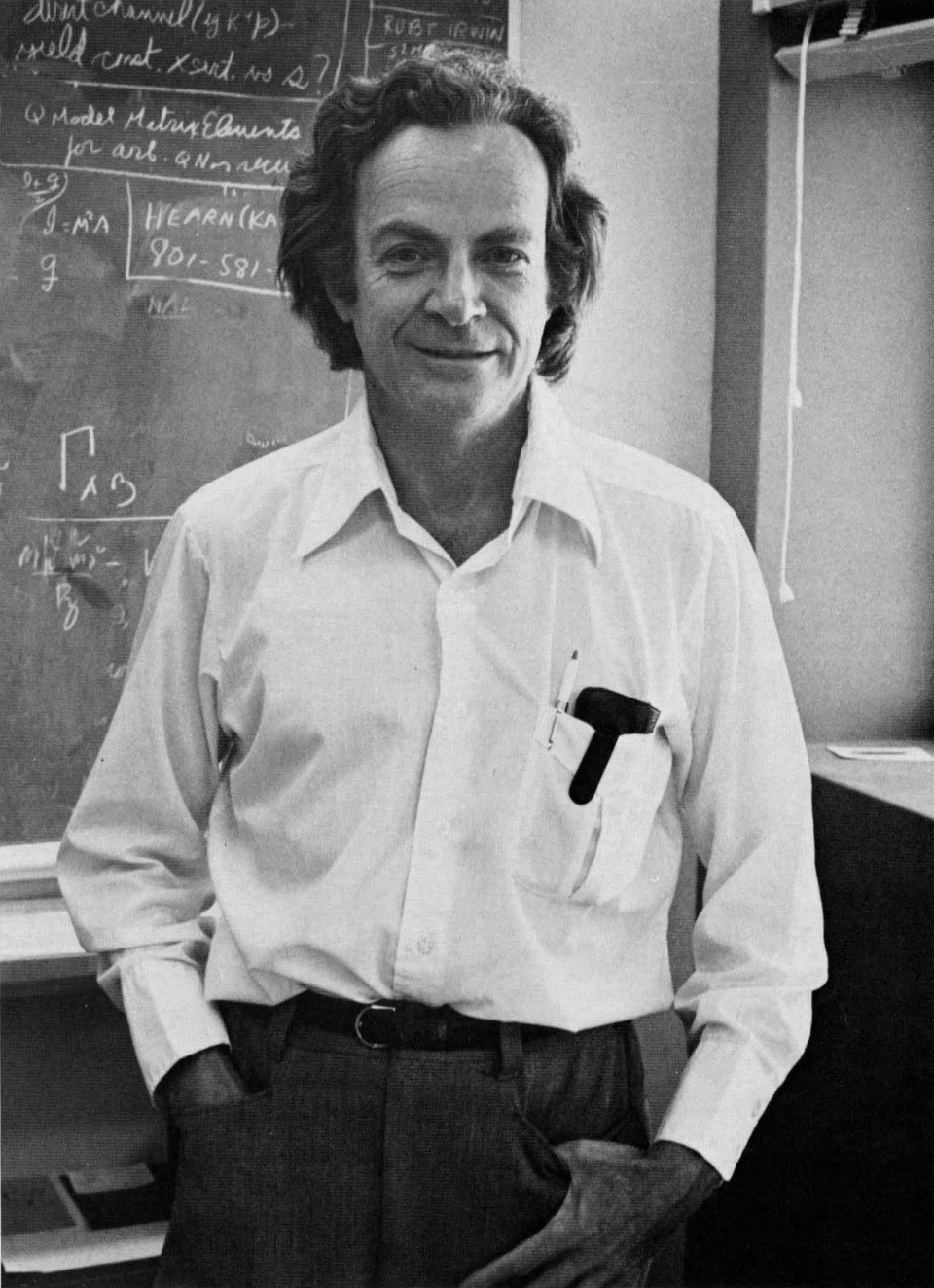
On the second page of the first volume of Richard Feynman’s famous Lectures on Physics (Lecture 1, Section 2), we find the paragraph:
If, in some cataclysm, all of scientific knowledge were to be destroyed, and only one sentence passed on to the next generation of creatures, what statement would contain the most information in the fewest words? I believe it is the atomic hypothesis (or the atomic fact, or whatever you want to call it) that all things are made of atoms—little particles that move around in perpetual motion, attracting each other when they are a little distance apart, but repelling upon being squeezed into one another. In that one sentence, you will see, there is an enormous amount of information about the world, if just a little imagination and thinking are applied.
That sentence exposes another type of sentence: a sort-of prison sentence Feynman was serving—as most of us are—confining us to our cells within modernity. In the Epilogue to my energy textbook, I raised this point and suggested an alternative along the lines of “Treat nature at least as well as we treat ourselves.” It’s sort of a golden rule that extends beyond the usual boundaries of human supremacy. Today I would go further.
As for Feynman, let’s take a look at how one of the broadest thinkers in physics can still be held captive in a narrow rut.
On Feynman
I never knew Richard Feynman personally. He died five years before I reached Caltech. But I can tell you that anecdotes of interactions still rattled about now and again. One that stands out is from my graduate co-advisor (with Tom Soifer), Gerry Neugebauer (hard-G; now also deceased, sadly), who pioneered infrared astronomy as a cracker-jack instrument builder and damned-fine scientist. I have nothing but admiration for Gerry, and learned tons from him about all aspects of being a careful scientist, a clearer writer, and a genuine person. He was also a renegade against stuffy authority.
When Feynman taught the undergraduate physics series—from which the published lecture series derived—a team of assistant professors lived up to their title and assisted in the execution of the course. Gerry reports that Feynman was undeniably luminous, and that interactions with him consistently delivered a great deal of insight. But he could also be a bit of a condescending jerk. Gerry was a lowly knuckle-dragging instrument-builder. When Gerry was doggedly trying to grasp some deep principle, Feynman would sigh: “Let’s see. How can I put this such that someone such as yourself might begin to understand?” This is directed to a professor of physics at Caltech, remember. Of course being a mature and well-adjusted adult, Gerry absorbed the treatment without grudge or animosity: it was about the job at hand, not personal grievance.
But we give Feynman some license, because what he produced was like gold. He had a knack for penetrating the essence of a phenomenon and breaking free of old traps that had stymied understanding. He was not bashful about admitting the limits to his (or especially our) knowledge, which is an admirable trait in someone as insightful as himself. He was a fascinating blend of hubris and humility.
Feynman was remarkably broad in his interests and manner of thinking. He always seemed to operate a level or two “above” others, which allowed new connections to be made. He was about as close as it gets to a guru on the mountaintop who could comment meaningfully on just about anything (relating to physics).
An aside, while on the subject of Feynman and his Lectures… Many aspiring theorists hold Feynman as a role model, and I even knew one grad student who seemed desperate to emulate his famous antics. I was more of a Bob Leighton guy. Who the hell is Leighton? Check the cover of the Feynman Lectures: Feynman, Leighton, and Sands. I (once) strove to be in the Leighton (and Neugebauer) mold. But I never worked very hard at emulation or studying others’ routes to success. I just let whatever path unfold before me—which it will always do.
Limits to Breadth
As broad a thinker as Feynman was, nothing in his body of work suggests operation outside the penitentiary of modernity. Indeed, his suggested sentence for transmittal to the future in the event of civilizational failure unambiguously indicates that his values and loyalties rested on modernity and modern science. His apparent goal was to jog humans “back on track” in case some misstep put us off the divine path. My stance was similar when I began this blog in 2011. I did not deem the “track” to be a disastrous and temporary departure from a much older and ecologically-proven way of being.
But we can’t really fault Feynman. Like most people, he was entrained in the exhilarating current of modernity, riding the top of a wave at impressive speed. He had a clear path to make big strides and found copious reward in doing so. Hey, if you’ve got it, flaunt it—right?
Feynman (born 1918, died 1988) witnessed loads of exciting—and terrifying—developments in his lifetime. The pace of change was so great as to push concern over hypothetical consequences well off the margins. When the upsides get all the attention; when developments come at a fast-and furious rate so that it seems pointless to muse about the future; when the costs have not yet become apparent; and when continuing the frenetic pace seems like the surest way to utopia, then of course the sensible reaction is to buckle down and contribute to the thrill ride.
I would say most present-day humans—and especially older generations—still inhabit this thought cage. Since no one 200 years ago could possibly have predicted the technological developments in store, we must humbly accept similar ignorance about the fantastic future—the thinking goes. It’s sloppy; presumptuous. Is the proposal that this will always be true? Is it an unlimited prospect? Will the equivalent of the fossil fuel windfall keep arising every few generations without end and without consequence?
Inside brains—where imaginations may not be limber enough to conceive/admit reversals of “fortune”—the answers to these questions can be a resounding “Yes!” But that means nothing to the actual universe in which we flow. A close cousin to the gambler’s fallacy is the fallacy that a streak is fated to continue because it hasn’t broken recently. The ubiquitous ecological ignorance of modern culture sure helps support this fantasy! It’s so much easier to fall victim to this expression of faith if lacking crucial context. The logic seems solid enough in isolation. Who needs messy context?
Sentencing
When I wrote the Epilogue to my textbook in 2021, I was partway along my journey of falling out of love with modernity. I was beginning to recognize the ugliness of human supremacy, and beginning to acquire greater awareness on matters of ecology and anthropology. My suggestion that we “Treat nature at least as well as we treat ourselves” was a foray into a new sense of wholeness and togetherness: that we share a bound experience with the Community of Life on this planet. However, the wording still carries echoes of a dualist dichotomy separating ourselves from “nature.” I would not today suggest the same sentence—although I still think it represents an important break from the “atoms” transmission.
What would I offer today? I suppose it may have been better if I had started drafting this post with something concrete in mind. Alas, I’m not that “together.” Instead, I’ll try to knock something up on the fly. Perhaps a phrase we already know and use hits close to the mark: “You can’t fool Mother Nature.” Others, inspired by Daniel Quinn, might be “Learn, all over again, to live in the hands of the gods” or “Humans were made for this world: not the reverse.”
I guess the most effort I have put into this direction was in writing the fictional story The Big Question (which has subsequently been published in the Winter 2026 issue of New Maps). While reasonably compact, it doesn’t tuck into a single sentence:
Humans would fare the best, maximize happiness, satisfaction, and longevity of their species by recognizing their forgotten ecological context and moving toward fully-integrated reciprocal, respectful relationships with the Community of Life and the more-than-human, biodiverse world of Evolved Life. Messing about with intensive agriculture, high technology, metals, and artificial intelligence is a devastating path that leads to a sixth mass extinction—including, of course, the termination of humans themselves. Humans are social beings who are happiest in medium-sized autonomous groups working together toward a common goal, wrapped in unconditional support and in pursuit of tasks that have direct [immediate] meaning to their livelihoods.
Views: 2390
Do unto Nature as you would do unto yourself.
Ah, yes, the irresistible force meets the immovable object: Scientists (that is, humans who pursue knowledge through use of the scientific method) are Humans! (What a pity, Basil…)
Beautifully stated…I couldn’t agree more
"There is nothing either good or bad but thinking makes it so"?
Try to be kind while enjoying the ride.
Growth followed by collapse is what nature does.
https://un-denial.com/2026/05/10/by-hideaway-scaling-laws-in-nature-and-human-civilization/
"It’s a challenge to summarize in a few words Hideaway’s Complexity Accelerated Collapse of a Thermodynamically Unsustainable System (CACTUS) theory, but here’s my latest attempt:
1) modernity depends on many non-renewable resources
2) new resources must continuously be extracted from the earth’s crust to replace those burned or lost to decay, and because 100% recycling is not economical nor technically feasible for most resources
3) reserve quality declines as non-renewable resources are extracted because they are finite, and because we consume the best first
4) therefore, the energy, materials, and technology complexity used for resource extraction must increase to compensate for falling reserve quality to maintain a given extraction rate
5) increasing civilization scale accelerates the development of higher extraction technology complexity
6) increasing civilization scale increases the efficiency of resource use
7) increasing civilization scale requires growth in non-renewable resource extraction
8) therefore, increasing civilization scale BOTH enables and requires non-renewable resource flows to increase
9) therefore, many complex interdependent self-reinforcing positive feedback loops collaborate to grow civilization quickly
10) eventually, a physics limit is reached that prevents one or more non-renewable resource flows from increasing, which triggers a cascade of interdependent self-reinforcing negative feedback loops to collapse civilization’s scale and complexity
11) therefore, modernity will be a short-lived rapidly growing and rapidly collapsing phenomenon anywhere that it emerges in the universe
12) we have hit several limits to resource extraction growth and increasingly violent world affairs reflect stresses in a system preparing to collapse
13) therefore, we are privileged to be alive to witness a rare peak of what is possible in the universe"
My sense is that nothing here is wrong, per se, but many other pathways—perhaps most unanticipated—may bring modernity down before modernity runs out of copper or the like. Ecology/biodiversity makes no explicit appearance here, for instance. Cultural phenomena like the global fertility bust or disillusionment or attrition of institutions could dominate. Or endocrine disruption. Or inability for sea creatures to synthesize shells. Illustrated here is one path of guaranteed failure (and that's significant: worth appreciating), but that path itself is not guaranteed if another source of failure sweeps in first.
Good points. There are many forces collaborating to end growth.
The important CACTUS points for me are:
1) Growth is not optional for modernity as many believe, for example as Dr. Meadows et al implied in Limits to Growth.
2) Growth is not only driven by our "choice" of a debt backed fractional reserve monetary system as many believe. Growth is primarily driven by the depletion of non-renewable resource reserves.
3) CACTUS predicts that regardless of what causes growth to end, the resulting collapse will be very fast, which is contrary to what many (most?) scholars of overshoot believe.
Yes, tmurphy, modernity is already "down," because it is against natural law: reciprocity, compassion, mutuality, synergy, and even evolution! Its persistence in our human culture is obsolete, supported only by escalating destruction and denial/defensiveness. We're deeply conditioned, though, to our fear of scarcity, so we react by competing for "control" — which is as ephemeral as "scarcity" itself ….
So whatever might trigger the collapse of "the world as we've believed we know it" could be any, or any combination, of many. What's true is that we breathe oxygen and the plants love our exhale, so running out of copper isn't really a problem.
Modernity isn't contrary to natural laws. If that were so, it wouldn't exist.
Mike,
I guess "natural law" has no clear definition. As opposed to the laws of physics. If we assume that we can add the factor of time into the equation, it is possible that modernity can exist in breach of natural law for a period of time, at which point it collapses. Without determining what the actual law is that Jim-el is referring to, it's difficult to say, but I suspect that anyone who reads Tom's blog regularly could infer.
Rico
Rob, I would suggest that "to witness a rare peak of what is possible in the universe" is a privilege, indeed, and the closer we look, the sooner we discover that the "rare peak" is happening Now, and changing ….
Diversity is the primary good.
'Nature has all the answers'. [H.T. Odum] 'List[en] to Nature'…. [William Cullen Bryant] 'To think is to listen. Listen'. [Tairona]
All around the world, 8-9B people are trying to make tomorrow a bit better for them than today was. And history tells us that Homo Sapiens are willing to do a lot of grim things to accomplish this.
I find most interesting the things that Homo Sapiens have overlooked. No more bees? Rent bees comes up as a new business! But there will not be a Rent coral reef business!
Even a capitalist country like USA eventually rolled back DDT a little bit. So while we're insensitive to ecological disasters, it's not 0. But very likely too low to matter.
Maybe the economic system does regulate the number of Homo Sapiens. Birth rates in Japan are low now. Apparently a combination of social norms and sheer costs of having children has reached a tipping point. But is it enough?
But what about the need for growth? And is it a strict need? Couldn't money printing make it go a while longer? https://www.greenhousethinktank.org/static/2014/why_capitalist_economies_need_to_grow_-_for_green_house_Oct2014.pdf
Is it possible that we're in for a shocker? Will the economic system collapse? (It seems like the weakest link.) If so when?
Will a mystery illness sweep the world in 2031 and kill 50% of us?
While I'm 100% onboard with the end of modernity, I think if the time horizon for that is >100 years out, most people will move on to other thoughts quickly.
What about the maximum power principle? You deserve a thermodynamic viewpoint: all things related to willpower are products of our overevolved big brains.
I did overlap with Feynman at Caltech. He was teaching the physics of computation, exploring neural networks with John Hopfield and Carver Mead, and speculating on Quantum Computing. I took his course on these subjects.
I don't think you give him enough credit when you assign to him this motive:
"…unambiguously indicates that his values and loyalties rested on modernity and modern science. His apparent goal was to jog humans “back on track” in case some misstep put us off the divine path."
I think he valued ideas – scientific ones and the thought process to perfect ideas. It is possible to separate this ideal from the baggage you have attached to it here.
Very nice that you had direct experience. I would be absolutely delighted to learn that he considered ecology to supersede quantum computing, or that modernity was by construction a temporary unsustainable anomaly, or that agriculture and written language may have crossed the threshold to the point of being unfortunate blunders. Is there any evidence that he even wrestled with such ideas? I might not have known him personally, but I've known plenty in a similar mold (probably know a dozen Nobel laureates personally—not that that's an authoritative measure of brilliance/breadth), and few-to-none venture into the modernity-questioning space, unsurprisingly.
Why this pathological drive to separate us humans from our life sustaining planet? It makes no sense. Is it because Earth is equated with Mother and little boys think that growing up means separating from mommy? It must be noted that for the most part, the authoritative voices boldly claiming humanity's future will somehow not include earth are overwhelmingly male.
You may be onto something. To me, it's a giant oversight of colossal ignorance (brains are good at that): humans are deeply integrated into Earth and the rest of the Community of Life. Separation is a silly idea: no precedent, and no support for the idea.
Have been enjoying Adam Becker's latest "More Everything Forever – AI overlords, space empires, and silicon valley's crusade to control the fate of humanity". Have you read it? Fascinating analysis on the limitations of AI and the propaganda of tech-evangelism. Highly recommend it.
It is a disease, a behavioural disorder.
The Africans call it Yurugu. The Indigenous peoples of the Americas call it Wetiko & Wendigo. The ancient Greeks called it pleonexia.
It has been recognised for a long time. The Enlightenment fuelled it and propelled it across the planet.
I feel like this piece about Feynman reflects our crisis of role models in a period without precedent. For a motivated university student or science enthusiast, Feynman feels like a "cool guy" – famous, evidently smart, and quirky in ways that present culture tends to encourage and exemplify. And he is those things within the context of modernity. But outside of this narrow context, there is the whole troubled human world and its exploitation, incompetence, and cruelty, and even outside of that (still selfish) circle, there is ecological reality, still unappreciated by species that is effectively waging total war against it. In this context (which feels more real to me, given that it contains more perspectives), Feynman seems like a total buffoon. Not that I have 'anything against' Feynman – his values were just subsumed by the system.
But what values can we stand for, what figures, present and historical, can we look up to? The oral traditions, poems, and creation myths of the world are probably more grounded then anything most people today can offer. That said, I do think there are some 'autochthonous' writers who took beautiful, life-affirming approaches this answer of how to live in modernity and in what comes after. Two amazing books come to mind. 'The Dream of the Earth' by Thomas Berry, and 'The Sunflower Forest' by William Jordan. There are certainly others which never reach writing or the english language, which I wish I knew about. No matter the storm ahead, the human species is going to need something deep and moving to guide it.
My one sentence would be from Black Elk:
"He who is prepared [to die] is he who knows that he is nothing compared to Wakan-Tanka, who is everything; then he knows that world which is real."
Excellent points. In fact, our fetishization of the individual—a focus on heroes—is part of the problem in modernity. Ecological reality (and Black Elk) place little value on the individual. Maybe this is part of why I find inspiration in how whole species live, or whole cultures who have figured out how to live in ecologically-sustainable ways in some particular place. The individuals flowing through these "structures" are like droplets in a standing-wave (cloud or water wave).
It can however all be summarised by one name:
BF Skinner
Reading him will cure your dualism (mind,inspire,gods) = Beyond Freedom and Dignity. Also give us an intermediate way forward = Walden Two.
Let's just make sure that our life ends at a higher elevation than wherever it began. That way, no matter the human arguments (or our own) about the value of our life, we will have provided a contribution to higher order, such that entropy will have some work to do, taking us back down to the level where we were born.
Hmm — and maybe better: To have our body composted at that higher elevation, and fed to an orchard whose falling leaves might head downstream, but whose fruits/nuts will feed generations of several species, perhaps some to move yet higher on the landscape ….
Tom
Sometimes in your posts you appear to paint this picture of a post-modernity life being "better" for humans , :
"Humans would fare the best, maximize happiness, satisfaction, and longevity of their species … "
Sorry, but not sure if I agree with you there.
I do think you are correct in that modernity is a fireworks show and will eventually end.
I do think you are correct in that when modernity ends … it will be GREAT for other non-human species.
I do think you are correct about a lot of things, ("the human reich", etc)…
But … I also think modernity is great for humans.
You can find man instances before fossil fuels, electricity, modern medicine … when things were not so great for humans.
For example … see : "The Black Death" … where 50 million people died from the plague. That doesn't sound fun.
As you've stated at other times in your blog … if we want to know what works long term, we should simply look to the deep ecological past to see what has worked and what hasn't. And one thing that you can find in that past, … is that humans supposedly have had population bottlenecks throughout our history … dropping to below 100,000 individuals.
Anyways… the point of all this is that … I am just one meat brain limited homo sapien myself … so who the heck knows what the deep future has in store … but if I had to guess … it would be :
* modernity eventually fails
* without modernity (food supply chains, thermal comfort, modern medicine, etc) … humans will endure a lot of suffering (compared to a human living in modernity)… and our species will be cast into the web of life amongst countless other species … where we may or may not make it long term … but judging by ecological history … that seems doubtful.
This is all just my wild guess … but would appreciate any take you have on this
I propose ignoring all the post-agricultural suffering imposed by hierarchical human arrangements: so "before fossil fuels," Black Death, etc. are not capturing the band-level human existence that persisted for millions of years prior to the very recent anomaly.
If the only way for a species be considered "not miserable" is lack of population pressure, then A) hello exponential catastrophe (thus ultimate misery at enormous scale), and B) life is misery. I don't buy it. Hunter-gatherers are no more miserable than chickadees or newts. Ignore the Hobbesian ignorance/propaganda on this count and look to actual people who will do almost anything to defend their beloved way of living in the face of modernity's maw.
I appreciate your response Tom, thank you sir
… correct… the beloved way of living that allows me … and you … to discuss all of this stuff on a blog … which we are both making the decision to do so …
… modernity is doomed … you're most likely right about that
hopefully homo sapiens survives for another million years or so … that'd be cool… but who the heck knows
Post modernity would certainly be more meaningful for most I'd expect. Modernity prioritises comfort, over meaning. It also relies heavily on a huge number of people being very poor, with no opportunity to pursue their own path outside of modernity, as it is all consuming.
Regenerate topsoil.
Shout out for New Maps! I've been subscribed for years now, I didn't know you were a reader, let alone a contributor. It's a strange synchronicity. I came to your work by accident, prior to you appearing on Nate Hagen's podcast, which I was also a follower of. Probably the algorithm or something!
"You are the universe, idiot, stop punching yourself!"
Speaking of the algorithm, I ventured onto substack today for the first time since reading your article on Tuesday. I was presented with a comment on, with video of, a Dr Feynman lecture. Despite me never having searched for his name, or likely ever typed it during my infinite browsing. A staggering level of data sharing must go on across the various platforms, and I haven't the will to prevent it!
Be careful reading YouTube articles supposedly by Feynman. For some bizarre reason there are a lot of postings with his picture as click bait that are not by him.
It's funny, because Youtube is riddled with eerie Feynman avatars conveying a very TomMurphian message (for instance, https://www.youtube.com/watch?v=nRuUK6hv9BI).
Well… we've known about the finiteness of our resources for almost ~60 years now (see The Population Bomb by Paul Ehrlich) … and what have we done? The exact opposite of what we should have done. We have continued to burn fossil fuels and expand expand expand …
What should we do going forward? I don't really know… I'm just a guy … but a few ideas come to mind :
* mandate English for all humans. If we can all speak the same language … maybe we can start working together more (doubtful)
* mandate at most one child per female, and provide monetary incentives to young people to get sterilized
* get rid of all countries and form some kind of one world government (like the UN) … but have it actually work and have world peace and all that stuff , … which would be great
Will any of this happen? … judging by the past couple of thousand years … HECK NO
What is more likely in humanity's future :
* strife
* cannibalism. a whole lot of cannibalism
* population overshoot
* burning as much of the fossil fuels as we can until war or conflict or it takes more energy to extract the fuel as the amount of energy we get happens
I wish this wasn't true. My guess is Tom Murphy wishes this wasn't true, also
Life on earth will go on. Insects, plants, cyanobacteria, etc etc etc – We are powerful … but it would be really really hard – even for us – to kill off all the bacteria and soil microbes and deep sea creatures
Maybe in a few tens of millions of years , some other advanced civilization will arise
They won't have all the easy resources we had (fossil fuels, etc) … so it'll probably be more like hunter-gatherer societies … and stay that way
I suppose we can find comfort that life on Earth will persist – with or without modernity. At least I am one homo sapien riding this modernity wave that feels this way at this moment
It was fun while it lasted I guess
The first "prescription" is characteristic of modernity-honed instincts—perhaps most embraced by the political left: perfection through policy, control, design, global unity. It's doubling down on what hasn't worked: driving toward greater monolithic hierarchy. I do get the impulse, but no longer have faith in cognitive control.
Elements of the alternative list might manifest in the intermediate term: modernity will fail in some fashion. A narrow path allows current hunter-gatherers (and some converts/experimenters) to get through the bottleneck into lifeways prescribed by local ecologies (rather than by cognitive design). At least I hope this can happen without the death throes of modernity tripping a fully-developed mass extinction. But yes, it seems appropriate to place highest value on the phenomenon of Life, best measured by degree of biodiversity.
Murph : Curious …
If you no longer have faith generally in cognitive control … why are you even doing this blog? Seriously though. I guess you are here to share your knowledge that you have calculated that modernity is doomed… which is rationale enough … so that makes sense
I guess you can point out all of the problems with modernity and how it is doomed to fail … at some point … somehow …, and just say
"I either don't know how to solve these problems, … or … I think that any ideas I do have to solve them are pointless anyways : because nobody will listen to me" … which would all make sense to me
Just wondering your rationale
Thank you
Similar to my reaction on questions of why I bother writing posts for this blog in the face of having no free will: my atoms make me do it (they are configured in such a way as to prescribe particular actions in response to an ensemble of stimuli).
A post slated for the next week or two tries to clarify cognition: when it's appropriate and when it's ill-advised.
Importantly, the cognition I employ is not aimed at establishing a controlled set of rules for how to live. It's more about recognizing dangers and ceding control to accept living in the hands of the gods, as Daniel Quinn would put it, and as all other creatures on the planet do (and all humans, until recently). Every living being employs some form of cognition, even if not neural. But (one branch of) humans are the only ones I know of who (only very recently) reject the provision of the gods and started using cognition not to fit within the rules but to reshape them without sufficient mastery of the entire ecological edifice. Dangerous move—especially as the requisite mastery is FAR beyond our means.
Ok …
So it seems like you are saying this blog is about sharing your knowledge that modernity is doomed …
… and that's about it … which is fine … it's your blog …
… so the blog … and these comments … are more like a group therapy session for those of us that recognize the folly of a civilization built upon a foundation of one-time-use fossil fuels … and we come here to discuss it together … which is nice … and I guess all we can do anyways …
"solutions" are pointless … because modernity is going to fail anyways … so let's not even talk about solutions … let's just talk about how the whole thing is going to end and there's nothing we can do about it
it is what it is
thank you for doing this blog anyways, … it is enlightening for me
why do you mention "gods" … I assume you are an atheist? I am a devout atheist. There is no god for humans.
"god" seems like a very modernity-human-construct to me. Is this a god for men? Do grasshoppers get their own god, or we share the same one?
I'd say the blog is more than you describe. The goal is to illuminate an exit path: not just comment from the sidelines. It advocates falling out of love with modernity so that the life choices of readers might act to slowly erode the bars of modernity's confinement. Yes, modernity is doomed. But that's not the end of the story. We will participate in (at least the beginnings of) a new emerging story, and that's worth some conversation.
I, too, would call myself an atheist (materialist monist), but one who embraces the metaphor of "gods" to label the innumerable complexities that we are cognitively incapable of grasping. For more insight into my comfort with the use of "gods," see posts A Religion for Life, Animistic Physics, and my first comment on the second chapter of the Ishmael series.
also… don't you have free will ?
you could choose to stop this blog whenever you want. Immediately. Next week. On June 6th 2027 at 6:06pm. (but … Please don't! mikey likey)
you are choosing to do this blog …
just like I am choosing to write this comment …
This opens up a huge can of worms that is riddled with every sort of preconception. I've written loads of posts on this, and an enormous body of comments that I won't repeat here. I do have a tag for it: https://dothemath.ucsd.edu/tag/freewill/ Maybe start at the oldest.
Based on your (all too common) reaction (did you even have a choice but to react that way?), I would anticipate stiff resistance, but so it goes. "Converts" are quite rare: seems baked into our patterns of thought/perception. Substantive changes in brain wiring are relatively rare—especially when culture and even the structure of modern languages incessantly reinforce dualist beliefs.
For almost the whole of human existence, survival depended not upon dominating the natural world but upon understanding it. Human communities flourished because they learned to recognise limits, cultivate reciprocity and cooperate within ecological systems far older than themselves. Civilisation brought extraordinary achievements, yet it also encouraged a gradual forgetting: the belief that humanity had become separate from the living world rather than one participant within it. The history that follows may be read as the unfolding consequences of that forgotten relationship.
Every successful civilisation eventually reaches a point where it possesses sufficient power to ignore the ecological relationships that originally sustained it. The measure of its wisdom is whether it chooses to ignore them.
The principal question, for me, is: Can an intelligent species remember that it belongs to a larger living world before its own success persuades it otherwise?
Excellent comment! The one modification I would suggest to the final question is to take the monolithic species-wide aspect away from it and ask whether enough members of that species can effect significant departures from the failing ways—and before any ecological tipping points render any such move impossible.
Good point.
Can enough people recognise a failing trajectory, and choose another, before the conditions that sustain civilisation pass irreversible thresholds?
History suggests that civilisations seldom change until circumstances compel them to do so. The question is whether enough people can recognise the necessity for change while choice still remains – and can convince those who don’t to the error of their ways.
Sadly, I fear it is way too late.
Your short formulations came back to me as I was reading a Wendell Berry essay today:
"We have lived by the assumption that what was good for us would be good for the world. And this been based on the even flimsier assumption that we could know with any certainty what was good even for us. We have fulfilled the danger of this by making our personal pride and greed the standard of our behavior toward the world-to the incalculable disadvantage of the world and every living thing in it. And now, perhaps very close to too late, our great error has become clear. It is not only our own creativity- our own capacity for life – that is stifled by our arrogant assumption; the creation itself is stifled.
We have been wrong. We must change our lives, so that it will be possible to live by the contrary assumption that what is good for the world will be good for us. And that that we make the effort to know the world and to learn what is good for it. We must learn to cooperate in its processes, and to yield to its limits. But even more important, we must learn to acknowledge that the creation is full of mystery; we will never entirely understand it, we must abandon arrogance and stand in awe. We must recover the sense of the majesty of creation, and the ability to be worshipful in its presence. For I do not doubt that it is only on the condition of humility and reverence before the world that our species will be able to remain in it."
From his essay A Native Hill
Talking about the one sentence inheritance: – Beyond the notion of 'sentence' conjuring sentencing and deprivation (or perhaps right within the bounds of that notion);
Isn't it time for a new kind of *Kuhnian Normality*? So we can start answering questions like this we couldn't even ask before? Maybe. But the instrument here is, surprise surprise, not some machine, but that beautiful of most beautiful things: malleable language. Your *rivulet*, but in the 'dreaming of the land' (Aboriginal phrase), not on the unfeeling window pane. (A side note: why don't we use *landscope* only 'landscape', when often it really is a question of SCOPE? E.g.: one sentence to cover all reality… What is 'scape' anyway? It is just a leafless stem, or the archaic form of 'escape'. Better to conjure images of a barren land from which best to escape than the richness of a living terrain.)
Just take the modern use of the word 'passion'. Innocent enough, right? We are supposed to be passionate; a scientist must be passionate about research. Indeed, passion is a thing that drives us on in the modern age. But where is the root of passion acknowledged; 'pati' from the Latin for pain, suffering? Unrestricted, uncontrollable. We certainly visit this kind of passion, pain and suffering, on the living kingdom, on most all ecosystems, to their diminishing and destruction. Bringing sites like an open copper mine closer to a moonscape from the richness of the land it had before. But the very language we use conveniently shields us from consequences that are inconvenient to ponder. So, as a result, we are blinded from them.
My other point here: right them down, fix it and record it, and you start seeing the word through satellites and flattened maps, mostly from afar; comfortably generalised and then generalised for comfort. Let it flow as a verbal, vocalised word of mouth, and you get the richness of malleable dialects and meanings to follow and respond to local necessities in flux. To my mind, the latter is the only real way to meet the challenges of the predicament that is the polycrisis called modernity.
True? Maybe. Certainly with a grain of salt. Godel would surely beg to differ. Take the example of a deaf and blind person. Should they be excluded from discovering their locality, finding out how to respond to it, and then sharing it with others back and forth by denying them the use of fixed and recorded Braille writing? Just because they cannot see and hear? I think not. And on the flipside: doesn't modern symbolic language we use so nonchalantly make us all deaf and blind and to a devastating extent? Just put passion in any singularly formative sentence today, restrict its meaning to common modern use, and the inheritance of successive generations might just turn to more moonscapes.
But I would not blame Feynman for not pondering this, if back then his Kuhnian normality was so different from ours.
One of Richard Heinberg's last sentences:
Earth is a system of systems, nature must be at the center of human concerns, and energy is the true currency.
(Second-to-last paragraph in https://richardheinberg.com/museletter-400-as-america-turns-250-its-attention-to-continued-survival-fades-and-fractures )
Sadly, he passed away on July 19, 2026. May he rest in peace.
Thanks for bringing up Richard Heinberg! It is indeed very sad to have lost such a gentle and talented communicator. His writings influenced me greatly when I was starting my journey into this space (and since then as well). It is indeed awkward to have a post on a different prominent/influential Richard just on the heals of our loss of Richard Heinberg. I can only say that it was written/queued before the bad news.
Oh: and I did read that essay, appreciating much of what he had to say.