Why are worldviews so drastically different? Why is it that obvious truths to one person can seem like unhinged insanity to another? The incongruity can be especially pronounced when pertaining to divergences among people who are clearly smart and well-educated.
The last month or so has been dedicated to posts airing the moderated conversation I had with Dave Murphy about whether technology saves modernity or the whole enterprise lacks viability. The net result is probably best described as an impasse: neither of us seemed to move very far from discordant starting positions.
This post contains a bit of musing about the foundations underpinning the disconnect. Because it comes out of my meat-brain, it’s likely all wrong—but it’s the best I can come up with. Maybe the general principle advanced here applies to other disconnects we encounter with others, to some degree. In a sense, it’s all in our heads.
A New Dope
What’s behind the disconnect, at base, may be a difference in opinion as to who’s the boss: humans or the universe? Is our brain-power so magnificent as to have flipped the script for the first time in Earth history, allowing humans to reject and transcend the constraints that have applied to all other beings? Are we now effectively and indefinitely apart from nature, in our sealed and controlled boxes? Do we put our faith in novel human thought, or in deep-time relationships—as expressed by the universe in realms like ecology?
Humans have been on this planet for about 3 million years, or 300,000 years in the form of Homo sapiens. The vast majority of that time has been ecologically governed/constrained. Another way to put this—the contemptuous way modernity might put it—is that humans once lived more like animals. They (not we, of course) were at the mercy of wild nature: not in full control as we are now. Human population was thus held in check, which modern mythology naively interprets as a testament to misery.
Human cognition facilitated the adoption of agricultural practices. The resulting mix of surplus/storage, settlement, possessions, division of labor, hierarchy, etc. instantiated numerous, novel, positive feedback loops that quickly jumped population doubling time to 2,000 years from 20,000 years or longer—or sometimes contracting. Most in our culture throw this fact on the same pile of positive traits as all the other praise heaped on the agricultural innovation: unshackling humans from demeaning limits. But the innovation has an obvious fatal flaw: it sets us on a rapid and—by all appearances—unstoppable path to overshoot in a time that is short in ecological terms. The widespread adoption of agriculture was a big deal. A fuse was lit.
Dominant cultural beliefs went from a basis in animism—emphasizing gratitude and humility as part of an integrated whole—to a basis in exceptionalism: we’re apart from; on top of; masters of nature—as a separate category. The world is ours to use—created for us, in many tellings.
The Inside/Outside Game
Perhaps counter-intuitively (certainly counter-cognitively), the best wisdom might derive from placing little stock in what goes on inside human brains (and what they write/produce).
Most of the universe is outside human brains, and has been since the beginning. Human brains are obviously a tiny—and new—subset of full reality…and also remarkably resistant to permitting this fact to truly sink in.
Inside human brains, fault-prone fragments of logic stripped of most relational complexity struggle to creep along at a few tens of bits per second.
Outside human brains, even the air particles in a single room are turning over information at rates around 1040 bits per second. The universe as a whole unfathomably outstrips what our puny meat-brains can track.
Inside human brains, modernity can be thought to be ecologically compatible. It’s so easy. Billions do it every day.
Outside human brains, a sixth mass extinction is underway. Most brains are unaware or simply deny this paralyzing reality, which—importantly—they are completely free to do. Mental models suffer no constraint on truth or accuracy.
Inside human brains, agriculture is A-Okay: why shouldn’t it be?
Outside, an order-of-magnitude jump in the rate of population growth lit that fuse mentioned before.
Inside human brains, a 10,000 year fuse is deemed unimaginably long, as to be effectively irrelevant. Nothing stops a brain from just deciding that.
Outside, 10,000 years is a blink on ecological, evolutionary, and geological terms. Nothing stops the universe from ignoring the brain’s slapdash assessment.
Before agriculture, when numerous ecological relationships—rather than cerebral imaginings—prescribed viable human modalities, human population was approximately a proportional share of the 5,000 mammal species in terms of biomass, with 50,000 kg of wild land mammal mass per human. Today, it’s 2.5 kg: the furry critters have been almost completely displaced.
Inside human brains, humans are categorically separate from icky biology—and could even install themselves in sterile space, if they wish hard enough.
Outside, no such thing actually happens beyond short-lived, phenomenally expensive stunts. Moreover, mentally-fabricated categories are not binding to the universe.
Inside human brains, Likes need not be tangled with Dislikes. What a headache!
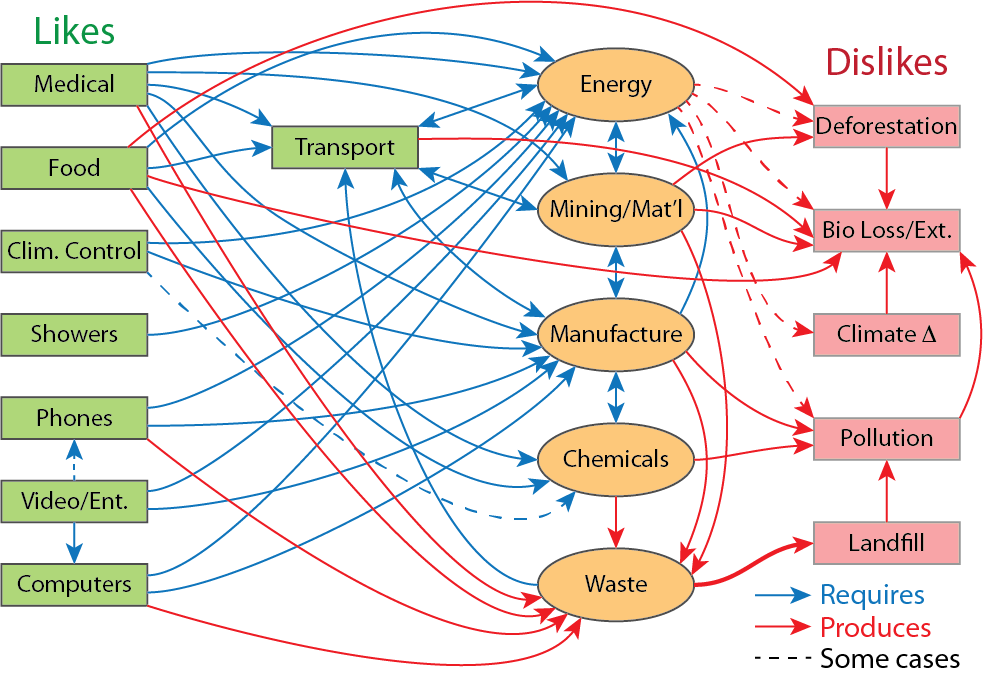
Outside, zero evidence obtains that they are separable.
For instance, inside human brains, a modern perk like medical care can be admired in isolation, sliced out as if served separately.
Outside, it is inextricably and bewilderingly hitched to every other phenomenon, including the most heinous practices of our day—even if our brains are oblivious to those entanglements.
Self-Deception
Human brains—and especially the modernity-promoted left hemispheres—love separation, categorization, abstraction, decontextualization, and logic. They are so proud of the matter we’ve pushed around, pretending to have created a viable alternative to a now-obsolete ecology—even if not commonly cast in those terms, exactly.
Our modernity-steeped culture is prepared to do anything to keep the sixth mass extinction fully underway—I mean keep modernity intact. Same thing.
The point is, what goes on in our heads is an insubstantial veneer within a larger, robust reality. Temporary and patently unsustainable practices can easily fool our gullible brains into the convenient and flattering belief that we’ve invented the one right way to live, amplified by pride in this “accomplishment.” Unreserved praise of agriculture, technology, medical care, etc. is the norm. But in ecological terms, our brains have led us—and countless innocent species—down a dead-end path.
Across billions of years, not a single instance is known to us of a cognitively-fabricated way of life sustaining for ecologically-relevant timescales. For that matter, no species has demonstrated enduring genetic viability after removing most selective pressures—like essentially eliminating infant mortality, for example. Hello, baffling health crises! We’re really playing with fire, on many fronts.
Even though the present experiment has spiraled in an ecological blink, inside human brains, we see no reason that we can’t cognitively concoct a viable template for living. Listen to that: we see no reason. That accidentally-professed blindness goes an awfully-long way toward accounting for the tragedy! We should be especially attentive to the fact that we stink at anticipating full consequences.
Dismissing Thought?
Why is it that over millennia of thinking and writing, so few have thought to discount and distrust thought as a viable basis on which to structure the foundations of how to live, when nowhere else has it been shown to succeed? It seems an insight this profoundly relevant (and straightforward) would at least be well-discussed, even if a matter of unsettled debate. But how could debate even serve to refute the hypothesis? Is it at all valid to dismiss the idea via a process of thought? It’s sort-of a self-destructive Kryptonite Konjecture. How many have even been exposed to a serious exploration of this theme? Is it just that scholars make a living on thought, and would never think to directly defile their primary tool? Is it back to the famous Upton Sinclair quote?
Brains only can know what they know, and have an insanely strong tendency to believe they are right—as a byproduct of their necessarily-limited capacities. In fact, show of hands: how many here think they have the wrong metaphysics? Given stark incompatibilities, they can’t all be right—if any of them are. Religion operates similarly, and it’s far beyond coincidence that billions swear by the religion they happened to be born into. In the case of the human-supremacist system of modernity that we were all born into, the least obvious premise—that for the first time in the universe, as far as we know, a viable bypass to ecology arises from neurons—is swallowed as obviously obvious. There’s a self-flattering glitch in there, somewhere.
Escape Hatch?
How might we try to avoid the trap of our manifestly faulty brains? One approach is to rely as little as possible on cognitive products: those of ourselves and of others. If that seems to leave nothing, then you’re deeply ensnared in the myth of cognitive primacy. What else is there, you ask? Why, most of the universe, of course! Scientists working at the edge of knowledge learn to try multiple triangulating approaches to address the question “how do I know if this is right?”—generally by asking the universe in various ways and hoping to be receptive enough to interpret its answer. For any piece of “knowledge,” ask about its provenance. Did it come primarily from human brains within recent millennia, or is it printed in the stars and rocks and living webs and DNA across deep-time? There’s plenty of the latter to admire.
It also seems prudent to seek the least anthropocentric, least individual-promoting view as a default. How many times must we learn the lesson that it’s not about us? Earth does not revolve around us, is not the center of the universe, and humans are one temporary product/variant of many millions falling out of evolution—sharing substantial DNA with microbes like amoebas. Oh…and if you prick us, do we not turn up elementary particles? Yet, plenty of mind-worshipers seem willing to cast even that as being nothing more than illusion created by the transcendent individual.
We might do well to place greater stock in non-cognitive deep-time arrangements that have arisen and proven themselves in a full ecological context. Blind faith in novel cognitive schemes is deeply risky and—given our demonstrated capacity for destruction—ultimately severely unethical to other species and to future humans. Let’s stop being the supervillains of the planet, just so we can have a few short-lived supervillain perks and pride of “accomplishment.” The only accomplishment that really matters in the long-view is enduring viability within a diverse Community of Life. The flashes and bangs can go jump in a lake.
Views: 1552
Masanobu Fukuoka, The Natural Way of Farming:
"Scientific agriculture developed early in the West as one branch of the natural sciences, which arose in Western learning as the study of matter. The natural sciences took a materialistic viewpoint that interpreted nature analytically and dialectically.
This was a consequence of Western man's belief in a man-nature dichotomy. In contrast to the Eastern view that man should seek to become one with nature, Western man used discriminating knowledge to place man in opposition to nature and attempted, from that vantage point, a detached interpretation of nature. For he was convinced that the human intellect can cast off subjectivity and comprehend nature objectively.
Western man firmly believed nature to be an entity with an objective reality independent of human consciousness, an entity that man can know through observation, reductive analysis, and reconstruction. From these processes of destruction and reconstruction arose the natural sciences.
The natural sciences have advanced at breakneck speed, flinging us into the space age. Today, man appears capable of knowing everything about the universe. He grows ever more confident that, sooner or later, he will understand even phenomena as yet unknown. But what exactly does it mean for man to "know"? He may laugh at the folly of the proverbial frog in the well, but is unable to laugh off his own ignorance before the vastness of the universe. Although man, who occupies but one small corner of the universe, can never hope to fully understand the world in which he lives, he persists nonetheless in the illusion that he has the cosmos in the palm of his hand. Man is not in a position to know nature."
I sometimes think about things like jellyfish and gingko trees. These organisms have been around without any obvious major changes for hundreds of millions of years. There are many species of birds, mammals, amphibians, crocodiles, and lizards that have similarly been largely unchanged for tens of millions of years. As far as I know, none of these organisms have ever learned that the Earth is spherical. It's doubtful that any of them have ever even bothered to wonder what shape the Earth is. For most of human history, humans thought the Earth was flat. My point is that the knowledge and reasoning skills we think separates us from all other life on Earth is very obviously unnecessary from an evolutionary standpoint. For four billion years life on this planet has gone along just fine without any species understanding that the Earth orbits the sun. I do think it is fascinating that humans have managed to understand many of these things, we just also need to understand that there is little to no evidence that this knowledge will confer greater fitness over long periods of time.
Well put: at best, the knowledge is "neither here nor there" in an ecological sense. But in practice, such knowledge is inseparably tangled into a sixth mass extinction…
Indeed. I wonder if "knowledge, without action" is even possible at scale? That's what we need to hope for. All evidence points to the contrary.
I recently had a discussion with a friend in which I brought up the unsustainability of modernity. My friend is a thoughtful person, but had what I suppose is the typical reaction about the need for the phasing out of modernity in that it would mean humans living like animals and losing all cultural heritage, etc.
We did not converge on a common understanding, but his ultimate argument was that everything dies, so why waste time swimming against the current fighting for long term sustainable ecological balance that will allow a complex web of life to persist on earth longer, when everything will ultimately die. In other words, enjoy modernity while you can.
That was depressing because it seems so selfish and under-awed at the amazing and complex web of life that has evolved here on earth. It's like the kids in Hawthorne's ‘The Artist of the Beautiful’ story who destroy the butterfly.
But also depressing because I didn't really have a good comeback for that because of course he is probably right that everything is doomed to die, is in a state of constant change with complexity eventually decreasing … entropy and free energy and such, but that attitude seems selfish and disrespectful to me. It made me feel like I'm Bruce Dern's character in the movie Silent Running.
On a brighter note, Zach Galifianakis's new "This is a Gardening Show" helps educate people about our current state. He continually states that the future is agrarian and in the beginning of the final episode clearly states what we humans are in for in terms of modernity. I think he gets it.
The hedonistic reflex is common. When confronted with the "shrug" response, I think about nuclear annihilation. Presumably, the shrugger should be okay with that as well: why wait to get it all over with, if it's all going anyway? Thus, I reject the "anything goes, since the sun will boil oceans in a billion years anyway" stance.
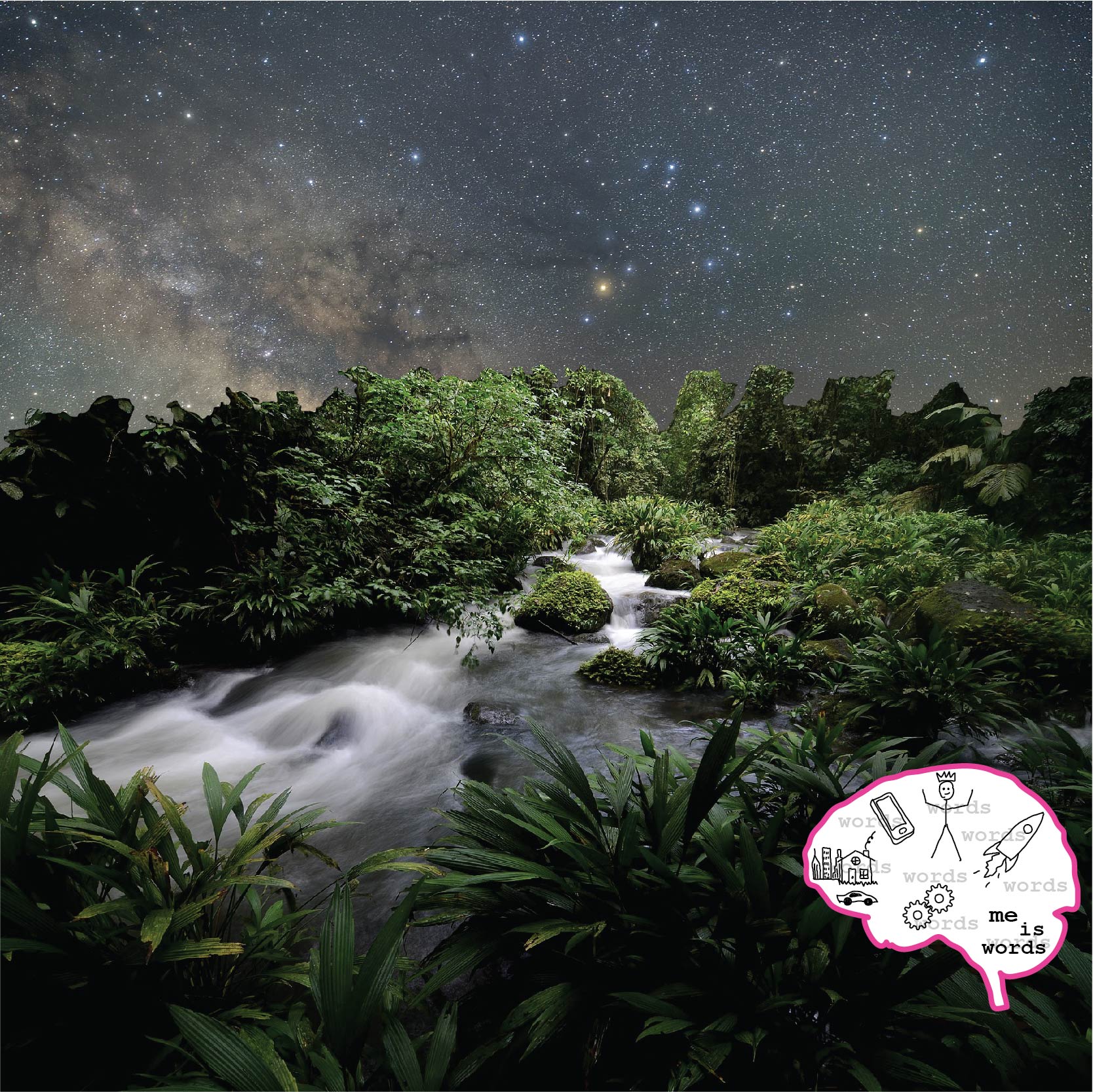
I absolutely adored Zach Gashinopolis' show (he, too, makes fun of his name). He's brilliant with kids. Want some applesauce? Kills me. In fact, note the "me is words" in the graphic I produced, inspired by a moment on the show. He's MUCH farther along than most people in understanding our plight. Perhaps like Chris Smaje, he is to be lauded for advocating a drastic pull-back from modernity. I'm not totally on board with agrarianism being ecologically compatible over the long haul (lacks evidence in the full complex contextual ecological deep-time universe), but it's a big step in a better direction, so I oughtn't complain too much.
Your friend makes a significant point. Although I understand your reaction, which would have been my reaction a few years ago, his point that everything dies is just another way of stating that everything in the universe is made of the same stuff, and none of it has any more right to exist than any other stuff. It all depends on one's point of view. Since I'd have difficulty finding anyone who'd prefer to live in a hunter-gatherer way (the only lifestyle I'm aware of that could be sustainable), I very much doubt humans as a whole would ever willingly dismantle modernity. Of course, it will happen eventually but, until it does, I suppose we should enjoy modernity while we can.
Assuming some life survives, I'm sure the Earth will again see a rich biodiversity, which may be some consolation.
Maybe the root of the "shrug" comes from thinking he (specifically he, your friend) is "exchanging" killing all complex life on earth for driving a Ferrari, trips around the world, champagne and a big house in Monaco…when in reality what most people get is an 8-hour soulless job in a factory to be able to pay the rent, eat and little else…does that modernity sell you a life style for which you're willing to transform the planet into an uninhabitable desert?, most people are really struggling, and what does "living the life now and screw tomorrow" means for him?, a friggin iPhone?
While I completely get you, there will probably come a point in our lives (for us "lucky" enough to live soul-grinding lives —I concur— but sheltered and still comfy in industrialized countries; for others that point has already arrived) when "living the life now and screw tomorrow" will involve choosing between much less trivial stuff: chopping down that one more tree for fuel for cooking or eat uncooked food; hunting down the last remnants of wild mammals or starve; keep producing complex medicines (with everything that entails) one is dependent on or, well, perish I suppose.
These all are decisions that improve one's survivability at expense of the biosphere's. And when life-threatening events knocks at our door, I presume most humans would choose the former.
We need to be careful when describing "humans," because 100% of the people most of us have met are culturally modern (human supremacists, mostly). I believe it is documented in Australia—but likely much more widespread—that some areas were off limits to hunting (taboo), and people would actually starve and die rather than violate the restrictions. Some cultures (of actual humans) build in restraint.
But I agree that everyone I know, afflicted with the individualism and separateness of modernity, would make the selfish choice. I fear how devastating this could be: a final "screw you" to the Community of Life, true to form.
Tom… by doing this blog, aren’t you neck deep in modernity yourself? Where do you get all your food from? Are you a devout vegan?
I think you are correct about most things… but you often seem to cast stones to others about living in modernity… when you have spent and continue to spend your whole life enjoying the Likes yourself. I respect you and your work, but one critique is you seem so easy to judge others… when you’re in this mess along with all of us.
If you've read enough of my material, you will have seen that I make no pretense as to living outside modernity. I am fully a product of modernity and am essentially trapped within it. I would be thrown in jail (or die first) if I went full hunter-gatherer in our modernity-dominated world. I would also need community. Think of a prisoner complaining bitterly about prison. Wait: is he a hypocrite for criticizing the lifestyle he himself lives?
This is also part of why I emphasize generational change: slowly sloughing off modernity one generation at a time. It's why I admire the Earth Abides book (see recent pair of Human Nature Odyssey podcast episodes on the topic). It's why the demographic decline barreling our way is good news: economies will fail and local adaptations will seed a few viable routes to a non-modernity future (as well as taking the boot off the throat of current hunter-gatherers so that they might thrive again).
But in the end, it really isn't about ME. I'll be long gone when modernity has strangled itself and ecologically viable ways return.
Ron,
I guess that your comeback would be that there are people and animals dying right now because of modernity. It exists through death and suffering and slavery. It doesn't just ignore the future, but the present. As per your second paragraph, part of the solution is to begin to dismantle the destruction by reducing the reliance on modernity and living as lightly as possible (although I'm with Tom on the agrarian solution). Enjoying it while you can, and I'm a hypocrite in this regard, is simply denialism. Your friend is in denial. Like the person with cancer who flies off to the deepest part of South America to search for the cure, via an Ayahuasca experience, dying in the jungle while their family is left at home in uncertainty and grief. The first step is acceptance. Then grief etc etc. They very clearly don't accept the case that you've put to them. Not yet.
Love the ‘inside/outside’ construct that your meatbrain conjured up. I will practice that.
thanks for the essay
i will add that animals also use their brains and react to words.
The problem with reducing the meanings of words/interpretations/associations/conclusions.
Animals act more broadly, involving what is dictated by the universe and preserved in genes and instincts (a baby roe deer walks a few minutes after birth).
animals-people are more plastic, more adaptive and cannot rely on genes and instincts to such an extent, they need a developed culture, and it is it, in relation to the time during which the population has experienced both disaster and prosperity, that creates the basis for long-term existence.
thank you!
Just a very minor note in the diagram but I'd say showers, video entertainment and even climate control also produce different amounts of waste. In fact, there are few if any modern human activities that do not produce any waste (outside of the natural cycles). Of course there are grades and not all modern activities generate are equally wasteful
Thanks for your work!
Thanks very much for this
Here is a short excerpt from an interview Nate Hagens did with the ecological biologist Corey Bradshaw last year I think, where Corey touches on human cognition in a way you might appreciate. it comes at about the 24 th minute of a long interview. Nate asks Corey if the future of life on earth is in trouble because of the sixth mass extinction…
The Great Simplification Ep 136 | Corey Bradshaw
Corey Bradshaw: “The Population Problem: Human Impact, Extinctions, and the Biodiversity Crisis”
Corey: It's not in trouble. Life isn't in trouble. Humanity is, but not life itself. So after a mass extinction, it opens up millions of new ecological niches that are exploited through basically the trial and error of evolutionary change. And so species extinction begets speciation. We always see the massive pulse and speciation, and even the rate of evolution increases after a mass extinction event.
Nate: So life will persist until the sun explodes and wipes out Earth entirely from the solar system, and that's several billion years down the track, so we don't have to worry about in the immediate term. But life will pretty much always persist on the planet. Like you said, will another sentient species emerge from that?
Corey: It's possible, but I tend to look at um, our big brains and our sentience as merely one of these disparity forms that have come out, provide an interesting chapter in the history of life, but aren't necessary for life to persist in any sense whatsoever. There's nothing of high value that we can attribute to sentience per se. From a life perspective, it's just, it just happened and we're using it to our advantage, but ultimately to our disadvantage.
Humans are the one species that (we can be certain) think about stuff. Humans are the one species that (we can be certain) are aware that their lives are limited. Humans are the one species that (we can be certain) wish this were not so. Humans are the one species that (we can be certain) will do almost anything to make it last longer. (Some of them will kill other members of their species to achieve this effect.) Humans are the only species that (we can be certain) will make up any manner of justification for why they have a "right" to do whatever it takes to make their lives last as long as possible. And anyone who suggests they do not have this "right," who might be attempting to take away this "right," is justifiably subject to losing this "right" for themselves.
For some, this "right" is embodied (or, perhaps, 'emculturated') in 'modernity.' After all, 'modernity' is the result of centuries of work on the project (the 'immortality project') that is the pursuit of this "right."