

Has anyone noticed the blasphemous tendency in my posts to belittle cognition? The position is that brains are imperfect and tiny subsets of the universe that are not remotely up to the task of supplanting time-tested ecologies with cognitive constructs involving agriculture, writing, money, and legal systems. Paraphrasing Frank Egler, it’s not that nature is more complex than we think, but more complex than we are capable of thinking. Brains can’t be expected to fool Mother Nature, in the end.
Does that mean cognition as a whole is ecologically worthless and inherently destructive? Of course not! Lots of creatures—even crickets—rub neurons together to make thought. Moreover, non-neural forms of cognition take place among plants, fungi and microbes to help figure out how to cope with varied situations. These neuron-free beings even learn (see examples of amoebas and plants). Clearly cognition itself is not ecologically disastrous—demonstrating compatible utility over eons. Humans used top-shelf brains for millions of years without precipitating ecological disaster. Yet human brains are also key players in staging the current disastrous path.
How can we tell what sorts of human cognition are safe, then? I propose a metaphorical framing that helps identify when cognition “goes rogue” that I hope will also be useful for others.
Let the Chips Fall
A hint comes from the animist sentiment found in Earth Abides, when the main character, Ish, asks his great-grandson if he’s happy. “Things are as they are, and I am part of them” was the response. It speaks to a contentment living in the hands of the gods, as Daniel Quinn would put it.
I spent several days visiting a friend who has a pool table, and in between sessions to work on constructing a cooperative billiards game, we had plenty of discussion about the limits and appropriateness of human cognition. Swirling the two together suggested a productive framing—motivated by the sense that authentic ecological human lifeways tend to accept the universe as it is, working with what’s given—or again, living in the hands of the gods.
What do “the gods” have to do with pool/billiards (I tend to use the two interchangeably, even though “billiards” can refer to a carom-based game without pockets)? In most games, the opening shot is a “break” of a tight pack of balls. It’s a randomizing event to initialize the game, where “the gods” set the stage for the rest of the game: no cognition involved. Thereafter, one accepts and deals with the outcomes, however inconvenient or fortuitous.
The skill is in working within the constraints: taking shots at designated balls that are not blocked. This is how cognition fits into ecology: figuring out ways to “make the shot”—in the world as it is presented.
The example image below represents a “tough” distribution, in the context of a game like 8-ball, whereby one must only strike either solid or striped balls with the white cue ball—the goal being to sink balls of that same type into the pockets.
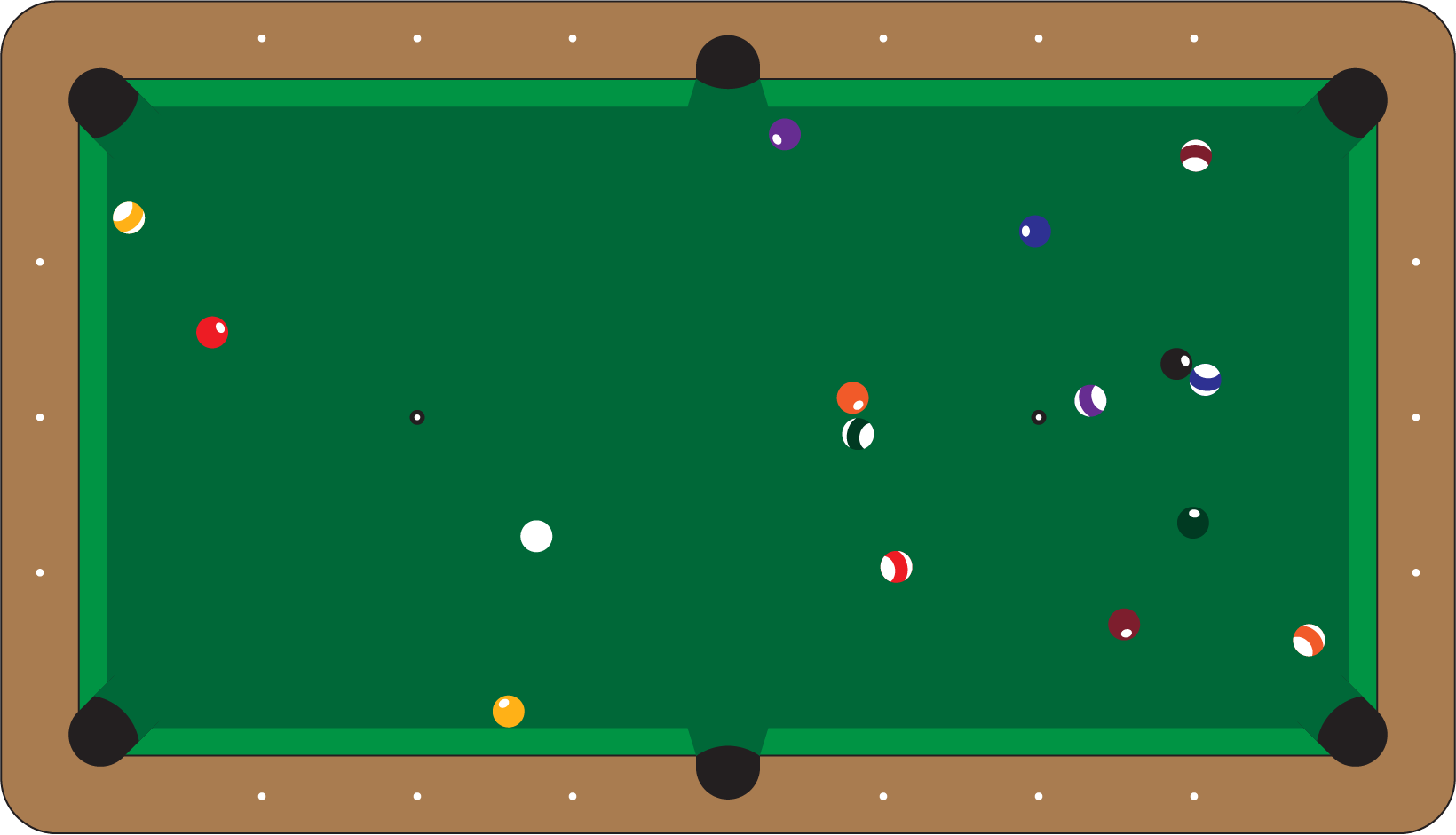
In this example, no direct/legal shots are feasible, leaving only shots that either involve combinations of ball strikes or the cue ball first hitting a rail. I myself would not expect success, but might attempt something like the solid red ball at left into the lower left pocket after striking the upper rail with the cue ball. I’d give myself a 5–10% chance of making such a shot, while I’m guessing that a master might have better-then-even odds of success. If I practiced that exact shot hundreds of times, I would expect marked improvement as I honed the requisite skill.
The Modernity Way
For contrast, modernity has used cognition to effectively bend or break longstanding ecological rules to human advantage. How much would the pool game change if one player assumed license to move the cue ball and any other ball to any position they like before taking each shot? The other player(s) would immediately cry foul, of course.
Now consider that the game of Life is played alongside many other species, all trying to sink their own balls in their own specialized ways. It isn’t too big a stretch to imagine the dung beetle trying to roll a brown ball to its preferred pocket. Crucially important is the fact that the success of one species hinges on the mutual success of many others. Not all shots belong to humans. If we tried to take all the turns/balls for ourselves, ecology would collapse and chuck us into the pile of losers alongside our victims. It’s no way to play the game: what looks like outrageous “winning” turns out to be colossal losing (e.g., low infant mortality is an inseparable part of a sixth mass extinction). Modernity has effectively jacked up one corner of the table to funnel all the goodies toward our pocket, to the systematic detriment of all other players on the planet. It’s not very sporting of us, and is terminating the game rather quickly—making losers of us all.
In a similar vein, I guarantee that I can deliver six sixes every time when rolling six dice, provided I bestow upon myself the “right” to rotate each one to my liking before declaring my turn over. How many people do you think would want to play with me if I did that? Why would the Community of Life tolerate our shameless manipulation of the ancient game? Isn’t it more admirable to accept what the gods provide, and strive to work within the emerging relationships and constraints? It’s certainly less dangerous!
How Hunter-Gatherers Play
In the billiards analogy, the hunter-gatherer doesn’t manipulate the rules, but is still capable of making impressive shots: leaning on cognitive processes to anticipate collisions, angles, friction, inertia, etc. Dung beetles can’t do that, so that our long-range shots—cognitively contrived—look like magic.
So, that’s where cognition can fit. Humans have little choice but to use powers of observation and cognition to devise clever ways to get what we need to survive within an ecological context. Different places on Earth require different “shots,” which we work out in our brains. It’s just always going to be a part of what we do.
Here’s another wrinkle that perhaps better captures ecological reality. After a shot attempt, the balls are returned to (at least approximately) the same positions as before the shot, so that the same set of opportunities and difficulties persist. Each location on Earth has a different number and arrangement of balls on the table, and a different cast of players—all settling into their own preferred “shots.” The image above represents a difficult setting…like a desert or polar region, perhaps: no easy shots available to the cue-stick-wielding humans. Or maybe such a challenging location would simply have fewer balls on the table. In any case, one can imagine people becoming expert enough at a particular possible shot in that place, making a living off one or a few available opportunities, even if requiring tremendous, specialized skill.
Dealing with Cheaters
The problem enters when we try to cheat. Cheaters loudly protest any accusation of cheating, and we would be foolish to expect practitioners of modernity to be any different. “Agriculture isn’t cheating: it’s being clever!” “Use of fossil fuels isn’t cheating: it’s fulfilling our destiny as the most powerful species on the planet!”
If a modality is novel on ecologically-relevant timescales—and especially if it effects signs of distress, then maybe it earns the “cheating” label. Also, why pay attention to the cheater’s protests? Isn’t it the perspective of the other (cheated) players that matters more? Let’s ask the Community of Life if agriculture is cheating. When the answer comes back as the unambiguous unfurling of a sixth mass extinction, maybe we should attend to that as being far more authoritative than whatever the cheaters make up to say. Practicing proponents of agriculture are essentially disqualified from rendering unbiased judgment, right?
What can prevent the use of human cognition to unfair advantage? Well, one way is simple failure: go ahead and practice your “cleverness,” but prepare to die as a species—alongside countless others. The other is deliberate restraint, which is sometimes called wisdom. Respect for rules and norms that are aligned to ecological relationships keep hunter-gatherers on safe paths over vast tracts of time. This respect applies most strongly to the more-than-human world, of which humans are one small part. Modernity, by contrast, treats the non-human world as a set of commodities—a resource-rich canvas on which to paint a glorious, ascendant humanity.
Inexplicit Ambiguity
This is no place for lawyer-types to squabble over definitions, for two reasons.
First, when it comes to the appropriate “rules” of the game, it’s no use pretending there’s a bright, sharp line here. When does the universe ever work like that? Every living being manipulates its environment in some way. It’s in the substantive manipulation of (inexplicit) rules that one asks for trouble. Insisting on a disproportionate number of turns, depriving others of their resources, tilting the table to our advantage, moving the balls around willy-nilly—these are the actions that break ecological health. Daniel Quinn’s Law of Limited Competition parallels this idea.
Second, the rules can’t easily be codified into rigid words. Attempts in that direction might signal the wrong path…like attempting to love someone by following an algorithm. The universe provides no recipe for safe operation. It only smacks down those who deviate too far, using a glacial hand: slow, but powerful. One time-tested method is to watch carefully the methods of other members of the Community of Life and adopt/emulate aspects of their proven patterns. If we don’t see other living beings using money or written laws, then maybe the wise choice is to refrain from such foibles ourselves. It isn’t hard to observe other species using brains to figure out their next “shot,” but none of them write it down or pay for legal advice.
Even more direct is to learn what actual humans have done to live in right-relationship with the Community of Life for very long stretches. For this, immediate-return hunter-gatherers are far-and-away the best template. It’s no mistake that many similarities link these lifestyles to those of countless other species.
Cautious Cognition
In the end, humans have always used cognition and will always rely on it as inevitably as we avail ourselves of fingers. The question is what we employ cognition to do. For many thousands of generations, it worked well to apply our mental powers to function within the conditions provided by the universe: accepting the “breaks” just as we accept the pool table configuration. Trouble came quickly when brains invented novel modalities that rejected the distribution set out by the gods and began concocting redistributions that seemed highly favorable in the short-term. Thinking we can do better than what ecology has tested over deep time is where the demons lie. Some cultures in human history understood this well, and carefully refrained from angering the gods with hubris.
Views: 1170
"The universe provides no recipe for safe operation."
True, but it's not difficult to evaluate actions in real time. For example, if I'm building a house, I can apply some logical statements to verify its sustainability (measuring sustainability, of course, should take the form of: what if everyone did it?)
Can its materials be returned to the earth, or reused?
Can I regenerate the materials used over the useful life of the house? (For example, if I cut down twenty trees to build my roof, can I regrow another 20+ before they require to be replaced).
Do the materials or building work require the exploitation of another human?
Do the resources used pollute another's part of the world? (Who's mountain am I chopping in half to mine my solar panels?)
And so on. If those criteria aren't met then the building isn't sustainable. Obviously those criteria are routinely ignored in almost all building works, food, clothing and energy etc provision, within modernity.
Human cognition is an evolved attribute, so it must have a goodly amount of adaptive fitness in normal circumstances. If human cognition is now maladaptive, perhaps it is because the circumstances have changed.
Based on your antipathy toward agriculture, you might think that the stable holocene climate, which allows agriculture to happen, is the change in circumstances. I think our impact could have remained benign enough even with agriculture, but then fossil fuels entered the picture and all hell broke loose.
When those huge supplies of exogenous energy are gone, human cognition will be adaptive again. It remains to be seen whether it will be enough to enable us to live in the world we changed semi-permanently.
Firstly, I'd say that "my" antipathy toward agriculture is more about reporting the ecological antipathy toward a practice that jumped population doubling time an order-of-magnitude and ignited a dangerous trajectory. I actually eat the stuff every day.
Secondly, hell had already broken loose well before fossil fuels added a few orders-of-magnitude of impact. A graph of fossil fuel use (initially coal) shows it first becoming significant (relative to the current "hell") after 1850. In 1800, it was less than three orders-of-magnitude smaller than today. Meanwhile human population was already at 1 billion, before the industrial revolution or fossil fuels took hold. That's agriculture's exponential gift. Growing at 0.4% per year, the gift was giving strongly: doubling time less than two centuries and thus two orders-of-magnitude greater than pre-agricultural (ecologically-vetted) living. By 1800, the mass of wild land mammals per human was already down three orders-of-magnitude since pre-agricultural days: far from what was a relatively stable balance for millions of years, all in a 10 kyr blink. Again, that's not my antipathy, but what the universe did.
Our horizons are so short that it takes a five-order-of-magnitude anomaly to register danger—and even then for a minority of humans, it seems. Fossil fuels certainly piled on a couple orders-of-magnitude, but things weren't "just fine" for thousands of years prior. The exponential rip was well underway, but loud as it was, we were—and still are—tone deaf (and super-defensive about our cherished modalities).
Tom
Have you explained how pre say 1800s agriculture was not sustainable? Where are your calculations or evidence for this? Just genuinely curious about this
Are you aware of any forms of agriculture being sustainable?
I am no expert by any means , but I have to think certain “herders” of goats/sheep would be self sustaining on long time scales.
Sun grows vegetation. Livestock eat vegetation. Homo sapiens eat livestock. Yes?
Thank you
At the top level, only a fully-integrated ecology can "decide" what is sustainable by empirical means over timescales far longer than our short 10kyr ag run. The notion that a brain—not *remotely* capable of considering the full tangle of relationships—could pronounce judgment is utterly laughable. Of course, those same brains object and maintain faith in their perception of mastery (or potential for mastery). Really it's pretty hilarious once free of that delusion. The "I don't see why not" line of argument is a perfect expression of this profound naivete. It's a trap of tremendous appeal that I would deem most people (of modernity) fall into repeatedly.
That's why I favor the story as the universe has actually expressed it. True, we only have ONE instance, but would be utterly foolish to ignore or discount its outcome, preferring instead stripped-down counterfactual fantasies brewed in crania. They count for very little.
So, in 1800 Europe was pretty deforested, so that naval enterprises started acquiring timber globally. That's one sign. Biodiversity loss and extinctions were already indicating that something's wrong. But the extreme exponential growth rate is perhaps more convincing. It doesn't matter how a brain might propose to curb it. What actually happens in the presence of positive feedback loops set up by agricultural practice (via surplus, for example) overwhelms any notional control. This started abruptly about 10kyr ago, when doubling time quickly jumoed from 20,000 yr or longer to 2,000 yr. The countdown clock started, and has only ever accelerated (again, the real outcome when all things are "considered").
Could agricultural practices of 5 kyr ago be sustainable? Well, evidence (again with the evidence!) is that ag regions built up salt and other mineral deposits detrimental to farming while depleting those minerals required for food production—turning verdant areas into wastelands that persist that way for longer than we've been able to study (i.e., still damaged). This necessitates a moving, consuming practice that also happens to have built-in expansion. Not only is it highly questionable that the practice *could* be sustainable, but we already have an *actual* answer that it appears to initiate a sixth mass extinction. That's powerful enough for me to distrust notional speculations on the matter, and advocate safer paths.
Ok… thank you for the response.
Do you have sources you can share / cite that explain in more depth about the evidence that agricultural practices from ~5,000 years ago built up salt and other minerals detrimental to farming while depleting nutrients necessary for food production? If that is too much of a hassle to produce, then no problem.
I'll see what I can locate, but I won't be "idle" until Monday so it might wait until next week.
" Dirt .The Erosion of Civilisations " by David
Montgomery , and "One with Nineveh " by
Paul and Anne Ehrlich are two relevant books.
(reply to Mike Black )
I feel that there are elements of human exceptionalism here, or maybe acknowledgment of human stupidity? You suggest watching what other species do in order the emulate them. So it seems humans aren't allowed to act in their innate ways, but must modify their behaviours to stick to the rules of nature. Or that humans are so clever that they could, if they so wished, act in a carefully planned manner in order to …
In order to what? To not "bend or break longstanding ecological rules?" But these rules are not written down, as you later say. In fact, isn't it true that there are no rules at all. Any imagined rules are simply imagined rules. Hunter-gatherers surely didn't follow any rules either. They simply lived day to day, as all other species do. They may have cared about tomorrow or the day after that but death can come any day. There is really only now.
Even the fact that we're instigating another mass extinction doesn't mean it's against unwritten rules. Mass extinctions happen. Things are as they are, and we are part of them.
Excellent points. Indeed, humans are exceptional—as are newts. My main beef is with an attitude of human supremacism, which I hope is not present here! It is abundantly clear that humans have tremendous power within the biosphere: enough to wreck it, in fact. It is also clear that cognition plays a central role. We're on a destructive track, and my question is one of helpful guidance for how to turn our cognition away from mass extinction and toward "right relationship." This may involve a "transition phase" in which we moderns turn our over-thinking habits toward emulation until it again becomes second-nature.
The only rule, really, is that unsustainable fails. Time passes judgment. Hunter-gatherers (a nearly universal mode found not just in humans!) have generally-speaking been given the thumbs-up, and I believe that recognition carries great value.
I've hit the point many times before that nothing in this universe is unnatural, up to and including/surpassing nuclear annihilation. Our reaction to the "stimulus" of an unfolding mass extinction *could* be a cognitive/philosophical shrug on the basis that it's natural, OR motivation to change behavior. We will do whatever we do, but clearly my impulse is to agitate for finding a way off the current path. It's what the atoms that make "me" are going to do, apparently.
Yeah, well, you are right – these rules do not exist. But what does exist are stupid moves and clever moves. E.g. – hunting whales almost to extinction was a stupid move, in that doing so eliminated the resource they represented. (Not that I approve of hunting the whales to obtain the resource, in the first place. Better for one's karma not to do either – after all, it was not essential for life – only for added comfort).
Do you think humans actually knew that they were hunting any animal to extinction (it's not just whales, and it's not just modern humans who do this)? And whether it's a stupid move depends on one's views and available information. We each make decisions that are the result of our brain chemistry. Thus no decision is intrinsically stupid or smart, it's just a decision.
What naivete that hunter-gatherers didn't have rules, my goodness! They had plenty. And then some. Those were spoken though, not written! Here are some examples.
To avoid blood feud, they instituted damage payment. For a long time it was in some portion of the spoils, or whatever you obtained with your own hands. (Some say, when the accounts of damage were started to be in standardised units – bushels of grains for instance – was when money started to take root.) In lieu of payment, you could simply render regular service onto the wrongdoer though. The Aboriginees in Australia called (and still call) it the "us-two" rule. You can refer to Jason Yunkaporta for details.
The Hurons even went to war against the Iroquois, when in their eagerness to please the foreign settlers they began hunting down every breeding pair of beavers in the common territory to sell them for fur in exchange for guns. They couldn't imagine a bigger sin and the Iroquois knew they were breaking the rule. You can refer to Baron Lahontan's diary of his journeys in North America for more details.
From those same diaries, you will find out that across vast planes the federation of tribes followed very sophisticated rules of successive hierarchies and delegation. At the very lowest level though, nobody had to follow the chief, unless they so choose. Women were allowed to divorce their husbands if they were not pleased without any reason whatsoever, so to avoid the shame they did damn well to please them. Domestic violence was strictly forbidden and stamped out. Another important rule, mind you. The tribe regularly cam together to decide on the form of common inheritance. In the hunting season, when too many males were away, it could be turned into matriarchy where the nephews inherited. During other times, patriarchy could prevail with the first born male inheriting.
The list could go on and on. They had plenty of unspoken and very strict rules! Not for nothing that they were able to walk away from the temptations of Cahokia, a vast urban settlement, when it became clear that they were beginning to break all the ancient rules they had thus far held sacred. They had even walked away from the institutionalised preparation of the ritual bread and beer, a sophisticated process requiring division of labour but not full blown agriculture, when they realised the above falsities also provided by their sweet comforts. They restarted hunter-gathering in tribal camps anew. Those rules were so strong, they prevailed!
I wasn't referring to the rules of communities. These would be different from community to community. The rules I was referring to are the supposed rules of how to live with the rest of nature. I agree that hunter-gatherer tribes would have had norms for how they live and hunt together.
I commented a few articles back about the laws the Australian Aboriginals had regarding Totem areas.
That would be in the category of rules of how to live with the rest of nature. Tim Flannery also has an interesting
section in his New Guinea book, "Throwim way Leg", about the " Hunting Forbidden " valleys he experienced there.
Thanks for the heads up, David. I put that interesting book on my reading list.
To my mind, when the 'norms' that Mike refers to are derived directly from a broader *Family of Living*, they ARE the law of the land. It is at once very strict and very flexible, as the need be; a great advantage of it being unwritten.
That said, recorded urbanite law could be extremely inflexible, even as far into the present as during early absolutism. Some say, a key legal aspect of Shakespeare's plays was that he was appalled by how the law had to be applied so literally. Even heads of state were not legally able to apply mitigating circumstances. According to scholars, this is what is meant by "equity not stirring", and why the example of mercy in the Merchant of Venice, however crude, was so revolutionary at the time. In reality, even the Doge, powerful as he was, could not diverge from the strictest letter of the law.
So, when we might say that a more HG attitude could liberate law from many a written shackles, some giants like Shakespeare have, in many ways, already beat us to the punch.
I’m a big fan of analogies because they let people see perspectives they might otherwise miss. To answer your title question, I’d say that cognition on its own is not inherently dangerous. Human cognition only becomes dangerous when it gains helpers that amplify its reach.
The first helper is human dexterity. Our physical abilities let us apply cognition in ways most creatures cannot. But even with dexterity, our bodies alone are not powerful enough to challenge Nature in any meaningful way. Without additional leverage, we can’t fell mature trees, reshape landscapes, or scale our population beyond ecological limits. In that state, we would be no more destructive than any other ape.
The second helper is technology. This is where cognition crosses the line into the danger zone. Technology multiplies our physical reach and lets us act far beyond the constraints of our bodies. The moment we use a stick as a lever or a club, we begin to extend cognition into territory where patience, foresight, responsibility, and rules become essential. History shows that we failed to apply these safeguards well enough to avoid our current ecological crisis.
We lacked the patience to let our understanding catch up to our innovations. We didn’t wait for foresight before using our new technological powers. And once knowledge finally arrived to reveal the dangers, we often refused to act responsibly or set boundaries around technologies that pushed us into the danger zone.
So the answer becomes a resounding “yes”: once technology is paired with cognition, and we fail to apply patience, knowledge, responsibility, and rules, human cognition sits squarely in the danger zone. Yet cognition also gives us the ability to stay out of that zone—if we use education to train ourselves to apply knowledge appropriately.
Thanks for this. Brains plus fingers worked well for humans in an ecological context for millions of years, so I agree that dexterity is not itself a tipping point. But I *would* place written language on the short-list. Talk about a direct amplifier of cognition! See posts on Spare Capacity and Worst Inventions. Of course, writing was in service of an already-deviant way of living without ecological precedent/vetting.
Reminiscent of E.O. Wilson's famous statement: "If there is danger in the human trajectory, it is not so much in the survival of our own species as in the fulfillment of the ultimate irony of organic evolution: that in the instant of achieving self-understanding through the mind of man, life has doomed its most beautiful creations."
Brains are part of "mother nature", and cognition might just be one of nature "trick" to make sure thermodynamics second principle is followed, in particular regarding all that potential energy that got built through fossile fuels.
This approach of seperating humans from nature is so dated …
Tom,
Pretty off-topic here… but if a Homosapien, let’s say… Me,… Were to read your book “ energy, and human ambitions on a finite planet “… would you still recommend it? Are there certain chapters you would say are more important than others? Would you change anything with the book at this point, such as the epilogue or final statements?
I am considering reading it… Just wondering if there’s anything you would change with it or if you would tell me what is worthwhile or not in terms of approaching the book
I read “energy a beginners guide” by Vclav Smil about eight years ago or so… I found it to be a very eye-opening and fascinating read
Thank you
Indeed, this is off topic, but perhaps of more general interest (and not sure where it would fit better anyway)…
I last taught from the book in spring of 2023, and found it wanting. I thought it had the wrong focus. It's not the book I would write today. The epilogue and appendix (sections D5 and D6) better align to my later trajectory. That said, just as the book details a quantitative exploration that was an important phase in my own journey, perhaps it is a useful stepping stone for others as well. Maybe it's easier to accept a recommendation of walking away from modernity if first convinced that maintaining 18 TW of power is not likely in the cards even on a technological basis. Failure is practically guaranteed.
The most glaring shortcoming is that the book reflects my ecologically ignorance at the time. But in that sense, perhaps it's a good match to the populace as a whole, as an entry point. In short, I don't consider it to be junk, but neither am I excited by it at this stage. I tend to recommend Ishmael and Civilized to Death as more relevant starting points.
Ok… thank you Tom
You seem to me to be a voice of reality in a sea of hype and naivety and salesmanship and ignorance… thank you for sharing your knowledge (for free!) with the public!!
Cognition is a great attribute, for it helps us utilize energy in ways that we can today find it useful, to function, live safely and be in control of every situation around us.
In the corporate world, professionals primarily input, process, and also manage the ways in which we direct the outputs of whatever we have been working with.
Actuators and alternators exemplify well-directed energy. Actuators utilize various energy sources to produce mechanical results, whereas alternators convert mechanical energy into electrical energy. Operating together as a collaborative phenomenon, these systems demonstrate how cognitive advancements can be beneficial rather than dangerous.
This is because accumulated knowledge must be properly managed and updated; applying knowledge correctly ensures optimal and satisfying outcomes.
Professionals—including scientists, engineers, economists, and politicians—must acquire deep understanding to design, build, and maintain structures, machines, devices, and processes. This expertise allows them to manage GDP growth, ensure political palatability, predict outcomes, and safely control their outputs.
Knowledge acquisition and control make it possible for actuators to work alongside alternators, rotors, and generators, just as they enable the use of seawater and plasma in nuclear fusion. However, mental acquisition becomes harmful when ethical standards are compromised by greed, selfish ambition, and sabotage.
Electricity sources—such as hydroelectricity, crude oil, coal, nuclear, wind, and solar energy—have revolutionized our world. However, this progress comes at a cost. Burning fossil fuels emits heavy pollutants, including sulfur oxide, nitrogen oxide, benzene, isoprenes, carbon monoxide, and lead. Consequently, these emissions lead to fatal illnesses and environmental disasters driven by greenhouse gases like carbon dioxide and methane. To combat these threats, global regulators established the Intergovernmental Panel on Climate Change (IPCC). Even though some climate impacts cannot be averted, strict standards have been set, and we must not bypass these boundaries. Ultimately, the true danger of human intellect lies in ignoring these principles for short-term gains at the expense of human life, environmental wellness, financial stability, and social freedom.
This reads like a love letter to modernity: a celebration of human supremacy.
Hahaha, we must appreciate the beauty of being human, in the presence of controlled mishaps.
It reads like an AI bot
It was meant to get the point through
Well, it sounds like you've solved it, mate! Good job, disaster averted. Whew!
As I shrink through your flattery
Tom,
can you elaborate a bit what you mean by "living in the hands of the gods"? How does this look like for modern day humans who need to go to (often stupid) work, who need to maintain the work to pay the bills, who have too little time to spend with their kids and so on.
I find this very hard to do and I think this was easier when there were less possibilities to manipulate our environment
Modernity deprives us of choice in many respects, so that living in the hands of the gods is more aspirational for us present-day inmates. I hope it becomes easier for future generations to begin practicing more authentic ways of living. What we can do in our current confinement is recognize the lack of choice/freedom and express our dislike—ideally absorbed by younger ears. Personal choices can also begin leaning toward better ecological relationships. Perhaps it's just in the margins at first (and for the rest of our lifetimes?), but one can begin prioritizing the more-than-human world in various small ways. If more people fell out of love with modernity and questioned why we put up with its nonsense, cultural attitudes would shift and some would start melting out of its grip. If institutions begin to fail, let them. Don't fight to keep the prison in perfect trim. Be less of a control freak, and let the universe do what it wants—going along for the ride rather than trying to tell it what it should do.
Hahaha…. if Elon Musk's favourite cocktail would be a statement this right here would be a contender. However the true question is rhetorical who owns the world, God or humans?
Omniscience doesn't require cognitive accumulation in order to recognise truth from error. While discoveries are based on human trial and error (hypothesis, feasibility studies) are just a time consuming cognitive compensation activity.
While nature has been freely given with a perfectly functional ecosystem. Humans are forever pursuing to better the ways we experience life.
With all this being said and done, an opportunity has been laid for us all, get a robot now while it's still reasonably affordable or get to experience consciousness separated from intelligence, are the unspoken words the world is saying on the professional point of view.
The decision we all need to make individually is which one?