
Most of us learn that uncompromising positions seldom work in the real world. We must bend, or risk breaking. As The Stones put it, you can’t always get what you want. The best place to witness such a lesson might be in the aisles of store where a toddler has a meltdown over the denial of something they really, really want. One is likely to even hear the “not fair” charge through tears and contorted facial muscles. It’s what we often say when not getting our way—from a highly-biased perspective.
While it’s true that ice cream might win hands-down against steamed cabbage in a taste test—even among adults—you won’t see (healthy) adults adopt a diet exclusively built on ice cream, or even ice cream plus cake for variety. The adults have figured out that there’s more to life than deliciousness. Narrowing one’s focus to a single quality—or even a few—is a recipe for unfortunate consequences, out of balance in a more holistic assessment.
Following the written conversation between myself and David Murphy, the Planetary Limits Academic Network hosted a seminar for the two of us to discuss our relative positions (some convergence, but dominated by divergence). We each gave an introductory statement of 5 minutes or so, and each shared two graphics. Mine were what I call the ecological cliff edge (or nosedive)—showing wild mammal mass per human plummeting—and the Likes/Dislikes mess (pictured again below). Dave showed infant mortality and poverty reduction, and also spoke admiringly of the demographic transition model waiting to usher the remaining poor toward arrival at “western” standards.
Here, I take on these attributes—mostly infant mortality—as aspects that would appear to be unassailably positive, yet amount to choosing a diet of ice cream and cake. In the end, it’s not even good for us, as humans! I know: the argument may not seem obvious, and even deemed reprehensible by avowed human supremacists. But here we go…
Infant Mortality
Dave showed a plot of infant mortality through the ages. A steady line at about 50% represented an essentially-timeless average across 17 hunter-gatherer societies, then a sharp plummet to 27% in 1950, 4.3% in 2020, and a dot at 0.3% representing countries with the lowest rates today. Its shape bears a resemblance to my “cliff edge” plot.
Dave’s point was essentially: how can anyone argue that this result isn’t worth the ecological costs we’ve accumulated? It’s a powerful card. Does my oft-used sixth mass extinction card beat it? Seems like it must. But let’s back up a bit.
It is perfectly understandable that we should dislike infant mortality. Losing a baby is painful, period. I would be seriously worried if we did not grieve every such loss. From this point of view, it makes complete sense that the pressure would be on to strive for its elimination. I’m not blaming anyone for this motivation. A campaign to reduce and effectively eliminate infant mortality is practically inevitable, once the tools are at hand. But to what end?
Entanglements
The point of my Likes/Dislikes graphic is that all the stuff we like in modernity is unavoidably hitched to all the consequences we don’t like.
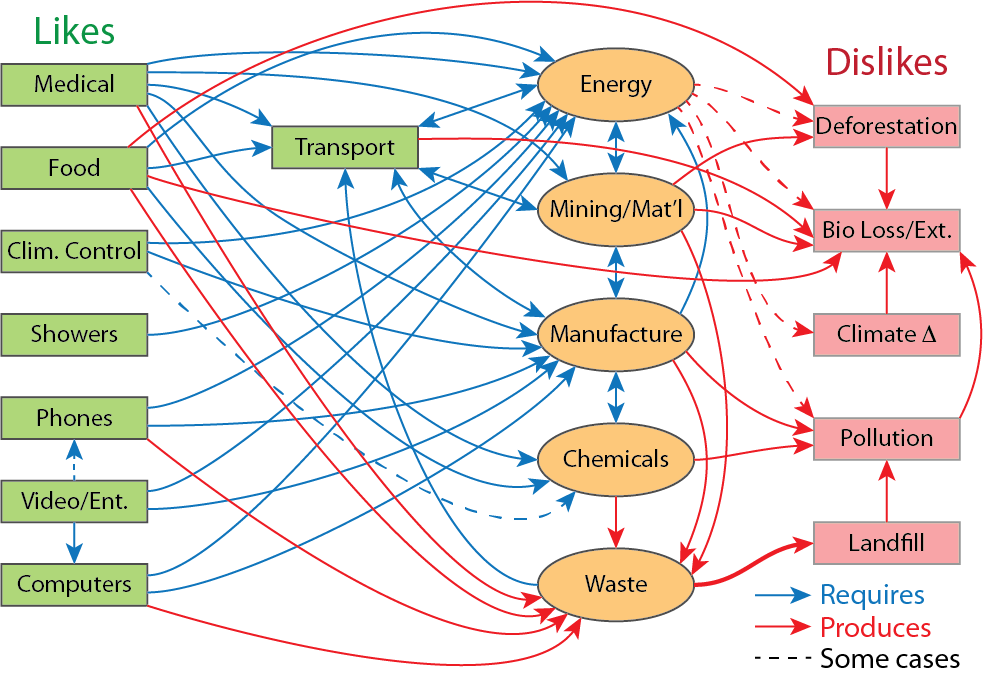
In fact, as messy as it looks, this graphic is far too simplistic, by orders-of-magnitude. The plain truth is that no human (or team of humans) could assemble an accurate and complete diagram of all the relevant factors and their interactions. Even designating boxes with word-labels instantly violates accurate representation, pretending that monolithic blocks can stand in for real-world arrangements. We must face the fact that the real situation is one giant Gordian Knot whose disentanglement has always eluded us, and will continue to do so.
Effectively eliminating infant mortality requires hospitals, or their equivalent, with NICU capabilities to handle early births; sterile, isolated environments; advanced drugs; high-tech tools and machines; insanely sophisticated diagnostic capabilities like MRI, CAT, PET (anti-matter!), ultrasound. It takes way more than a village!
These devices and capabilities do not exist in a vacuum, but depend on high energy-throughput, high material-throughput, global supply chains, and in general a resource-exploitative civilization. Not only is the proof most definitely in the pudding, but no one is even crazy enough to suggest a way to preserve such capabilities in a fully ecologically-integrated context like that practiced by hunter-gatherers.
I think it’s obvious enough that one cannot have a hunter-gatherer lifestyle and essentially no infant mortality. This superficial truth causes most to instantly discard the former for the latter. Boiled cabbage? Blech!
What We Miss
Given that even the vastly-oversimplified Likes/Dislikes diagram above already hurts our heads (and is not held in any sort of awareness by most in our culture), it’s no wonder that we’ll pick the “ice cream” option of no infant mortality if inside our brains the choice is that simple: all benefit and no perceived cost. It’s a great trick of ours to pretend that what we don’t conceive must not exist! Ah, the arrogance of ignorance…
But here’s what we actually know: hunter-gatherer life failed to develop a sixth mass extinction for a few million years—and far longer when considering that the entire rest of the Community of Life has practiced what are essentially hunter-gatherer lifestyles for billions of years. Beginning with agriculture, numerous positive-feedback influences defined a modernity that has unambiguously initiated what a consensus of conservation biologists calls a sixth mass extinction. Infant mortality is one of many aspects of modernity that cannot be separated from the extinctions outside the confines of human brains (where anything goes, fantastical or otherwise). In other words, it is irrelevant what any individual might think about the situation: the facts are laid out.
We get (too easily) fooled into believing we are making an easy “cake or death” choice when it comes to infant mortality, but it turns out that cake translates to extinction, by a path too cumbersome for our brains to fully track (thus it can’t be real, we conveniently lie to ourselves). If the death of half of human infants is the price for the endurance of millions of species (including humans!) in the Community of Life—and every other creature on the planet pays a related tribute—then as hard as it is to bear, it seems it must be worth it, right? Death is a necessary part of life. Fairness will not always appear to operate in our favor.
Silver Linings
What could possibly be the upside of infant mortality? Mustn’t it be 100% bad? I will try three approaches.
The first involves chickadees, to pick a somewhat random example. They are on my mind because each year around this time several families of chestnut-backed chickadees fledge new chicks around my house. They typically hatch something in the neighborhood of a half-dozen eggs. Adults may live up to ten years, breeding each year. If life expectancy were, say, 5 years, providing four years of successful reproduction, then elimination of infant mortality among chickadees would result in a fertility rate of around 24 per female. Combined with natural attrition (lose about 20% of adults per year), each year the population swells by a factor of 3.8. Chickadee populations would grow by more than an order-of-magnitude every two years. Let’s say they occupy one-hundred-thousandth of bird biomass at present (likely a low figure). Within a decade, they would dominate bird biomass. After another decade they would far outstrip human biomass—in fact swelling to outweigh all other life on the planet! It’s insane, as all exponentials ultimately are.
Now allow the same provision for every living being: no infant mortality. It should be obvious that total ecological breakdown ensues rather rapidly. Ironically, elimination of infant mortality is no way to live. Try making the argument that humans deserve special treatment without being an unapologetic human supremacist. Infant mortality is part of a healthy ecology (yes: could be offset by lowering fertility rate, but the constraint to live ecologically doesn’t disappear—which modernity and its low infant mortality rate most decidedly violates).
The second approach involves child value. Research into how hunter-gatherers raise children indicates that children are treasured: much-loved recipients of abundant attention from an extended multi-generational clan. Those (roughly half) who survive to adulthood tend to be psychologically well-adjusted and well-socialized. One could argue that 50% infant mortality makes each living child twice as valuable, and they feel it. Maybe that’s not a 100% terrible trade.
Lastly, one must worry about genetic decoherence. By this, I mean that each individual human is a new experiment. Leaving mutations aside, the random jumble of genetic combinations from two parents will produce quite-different individuals. Siblings prove the point: often having vastly different personalities, different allergies, different aptitudes, different susceptibilities to disease, etc. Natural selection might seem a cruel boss, but what are we without it? We would not be here at all had we not been shaped into healthy individuals by selective pruning. If such selection processes are terminated, we can expect the “genetic load” to accumulate, eventually flirting with basic viability and thus extinction.
I have to wonder to what extent—among many other modernity-related factors, of course—the recent rise of unusual diseases among humans traces to the similarly-recent elimination of infant mortality. Every generation would be expected to be a little worse off, as deleterious traits are passed on. In the extreme case, interruption of natural selection leads to (and perpetuates) non-viable animals like French Bulldogs who don’t “naturally” reproduce (or breathe well)—or apples that can no longer propagate by seed but require the intervention of grafting.
Poverty and Demographic Transition
I promised to address poverty and the demographic transition as well, but I will be quick about it. Like infant mortality, Dave portrayed poverty reduction as being unquestionably good. And again, it ignores the accompanying tangle of ills. I’ve made the point before that if every billionaire in the world redistributed their money, spending on material goods would go through the roof (cars, houses, devices), incurring enormous ecological damage. Forests would be leveled; metals mined; tailings and pollution would accompany mining and manufacture; demands on energy and land use would increase. The squirrels would be sad, indeed—those that are not exterminated outright. And for all that destruction, much of the spent money would end up back in billionaire pockets.
Taken to an extreme, if billions of humans were to acquire “western” income, thus eliminating poverty, the pressures on ecology—already at mass-extinction levels—would assuredly increase. Holding up downward trends in poverty is a great advertisement for ice cream, but is mirrored by increased devastation in the “Dislikes” column. The bliss of cognitive separability is more fun, though!
The demographic transition narrative follows very similar lines. As elaborated in Chapter 3 of my 2021 textbook, historical progressions through the demographic transition (as executed by affluent countries, landing at low birth rates) involve in every case both a population surge (factor of two, typically) and an affluence boost by usually an even larger factor (factor of five or ten?). The combined effect is a vastly greater resource demand (material, energy, waste, pollution). The Earth cries out in pain, and in the fullness of time we ourselves are—yet again—the ultimate losers from this folly.
Another point is that the stale tale of demographic transition might have worked well for affluent countries when much of the world remained to exploit, and lots of “third-world” countries were available as facilitators/victims of said exploitation. But the poor countries today have no one to “kick down,” and relatedly no virgin Earth to plunder. It’s yet another case where the context has changed, and the biophysical reality that permitted past surges is not ready for more of the same. Limits are beginning to assert in a way that is becoming increasingly obvious.
Now, About that Cabbage…
So, I’m sorry, but I am compelled to rain on the parade. Parades are fun, but rain is even more essential for a functioning ecology. I advise against an ice-cream-dominated diet. Cabbage might be less sexy, but is a healthier choice. Infant mortality might likewise carry a bitter taste, but is part-and-parcel of how we came to be amazing creatures. It’s a tribute every living being pays: the price of admission. Hopping the turnstile and riding for free may be an adrenaline rush, but we’re gonna get caught and banished from future rides. Just as death is an unavoidable consequence of living, infant mortality is a price for overall health. Christopher Ryan does a great job addressing this topic in his book Civilized to Death.
Similar arguments apply to poverty and demographic transitions. While we are talented at mentally separating the attractive aspects from the many—and often unseen—costs, the universe is not so easily fooled. Full-cost accounting indicates no free lunch, and suggests that cabbage will serve us better than ice cream.
Views: 1764
The hair in the soup comes at the point when "some babies" becomes "my baby." A secondary hair comes at the break point between "rich people" ('good' people) and "poor people" ('bad' people). A great historical example is the Hapsburg Lip, when the distinction between 'good' and 'bad' was taken to an extreme.
Did our h-g predecessors accept infant mortality because they understood that an endlessly increasing population was a bad idea, or because they did not have any f-ing choice, and spending the rest of your life moaning about it wasn't gonna get dinner on the table.
Telling an audience that infant mortality might not be such a bad idea is very different from telling the (indigent) mother of a premature baby that you are going to let her child die. And fugodsake don't let her see what you are doing for the rich mother's baby.
It is a dilemma, the horns of which are becoming increasingly sharp.
Sharp horns, indeed. To be clear, any human facing the question: "Should we employ available methods to save your baby, even if the acquisition and preservation of such methods contribute to a sixth mass extinction?" will answer YES or something is pretty wrong with them. When it becomes personal, the choice (free will?) essentially disappears. But asked another question: "Is low infant mortality enough justification to remain cheerleaders for modernity, when mass extinction is at stake?" I hope the answer could be different for some.
In other words, as we consider future paths, will we be willing to let go of currently-available capabilities knowing that some pain will accompany that loss, but the overall loss to our species and Community of Life can actually be reduced in the bargain? Will we insist on preserving current methods (for impersonal future cases) or will we be able to loosen our grip, accepting the trade-off?
I'm not fond of kidding myself. I suspect the answer will be that capabilities slip away by means other than planning. I suppose what I'm after is to prepare generations to accept such slippage rather than cling to a harmful modernity.
Believe it or not, there are some people – comfortable Americans no less – who are choosing to reject the ‘survival at all costs’ of modern birth and going it alone, knowingly and consciously choosing to risk that the baby might not survive the birth process sans modern interventions.
For some, the interventions themselves may seem traumatic and not a good outcome.
Reality is that given modern climate control, hygiene and diet, eschewing modern medical care during pregnancy and birth would likely only increase infant mortality by a small margin, as those things alone are responsible for the majority of decline in infant mortality.
But the fact that some people are consciously choosing to face the possibility of losing a child in order to have a non-technological birth process, is hopeful to me.
If We dont have degrowth there is no healthcare at all. All pharmaceuticals is made from oil in factories in China and India. They are transported with bunker oil and diesel.
Modern healthcare is not only hospitals it is also a five continent supplychain and plastic production including from e.g. Cancer valley.
Much of modern healthcare is also made posible with forced labour and child labour. It is well known that child labour is not unusual in the supply chain.
We should have som local production of pharmaceuticals. «Preventing a global health care systems collapse through low-tech medicine»
https://pmc.ncbi.nlm.nih.gov/articles/PMC11309522/
The Degrowth movement explicitly aims for sufficiency for all rather than a blanket goal of raising the Global South to the same level of material consumption as the Global North, the latter being clearly untenable.
The aim is to find a space within fair social and ecological limits, with a decent standard of living being accompanied with a massive reduction in unnecessary consumption.
This paper gives a good overview of the concepts:
https://www.sciencedirect.com/science/article/pii/S0959652626012795?via%3Dihub
Actually steamed cabbage is not only unpleasant and unsatisfying, but it's not really food at all. See any good source for the carnivore diet, such as Dr Shawn Baker's book of that title. Or the UK Carnivore's Substack. https://substack.com/@theukcarnivore
The better choice would be between ice cream and steak or roast lamb. If I had to choose only one and I were hungry, I'd go for the meat every time.
Thank you for the courage you had to brew in yourself to talk about this.
Awareness of death in general, and death of young humans in particular, is (I believe) the origin of all our troubles. It was what made us become who/what we are, and also what sowed the seed for us to uselessly wage war against reality itself.
Acceptance of death, our own and especially that of our loved ones, is the seed that may bring us back into life.
A supremely difficult work, which each of us must necessarily complete on our own. Maybe with some support, but the true work is internal, where no pretending is possible. Stephen Jenkinson is a good guide to get started, but the road is long.
This is why I don't believe we will "solve" anything: we are collectively not willing to face death, and will avoid it as long as we can – thereby calling unto ourselves a bigger, deeper, less avoidable collective death, until we can do no more than accept it.
If the earth is lucky, our heating of the atmosphere will bring a new tropical age, where life will again flourish and diversify. If we humans are very lucky, some of us might survive the process, and who knows, maybe evolve a little… and this time, maybe, evolve not just physically.
We'll see what happens in the next million years 🙂
Even in agricultural societies of India, infant mortality was very high. My maternal grand parents were born in the late 1800s and were surviving children of their parents. They lived up to eighty, saw village doctor may be half a dozen times in their whole lives. My grand mother gave birth to babies at home; only half of them made to the first birthday. In fact in Hindu customs, the first birthday is a big celebration as a big achievement. Both were active and indepndent until death that visited them suddenly.
Compare that to the present generation with half having some metabolic disease and would need assistance late in their lives.
When I grew up infant mortality was down, but babies still died regularly. Parents will lament for a few days and get along with their lives. That price is worth the enormous health care we have to sustain for eliminating infant mortality.
Thanks for this. The idea is usually skirted around or repressed. Medical technology doesn't only reduce baby deaths, of course, it enables lots of conditions that would have resulted in death, to all ages, to be cured, or at least suppressed, enabling people to have longer reproductive lives than heretofore. This all adds to the pressures on the planet. And the natural selection argument you raised also applies here.
In a similar vein, I often come across self-styled environmentalists who get angry at people choosing to have children, as though a path to certain extinction of humans is the only path we should choose.
It's often framed as our battle against nature, as though nature was something to be conquered.
I wouldn't have an argument against the abolition of all medical interventions (and thus of the whole industry) but when it comes to my own health and that of my kin, I'm almost certain to choose to indulge in such interventions.
I'd like to propose a general principle – one which I always apply in every situation. First get your facts and figures complete and correct, and THEN you can think what you want to do about them.
It looks to me as if the fine article implies that humanity's only shot at long-term survival is to call agriculture a failed experiment and return to hunting and gathering. If so, the only choices are to do that – or to accept extinction.
Wishes must never be allowed to override facts.
I suppose this cuts both ways. Wishing that agriculture is proven as sustainable against the facts of an initiated sixth mass extinction—and especially after a mere 10,000 years (compared to orders-of-magnitude more time in ecologically-integrated hunter-gatherer mode)—seems very dubious indeed. The facts are not in strong support of agriculture as being ecologically successful. Emotions, however, strongly favor the familiar.
I think Tom W is rather arguing that as agriculture is a dead end we need to move to hunter gathering. I agree that is logical but unfortunately not possible now.
Quite possibly; it was hard to discern. I suppose given our overall culture, pushback is more common than agreement on this topic. I interpreted it as: "This is a fine article and all, but it puts the cart in front of the horse in a flight of fancy BEFORE all the facts have been worked out." In any case, it is fair to point out that it takes no explicit position.
Do you think that agriculture can guarantee the long term survival of humanity? What are the facts that support such a hypothesis?
Congratulations!
It seems an impossibly strange fact that communication on this sensitive topic usually ends with:
1) Accusations of eugenics and Nazism
2) Attempts or proposals to lose/give up one's own children to chance
3) Accusations of anti-humanism, misanthropy, anti-life, anti-state, anti-citizenship.
4) etc.
It is often difficult to understand at what point in history freethinking and reflection became so "narrow" and politically correct, etc.
It is always worth noting that this is not about politics, parties or choices. This is about reality itself with all its consequences.
Yes, it's a great game to get any food you want, to save 150 gram terminally ill drug-dependent or equipment-dependent children, to synthesize hundreds of thousands of tons of the most toxic compounds in the world and then release them into the world, to modify human conditions, desires, needs and surroundings so much that it makes them an analogue of white laboratory rats and then suddenly be very surprised when all this "barks" at one moment after correction by reality, due to the accompanying ecological, climatic, economic, financial, etc. problems.
Fictions made of sand are always destroyed by a wave of reality during the next tide.
I've mentioned my diabetes suffering daughter before. Hers is a prime example of the wonders of modern medicine. She has an automated insulin delivery system that sticks to her leg, interfacing with the sensor on her arm. I'm fully aware that in order for her to have this, to live, someone somewhere else cannot. There is an argument that everyone could have access to such things, but if the person who spent hours down a mine to retrieve the minerals required for this technology had access to free healthcare and the other benefits, then why would they choose to continue to work down the mine? They wouldn't, the supply chain requires the exploitation. That's even before we get to the exploitation across time, as future generations won't have access the depleted resources required to make her treatment a reality. It's effectively a zero sum game. Save my child today so that yours (or hers) won't be tomorrow.
The inequality angle is an interesting one. I think as soon as you start discussing taxing billionaires, you're probably already on the wrong path. If you're not questioning tax, money and what wealth is, then you're just perpetuating the system, or at best discussing through the lens of the system. The answer is not going to come through social abstractions like those. Dave W was still rooted to that paradigm. He's lost!
Thanks again for a nice thoughtful post.
and old example of the same logic. Table of Options
https://www.youtube.com/watch?app=desktop&v=kZA9Hnp3aV4&t=962s
Exponential Growth Arithmetic, Population and Energy, Dr. Albert A. Bartlett
The more things change, the more they stay the same. The coming 'collapse unraveling' will be a very good thing all round despite the tears and knashing of teeth.
Tell me, Mr Murphy, speaking of loss, what do you think of this video
https://www.youtube.com/watch?v=C25qzDhGLx8
I would characterize it as delusional escapism mixed with unapologetic techno-optimism and some very sloppy (decontextualized) logic. We are gods and can do anything we set our minds to: transcend the universe. Next we'll learn we're not even made of atoms, and are not dependent on ecology.
Another too-little-studied point that favors not limiting infant mortality: women's health would benefit. Several diseases such as certain types of cancer can be linked to overexertion of the female body due to a very high number of periods. Roughly one per month for 35 years results in ~400, whereas I understand that our hunter-gatherer ancestors had about half of that. They carried more children (possibly because some of them died) and breastfed far longer (up to four years), had their first period later and the last sooner (possibly due to lower calorie supplies), where the transition from last child to no period often was a smooth one.
Just to be clear: I'm not saying all women need to give birth and it should be their job to stay home, thus keeping them from equal participation in everyday life. For this benefit to fully work, a lot would need to change; as animism says: it's all connected.
Thanks for the discussion of this topic, and I agree that (in what I regard as the rather unlikely) event of medium to long-term human survival, substantially increased infant (and other pre-reproductive age) mortality is unavoidable. There is to my mind a bit of a paradox here, in that there is only one species in one extremely atypical and miniscule timeframe which has not tried to maximise its reproductive success: ie. humans living at the apex of hypermodernity. This does not seem to me a fluke, as they/we have been using the products of hypermodernity to limit our fertility, be this directly in the forms of contraception, abortion and sterilisation, or indirectly in the multitudinous diversions and lifestyle changes which modernity affords us. I'm not aware that pre-agricultural humans took any significant steps to limit their fertility, and the ubiquity and antiquity of fertility goddesses and rituals suggest that a procreative bias is pretty deeply rooted in human psychology.
As to the acceptance of infant (and other forms of) mortality – clearly we are living in a very anomalous time where we have succeeded in hiding death and dying away and probably heightening their terror. That said, my hunch is that HG women who succeeded in raising half a dozen offspring were envied by their less fortunate brethren, and that if magical means of preserving infants (eg. those of western medicine) had appeared, they would have been sei\zed at. All this leads me to doubt that, as with most other aspects of modernity, there is any gradual off-ramp: ie. no scenario where we go through an acceptance of gradually rising infant mortality as modernity is scaled back. It seems much more likely that we will pursue zero infant mortality, along with all our other modernist delusions, up to the point of catastrophic collapse.
As far as my ignorance allows, I believe that fertility/reproduction *was* moderated when conditions suggested. Immediately coming to mind was Tikopia, where procreation was deliberately (voluntarily) suppressed to keep from overrunning their small island ecology.
But I agree that the most likely path will be one of failing capability rather than deliberate departure from the methods of preventing infant mortality. Part of it is conditioning and expectations, at this stage.
I can hear the screaming accusations: Baby Hater! Baby Killer! Baby Eater! The only thing worse would be if you went after someone’s pet tabby.
You didn’t mention it but I also wonder about the practice of infanticide. It’s an ancient adaptive behavior in response to material conditions and survived into the relatively recent past. I’m not arguing for it but merely pointing out that it arose as an option for dealing with a problem, presumably over-reproduction.
An alternative (or adjunct) to not saving babies would be not saving elders. (And I say this as an elder, albeit one who has not had reason to see a doctor in over a two decades.)
That would allow either better health care for everyone else, or vastly reduced expenditures, as a large majority of health care expense is spent on the elderly, particularly in the US, which leads the world with twelve years of poor health before death.
Another alternative would be Ctuzelawis's Law of Reasonable Warfare (in *The Lomokome Papers*, by Herman Wouk: https://archive.org/details/lomokomepapers0000herm).
Two warring populations of lunar inhabitants nearly wipe each other out, and a scholar (Ctuzelawis) comes up with a solution: periodic volunteer war simulation, which controls the population while avoiding the greater damage of war and the possibility of mutual annihilation.
Unfortunately, a US astronaut screws it all up, and everyone disappears (dies?), the story known only by the astronaut's notes, which NASA chalks up to hypoxia delusion.
Besides being a great name for a rock band, as CO2 rises, we'll increasingly suffer from hypoxia delusion. In fact, it appears to have already started.
Interesting. Have you seen Prof Jarle Breivik writings or Prof. Seamus OMahoney.
https://www.medicalindependent.ie/comment/opinion/what-would-a-cure-for-cancer-mean/
Every time I see the Likes/Dislikes chart, I'm reminded of The Book of Horrible Questions, a favorite of mine in high school because it actually put a price on things in our lives – even though it was through bizarre, often gross hypothetical scenarios posed to respondents, rather than the truly horrific 6ME. I think I liked it, besides the shock value, because it made people acknowledge that their life and conveniences might have a cost, but it also showed what I already suspected at that age, which was that most of the people around me, despite posturing otherwise, secretly thought they were the most important in the world and if 100 foreigners had to die so they wouldn't have to sit in a traffic jam, so be it. If I had to make a guess at which countries' citizens overall would find the premise of this post most egregious, my money's on the wealthy ones and especially death-denying America, because like anything to do with population, they can frame themselves as defenders of the innocent while living out the opposite. Plus, you know, we're going to space soon and there's lots of room on the moon! On that note, it's interesting to me how those longtermists propose making a trillion humans on this planet don't seem much interested in quality of life – initally they'll try to sell the idea that in techno-utopia everyone has the chance for bliss, as they've been selling for the past 10,000 years, but when pressed will admit that, well, yes, it's possible that there will be misery and depravity that we now can't even fathom – but it's worth the risk for the singularity or whatever nonsense they're promoting that week.
And that's what this comes down to – quality vs quantity of lives, and diversity vs uniformity of species. I found point #2 on potential benefits of infant mortality, child value, especially worth contemplating. Though it's hypersentimental marketing would make one believe otherwise, it seems civilization often results in the opposite ratio of attentive caregivers to little ones that you'd see in an HG culture, and I've often wondered if an adversial relationship between parents/children is yet another common, unfortunate consequence of the larger hierarchal structure that encourages having way too many babies. Neglected children are told they should be grateful for being alive, even if they're living in atrocious circumstances (the movie Capernaum, about an imprisoned, impoverished boy who sues his parents for giving birth to him and continuing to have more children they can't care for, turns this on its head). It's too bad that those parents with only one or two kids, which is at least better odds for truly cherishing, would seem to prove the point if it wasn't for the fact that they're concentrated in rich countries where the cost of raising one offspring is like a million dollars, which I imagine makes it hard even for the well-intentioned (also another strike against demographic transition). My only other thought is that there was high infant mortality during times like the Industrial Revolution and I don't get the impression that the few remaining/surviving children were cherished, but rather sent to work in horrible conditions, so maybe it runs deeper, or just that extreme poverty forces people to make extreme choices.
All that being said, I did also have the same thought as Jan, that if tackling the insane waste of the medical system, starting with those who have already lived long lives might be a more accessible entry point. One of the most frequent arguments I hear for the need for population growth isn't about keeping babies alive for their own sake but rather to prop up medical care for octogenarians (again, potential for generational conflict – you choosing to extend your life with extensive procedures may mean depriving your grandkids of basic care in the future) .
I wonder if human societies can't opt for a strict control over the number of births per year. Let would-be parents be prohibited from conceiving children without special permission, the permission to be granted on the basis of where the demographic trends are going. If they're too high, grant less. If they're too low, grant more. (And let everyone be sufficiently educated that they would understand why we need to do all this.) Also practice steady-state non-growth economics and let the population of each society be sharply limited to say half a million. Then you can have zero infant mortality and ALSO a humane, becoming existence for everyone, yeah? It will be highly authoritarian, I know, but what's the alternative?
If we're (all) willing to accept that ice cream isn't all we should eat and there are many other things we need for proper nourishment, then I don't see why we can't have ice cream.
When have such designs ever worked? Lots of folks have had fantasies about running the perfect society, but real life is just too damned complex to dial in a prescription for full control. It works in our heads, but that's where it stops.
I wasn't talking about a perfect society, just one in which things like infant mortality are minimized while the basic needs of life are still available to all. Such a society would still have various problems, but at least it would be one big step way from the tragedy of reverting to a state of savagery.
If we're not sure whether something will work, do we (1) experiment to see if it works or find out how to make it work, or do we just (2) sit on our butts, accept what we're faced with and do nothing? Your cellphone is actually an enormously complex device, but we've managed to create this thing anyway. As for ways of social organization, some civilizations have been able to pass the torch for millennia.
All in all, I remain unconvinced that there's never been a solution to the predicament modern humanity faces. There was, except it stood in the way of wealth and power for a small handful of psychopaths. Still, I accept that you might beg to differ, in which case let's just agree to disagree, and go our separate ways. (Shrugs.)
What is often, maybe almost always, overlooked is that a modern society requires the use of non-renewable resources. This makes such societies unsustainable (because, despite better recycling, it can never be 100% effective, so more non-renewables will always need mining) and so they must end. This is definitely a predicament that has no solution.
Those who try to come up with a solution just say that less mining is sustainable. It isn't, but there is an additional problem in that the low hanging fruit of minerals has been mined. It takes increasing complexity and increasing energy to mine the less accessible or lower grade ores. This requires growth, so I can't see their ever being a gentle way down to a hunter-gatherer existence. At least not for most of humanity.
I think there are a few points where I disagree, but first I want to make sure I understand your main argument correctly.
As I understand it, you're saying that we can't achieve near-zero infant mortality without modernity and everything that comes with it. And that a modern society with near-zero infant mortality is ultimately much worse for the world than a hunter-gatherer society with, say, 50% infant mortality.
Is your argument that achieving low infant mortality requires modern technologies that are inherently environmentally damaging? Or is it that low infant mortality inevitably leads to larger populations, which in turn cause environmental damage? Or is it both?
If it's the first, I'm not convinced. I think we could probably reduce infant mortality to very low levels (perhaps below 5%) using interventions that have only a modest ecological footprint. The Our World in Data link you posted lists the major causes of infant deaths: respiratory infections, preterm birth complications, diarrheal diseases, birth asphyxia, malaria, and other infections.
Better hygiene, basic medicines, and vaccines would likely prevent a large share of these deaths. Of course, producing and distributing these interventions has an environmental cost, but I don't think it is especially large. The real challenge comes when we try to reduce infant mortality even further—say below 1%. At that point, we increasingly rely on advanced medical technologies and intensive neonatal care. The resources required per additional life saved become much greater.
Regarding your point about genetic decoherence, I'm less certain. If infants are primarily dying from infections and other preventable diseases, then it isn't obvious that those who die are genetically less healthy than those who survive.
Take malaria as an example. The case fatality rate—the proportion of infected people who die—is only about 0.3% (https://en.wikipedia.org/wiki/List_of_human_disease_case_fatality_rates). That means the overwhelming majority of infected children survive. Yet malaria still causes many deaths simply because so many children become infected. To me, that suggests these deaths are driven much more by exposure and lack of treatment than by underlying genetic fitness.
The first direction seems more important. In principle, the reverse (low mortality means surging population) could be nullified by low birth rates—which is indeed precisely what's happening presently.
We have no evidence that vaccines or medicines beyond herbs can exist in an ecologically compatible way of living. Can they exist without agriculture, written language, mining, etc.? None of these practices is shown to be ecologically vetted to work on timescales that matter. It's all too easy for our brains to *think* something could work, or fail to comprehend the tangled interconnections—especially when evaluating something we wants. That's why the proof-in-the-pudding is the most powerful persuader to me. The rest is dangerous speculation conjured in mere seconds within manifestly incomplete mental models. Such musings have essentially no authority.
If that's your reply, then why discuss any of these questions at all? Why calculate the limits to growth? Why analyze the limits of renewable energy? Why write this blog in the first place?
To me, that answer is not satisfying. We don't really learn anything from it, and I doubt it will convince many people, if it convinces anyone at all. It almost feels like shutting down the discussion.
Of course, you're right that there is no proof such a scenario would work. But simply asserting that it won't work because it cannot be proven to work does not convince me.
We can imagine the modern world with 8 billion people, as it exists today. We can also imagine the world of hunter-gatherers with roughly 8 million people, as it existed in the distant past. Between these two extremes lies a continuum of possible worlds.
For example, suppose we return to a population of 8 million hunter-gatherers who otherwise live as they always did, but retain today's knowledge and produce a limited quantity of vaccines. They manufacture only what is needed for those vaccines and do so in the least resource-intensive way possible. The environmental footprint would probably be on the order of 10^3 x 10^5 = 100 million times smaller than it is today.
Certainly, this would still require energy and some mining, but the quantities involved would be tiny compared with current levels. It seems plausible to me that such a system could be sustained for on the order of 100,000 years. I don't know whether that is actually true, but that's precisely my point: these are questions that require analysis. We shouldn't dismiss the possibility simply because we cannot prove it in advance.
My goal is to appreciate the extreme limits of mental model musings. I think it's totally fair to observe different modalities that have fully expressed themselves in the actual world (not in brains) and note the differing degree of ecological longevity—and to use math to illustrate the absurdity of assumptions. So, the point of this blog—as it evolves—has generally been to cast serious doubt on assumptions: the real universe is far too complex to be captured by our brains.
If one still craves that mental mastery, then yes, I can see why this blog would be irritating and be perceived as "shutting down" flights of fancy. Maybe the whole point is not what one assumes or wants it to be. The bottom line is: practices that are not ecologically sustainable will fail, and we are incompetent to judge/foresee the consequences of an idea. The strongest evidence we have comes from what has worked in the past (for humans and other living beings) and not what we fabricate in incomplete mental models. The notion that we could pick out vaccines and only carry that element of modernity without it being hitched to a morass of other practices of modernity seems like a pointless mental exercise, whose associated quantitative analysis looses meaning.
Imagine someone asks: "Can our economies grow forever at 2% per year?"
You could answer: "No, because nothing can grow forever in a finite world."
Or you could say: "If we extrapolate 2% annual growth in energy use for just a few hundred years, we would need to cover the Earth's surface with solar panels."
Now imagine someone asks: "Is it possible for humans to live sustainably while still practicing agriculture?"
You might answer: "No. No other species does it, and we have already caused enormous ecological damage in just 10,000 years of agriculture."
Or you might say: "Agriculture fundamentally changes the conditions under which we live. Nature is no longer something to participate in and sustain, but something to clear and control to make room for fields. Hierarchies emerge, and during periods of scarcity it becomes rational to raid your neighbors."
Finally, suppose someone asks: "Can we retain some elements of modernity, such as vaccines or perhaps electricity?"
You could answer: "No, because there is no proof that such a society would be sustainable."
Or you could instead try to explain the mechanism. *Why* wouldn't it work? Perhaps every vaccine requires minerals that cannot be obtained sustainably, or perhaps their production inevitably depends on fossil fuels. Those are concrete claims that can be examined.
My point is that all of the first answers may ultimately be correct, but they are also much more abstract and therefore much less interesting to me. Because they remain at such a high level, they are difficult to discuss: the underlying assumptions are left implicit. I much prefer explanations that make the causal mechanism explicit and specify why something would or would not work.
To me, thinking through the third question is not a pointless mental exercise—or at least no more pointless than analyzing the first two.
This is helpful framing; thanks. One adjustment: my tendency—or at least intention—is to answer something like "Probably not" rather than a falsely authoritative "No." My meat brain is limited like any other, and not up to the task of tracing all the connections and dependencies involved in such analysis. In this sense, the three questions are not of equivalent standing in terms of the "high level" nature of what's being asked.
On the one hand, inability to provide a detailed analysis might seem to open the possibility (of hunter-gatherer vaccines, by some bizarre arrangement that confines itself to this technology). I suppose a near-infinite set of "what if" scenarios would be comparably impossible to rule out via cognitive analysis, however "outlandish" or improbable. In this sense, it seems intuition can be a decent backup. Imagining a lifestyle that is essentially hunter-gatherer while somehow maintaining the technological capacity for vaccine production without it "leaking" into widespread technological reliance (thus ecologically unsupported) simply strums the "absurd" chords on an intuitive level. Doesn't mean it's proven or right, but it's still my response.
I'll add that such a "fantasy" scenario is characteristic of our chief cognitive handicap: isolating something in the brain and believing it to be viable simply because "we do not see" all (or most) of the reasons (connections) that render it unviable in the full-context world. We're particularly bad at that game.
Tom,
I agree we should not discuss every possible "what if" scenario; it is neither possible nor useful. I also agree that appealing to intuition can sometimes work; but not in this case. It might work if we would be discussing matters of ordinary life, that people directly experience from day to day. Or it might work if you would be discussing with a colleque how to approach a difficult problem in math. Maybe you need a theorem, you are not sure how to prove it; but you appeal to your and his intuition by discussing some examples and explaining it on an intuitive level. Both of you agree on moving on and assuming the statement to be true for now.
We are discussing something very different, however. Nobody can have any direct experience of human life on earth in 10,000 years. Our intuition about such matters is not "calibrated" or "dialed in", there is no feedback loop refining it. To you, the claim that HG retain vaccinces is absurd and outlandish. To others, the claim that we will not colonize mars is absurd and outlandish. Some weeks ago I discussed renewable energies with a friend. His intuition was that Europe is net-zero by 2050, because solar panels are so wide spread now and it can only get cheaper and more efficient. It will be adopted more and more and sooner than later humanity lives on infinite supplies of clean energy. Intuitive, right?
I think of appealing to intuition as a lazy but sometimes necessary shortcut to move on. We can not discuss everything on the most detailed level. But I think it won't work if intuitions are vastly different. This may have been the core problem in your discussion with Dave Murphy. Essentially, both of you have been appealing to the others intuition. None made any precise-enough claim that could be analyzed.
To better tackle these questions, we need to find a suitable level of abstraction and discuss the most important causal relationships more carefully. I guess when human life in 10,000 years is concerned, this is maybe not that difficult? I think what matters is essentially:
1. How much energy can we produce without fossil fuels or hard-to-reach minerals?
2. Which technologies could be de-carbonized? Can we substitute rare minerals with more common ones?
3. Can these technologies be "controlled"?
4. Can the knowledge how to implement them be retained?
Something like this. I am not saying we could answer any of those questions with certainty, but it should be possible to carve out scenarios of which some maybe likely, others possible and again others almost impossible.
One of the problems with suggested scenarios like this (living as hunter-gatherers but retaining an ability to mine and refine minerals, and the means to develop and test even a small number of vaccines) is that a lot of its being possible is questionable, at best.
Hunting and gathering doesn't seem to be compatible with building the infrastructure needed to mine and refine minerals, even just a little bit. A lot of equipment and infrastructure is needed to mine and refine minerals, especially as the easiest to access and highest quality deposits are gone, so it's complex and energy intensive to go after what's left. But to do so for a small rate of mining means the return on the effort is almost negligible (a whole lot of effort for very little return). Then, where does the energy come from? For mining and construction, fossil fuels are needed, so a viable fossil fuel industry is needed, with all of that infrastructure and resource input. On top of that is the technology required to develop vaccines.
Some of this is specialised work, meaning that a substantial portion of the hunter-gatherer population would have to devote themselves to those specialised activities, and to the training of people to do them. The rest of the hunter-gather community would need to support them in food.
If there are environmental stressors which reduce the daily catch and gather, hunter-gatherers could move on, allowing the previous territory to recover. Do they then rebuild the infrastructure needed for mining and pharmaceuticals elsewhere?
I can't see how a hunter-gather system can be married to a minimum industrial system in the scenario you outline. It seems to be all or nothing. And, given the unsustainability of any industrial activity, the "all" will have to come down to a completely hunter-gatherer way of life.
Mike,
Thanks for engaging with my scenario.
To be honest, I don't know how many fossil fuels or minerals are actually required to produce vaccines. Perhaps clever engineering could reduce those requirements substantially, or even eliminate some of them altogether. In any case, your arguments make sense: for a hunter-gatherer society, maintaining even a small vaccine industry would certainly be an additional burden.
On the other hand, if fewer children die from preventable diseases, there is also a benefit. Fewer calories and other resources are effectively "wasted" raising children who then die in infancy.
Maybe such a system wouldn't work. But if that's the case, why not ask whether a small amount of agriculture around the vaccine production facilities would make it viable? I'm not claiming that such a society would be preferable to a purely hunter-gatherer one. My point is simply that without some kind of modeling—even if it is only approximate—it remains unclear why such a system would or would not work. The assumptions behind our conclusions remain implicit, the mechanisms remain unexplained, and we learn much less.
In fact, that's one of the main lessons I take from *The Limits to Growth*. The authors didn't simply argue that finite resources eventually run out and therefore society must collapse. They built a model and showed that, across a range of plausible assumptions, the system tended toward collapse. That kind of analysis is far more convincing because it makes the assumptions and causal mechanisms explicit.
Konstantin, you seem to be discounting the basics of what would be required to produce vaccines on an ongoing basis. All of the equipment, buildings, energy systems, mining, transport, support industries, education that would be needed. The maintenance of all this, the rebuilding, continuous mining and refining of ever decreasing ore grades. All of those industries need to remain at a viable scale to continue. It's hard to see why we would need to model all of these things to realise that producing vaccines in an otherwise hunter-gatherer society is just not feasible, not in a sustainable manner and not even in the short term.
When considering sustainable scenarios, there are only a few things to consider. Can the resource extraction continue indefinitely, at the required rate, and can the waste streams into the environment be kept at a level that the environment can assimilate safely. I have been thinking about and researching these things for years but haven't come up with a system that isn't pure hunter-gatherer.