

It was about two years ago when the global downturn in fertility came onto my radar, falling out of my attempt to reconcile the disconnect between observed population trends that suggested a possible peak before 2050 and UN projections that put it in the 2080s (see initial post). As made clear in subsequent posts and a video, year after embarrassing year, UN projections kept failing to anticipate tanking fertility around the globe.
The trend really is astounding. Over two-thirds of humans on the planet live in countries whose fertility has fallen below replacement levels, and generally still heading downward. In a decade or so, when populations in affluent countries around the world have all peaked and started declining, we’ll realize that we can’t manufacture twenty-something-year-old humans who were never born so that they may pick up the reproductive torch. In this sense, the train has already left the station. Population decline is arriving soon at an affluent country near you. Indeed, it’s already started declining in dozens of countries like Japan, China, Italy, etc.
While these countries are currently buffered by engaging in a still-growing global market, as more join the club there will be nowhere left to hide: the affluent consumer-base will inevitably contract. Add to this an increasing ratio of elder-dependents to working-age people and economies will be circling the drain. Those who worship economic growth are sounding the alarm (e.g., Vance, Musk), justifiable in their panic insofar as money is what matters most. But to the extent that economies wreck ecologies, I’m rooting for the other team—and population decline sounds perfectly peachy, even if the adjustment will be rough.
I can’t tell you how many YouTube videos I’ve watched in an effort to better understand drivers behind these trends. This post was motivated by one such video that seemed worth sharing. The hypothesis involves smartphones, which I had heard before without it making much of an impression: one of many plausible “theories.” Then I saw the data.
What the Videos Say
First, it is worth being clear that I am very selective in what I click to watch. I’m highly skeptical of politically-motivated content, which might be biased and contain misinformation that could elude my filters. I also don’t want my YouTube recommendations to become flooded with dubious content, and there’s a lot of pronatal alarmism out there. This means I might dare to click on only one in five (or even ten) videos on the topic. Still, surely I’ve watched a few dozen in the last couple years.
Largely, I go for content heavily grounded in reporting, by people or news agencies trying to understand or at least accurately capture the phenomenon. At the first (or perhaps second) instance of information I know to be wrong, I’ll often terminate watching. Who knows how much other misinformation I’m not catching as wrong?
As a result, I’ve listened to countless interviews of young people in places like Korea, Japan, Italy, the U.K., and the U.S. as to why they are not having as many children. A large number of highly-credible factors keep popping up, including:
- Economic stress: hard to make it even without kids
- Housing stress: can’t afford a suitable home for raising kids
- The prospect of competitive child-rearing is stressful and exhausting
- Women want a career and not a man-child plus young kids to raise
- Delays in getting established until it’s too late or too risky to have kids
- Climate change dread: why expose a child to disintegration?
- General existential doubt in modernity’s path
I’m sure I’m leaving some out. The thing is: all these are real, and all operate all at once, together. The phenomenon is multi-faceted. Yet the surprising result is that the trend is eerily similar around the world, despite markedly different cultural values, expectations, support structures, policies, fraction of women in the workforce, educational intensity, etc. It begs the questions: why so universal, and why now? The commonality might suggest other factors such as biological fertility decline—e.g., endocrine disruption from toxins spread around the globe.
Sure, why not. When it comes to this phenomenon, who are we to say “no” to any credible suggestion? The more appropriate response is “Yes—join the club—and what else might be playing a role?”
The New Video
I was intrigued by the 12-minute video titled “Why birth rates are falling everywhere all at once” by the Financial Times. That checks my boxes: a reputable outlet seeking to understand what’s behind the phenomenon. Maybe I wouldn’t learn anything new, but I hoped it might at least be a good synthesis and/or have worthwhile updates on various statistics.
Of all the content I’ve absorbed in the last few years, this one seemed worth sharing via blog post. It contains lots of graphic data, so I recommend keeping a finger on the pause button to absorb each one before moving along. It was the graphic at around 7:43 that made me sit up straight.
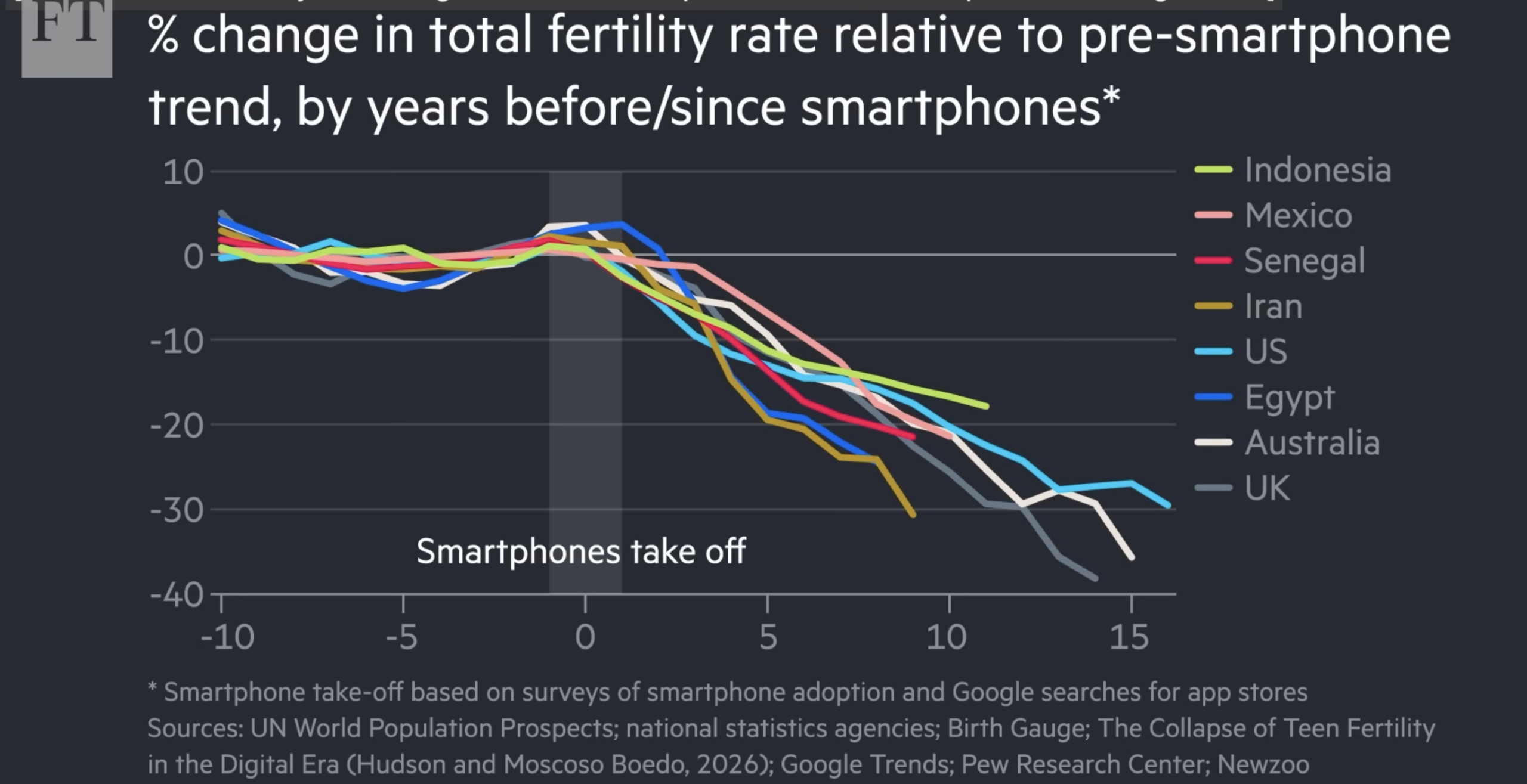
Smartphones broke out at different times in different countries. Affluent countries like the U.S., Australia, and the U.K. were early adopters, while countries like Senegal, Iran, and Egypt were several years later. When aligned to the year of smartphone break-out, the downward deflection in fertility overlaps astoundingly well.
Admittedly, I have not looked into this personally. How cherry-picked are the countries on the graph? Pedantic reflexes in some people reliably trigger the “correlation is not causation” mantra, which often reminds me of the Vogon guard’s comfort words “resistance is useless” in The Hitchhiker’s Guide to the Galaxy. While caution is warranted, links between the two phenomena are not particularly difficult to spot—as offered in the video.
We all know that smartphone screens grab attention—maybe especially among the young. While it could be argued that dating apps facilitate connection, it is also apparent that smartphones seriously eat into time for personal contact. Moreover, digital profiles are fashioned to provide grossly distorted apparitions of lifestyles, making “real” people (IRL) seem disappointingly dull and pathetic. I could also believe that while dating apps make it possible to swipe through hundreds of potential matches in an evening, the vetting is necessarily both superficial and prone to perfectionism. Anyway, the net effect (3:50 in video) is a decline in the fraction of people finding partners. Fantasize all you want about connective efficacy, but that’s what’s actually happening the world-over. Moreover, the correlation is extremely high to declining fertility. And before you ask, I hope you’re able to identify an obvious causative link!
As for cherry-picking countries, I doubt the trend is a simple result of this freedom because the “downwash” is pretty universal (see plot below), as is the explosion of smartphones around the same time.

Smartphone adoption cuts across cultures, policies, histories, etc. in a way that very few “explanations” for such a global trend can manage. Normally, demographic trends have more to do with slow cultural changes that can be delayed by many decades from one region of the world to another. When Australia and Senegal are on a similar schedule, eyebrows should go up.
Story of the Century
Besides the story-of-the-millennium headline I propose should plaster every newspaper in huge font every day—SIXTH MASS EXTINCTION STILL UNDERWAY!—I believe the fertility drop (and the population decline to follow) is the story of the 21st century. We all know by now that modernity fails, right? But how? Will it be resource limits, climate change, biodiversity collapse, nuclear war, or what?
For most of the last two decades, I believed resource limits would drive the show: peak oil, peak transportation, peak materials, etc. All of this is completely valid on a long-enough timescale (still short in ecological terms). But never underestimate modernity’s canny ability to source what it needs by hook or by crook—kicking the can down the road no matter the damage. Sure, it can’t do so indefinitely, but don’t count out squeaking through this century—tolerating even the fallout of climate change.
Ecological collapse certainly has the prerogative (and mandate?) to upend modernity’s grand plans, in ways that I am—and basically every human is—too ignorant to spell out. I mean, if continuing on the current trajectory, the developing sixth mass extinction is going to terminate modernity at some point—yet the how and when is beyond our ken.
But here comes the fertility crunch. It’s basically baked in now, and operates on few-decade timescales. Human population will crest this century, and most likely in the next 10—15 years in the “affluent” (market-driving) two-thirds of the world. Growth-based economies (i.e., all of them) will convulse in a death-rattle. Schools will shutter for paucity of kids. Pensions, social security, and medical coverage for the elderly—based on growth models—will evaporate. Supply chains will falter. Institutions will scale down and flicker out in ragged disharmony. Investment in a “bigger” future will dry up. Currencies may go apoplectic so that precious metal coins see a (temporary) heyday before they also lose value when markets fail more generally (little left to buy; and the spell will be broken by which we all agree that metal coins represent value). To the extent that bleak economic prospects or existential concern currently suppress fertility, you ain’t seen nothing yet. The fertility decline seems most likely to exacerbate itself before it turns around.
On the other hand, to the extent that smartphones and screens in general are factors in low fertility, these will fade as personal interactions rise and people are appreciated for their real (as opposed to digitally-skewed) qualities. Fertility will eventually rebound. But it will do so in the context of increased death rates and infant mortality as well, when advanced medical access is another inevitable victim of simplification.
In any case, I seriously doubt the music will start back where it left off. The world will be transformed and singing an entirely different tune. Local replaces global. Permanent damage to institutions and infrastructure renders them defunct and obsolete.
Obviously, the picture I paint above is highly speculative, as what’s coming is entirely unprecedented. Still, I would call it fairly plausible. I do believe that a contraction of population that has no end in sight (for few-decade timeframes) has tremendous power to transform the modern world into something barely recognizable—and quickly given the volatile non-linearities involved. The phenomenon can be far more impactful than resource limits, and faster than ecological disintegration. The lie will be exposed: growth is temporary; economies are fragile; institutions are more hollow than they seem; political arrangements evaporate once faith is shaken; money is a fictional game requiring agreement on the “rules.” We will never be the same. And it’s basically “already” happened via the generational deficit planted over the last 10–15 years (and still going strong)—but most people don’t know it yet.
Views: 2660
As a footnote, this situation reminds me a little bit of how the left hemisphere makes up stories to account for actions. Functional MRI shows that decisions are made long before conscious awareness of that decision, but narratives constructed after the fact frame it as if it was all orchestrated by "the helmsman."
In the case of fertility decline, interviews with people frame the outcome as a choice based on economic or other factors, but not a one will say it's because a smartphone has commandeered their attention. We may not be aware of the root cause, but need to construct *some* narrative to account for our behavior—even if wrong or incomplete.
Tom —
The synchrony argument is the strongest thing here, and I want to grant it fully before pushing on it. Education, secularization, and women's rights diffuse over generations; they cannot produce a deflection that hits Australia and Senegal on comparable schedules. Whatever bent the curves propagated globally inside a decade, and very few candidates satisfy that constraint. Smartphones do. Common exposure, staggered arrival, common response — that is legitimate epidemiological inference, and it deserves a better rebuttal than reflexive recitation of the correlation mantra.
But the inference is only as good as the event study underneath it, and that is where I would concentrate skepticism. You flag country selection yourself. The bigger researcher-degree-of-freedom is the alignment date. "Smartphone breakout" has no canonical definition — 20% penetration? 50%? First subsidized handset? If the analyst enjoyed any latitude in choosing each country's breakout year, overlapping curves can be manufactured, and the exhibit becomes a garden of forking paths. The stakes are high because a rival globally synchronized shock sits directly on top of the affluent-world adoption window: 2008. In the OECD, smartphone breakout and the financial crisis are nearly collinear — US fertility inflects in 2008 on the nose. The staggered arrival in late adopters (Senegal, Egypt, Iran) is precisely the design feature that could discriminate phone from crisis. Which means the integrity of those alignment dates carries the entire argument. Before anyone builds the story of the century on that FT graphic, it needs an audit: what threshold, defined by whom, fixed before or after the fertility curves were consulted?
Second, "smartphone" bundles at least four distinct mechanisms: (a) attention capture and mate-search decay — your reading; (b) norm transmission, global media resetting family-size defaults (the Kearney–Levine "16 and Pregnant" result, contested at the margins but sound in design, showed content alone can move birth rates); (c) dating-app restructuring of the partnership market; and (d) contraception knowledge and access delivered by the device. The Philippine collapse raised upthread is instructive but confounded: the window in which penetration doubled is the same window in which the RH Law finally broke the Church's long blockade on family planning. Phone-as-contraception-delivery-vehicle is a different animal from phone-as-attention-parasite — different moral valence and, critically, different reversibility. That matters because your rebound scenario, where screens fade with simplification and courtship resumes, is conditional on mechanism (a). If the operative channels are (b) or (d), the genie does not return to the bottle when the screens go dark.
Third, worth stating explicitly: the hypothesis survives only as a claim about the deflection, not the level. Israel is saturated in smartphones and holds fertility near three; Korea shares the exposure and sits at 0.7. Culture sets the level; the phone at most bends the trajectory. Critics will reach for Israel, so better to pre-empt them.
Fourth, the confabulation footnote. You are right that self-report is weak causal evidence — nobody will testify that the phone commandeered their courtship years. But as deployed, the move is unfalsifiable: every interviewee citing housing or economics gets reclassified as a left hemisphere narrating over the invisible cause. The same acid dissolves your own position — a tidily aligned graphic hijacks pattern recognition at least as efficiently as a folk narrative does. Independent arbitration is needed: time-use data against partnership-formation rates, individual-level dose-response, and especially lag structure. If the deflection is near-immediate upon breakout, that is evidence against slow mate-search decay and toward the faster channels — within-couple displacement, contraception access. The lag discriminates among your own candidate mechanisms.
Two smaller items. Period TFR overstates decline during postponement transitions; some of the downwash is birth timing rather than completed family size. Korea survives any tempo adjustment, but the OECD-wide slope softens somewhat. And on collapse choreography: Japan is three decades into the demographic turn and has delivered orderly stagnation — schools consolidate, pensions trim, the yen has not gone apoplectic. I will grant the rejoinder that Japan aged inside a growing world system that supplied external demand, a cushion unavailable when everyone is Japan at once. Untested, then, rather than falsified — but asserted with more confidence than untested warrants.
Tests that would move me: within-country staggered 3G/4G rollouts against local fertility (a German broadband-rollout study found fertility gains among educated women, so the literature is not one-directional); Haredi and Amish differentials under partial exposure; and China, which fell to near-Korean depths inside a walled domestic app ecosystem with no Western social media — consistent with the device, or with screen content generally, and fatal to "it's specifically Instagram."
The planning conclusion survives all of this, for what it is worth: population peaking decades ahead of the UN schedule follows from the fertility data regardless of cause. The mechanism determines only whether it reverses. Which is, of course, the only question that matters.
I checked the internet and can confirm that the elites – who, for years, have been aware of the impending metacrises – have embedded subliminal messaging into our smartphones to ward us off procreating. Obviously, the really smart ones, like me, weren't susceptible. Just the sheeple.
It'd be interesting to see if there was a difference between smart phone use, and social media use. I'm not on social media, have had children in the time of smart phones (although I met my wife pre smart phone, in the dial up days). I wonder if it's specific to the software applications being used, or if it's just the attention grabbing of all smart phone use. I limit my use, because I'd never be off the dothemath blog otherwise.
Can I recommend the excellent book by Jonathan Haidt: The Anxious Generation. Loads of data in there, and they make a strong case that it is the *combination* of social media and smart phones that triggered all the graphs to bend. The theory seems to be that there's a limit to the damage that can be done if you have to access your socials via a desktop PC, but once it is on your phone it is ever-present and constantly drawing on your attention.
This book had a direct influence on the debates around banning social media for under 16s in Australia, the UK, and other countries.
Yes, it's a good book. I guess it was the other way round I was considering. Does a smart phone without social media still correlate with the downward trend in fertility? I suspect that the data wouldn't exist, and I don't remember as far back as 2007 as to whether we had a period of smartphones without the social media apps. From memory, we did. I certainly did! In other words, is the issue with the smart phone the fact that it takes your attention, explicitly, regardless of application? I think it probably does. Ending social media, then, would still leave us with a distraction device, and perhaps it's that that causes the fertility issues. In theory!
"we can’t manufacture twenty-something-year-old humans who were never born so that they may pick up the reproductive torch"
True, we can't manufacture twenty-somethings, but we can "import" them. There are millions of twenty-somethings that would be willing to integrate with advanced countries. There really is not a shortage of twenty-somethings.
Overall, the population is still growing.
Elsewhere you speak of a future with far less energy. If we are forced back to a world with far less energy and fertilizer, wouldn't this reduced population be helpful? Wouldn't it make it easier to find food for everybody? Is a controlled degrowth not the best thing to do at this point?
Absolutely a declining population is a blessing that could dovetail nicely with retreat from high-impact living. The fact that it might actually *lead* the retreat (via faltering markets) was not on my bingo card, but could well be the way things develop.
My message should not be interpreted as suggesting that unplanned deaths due to any cause are acceptable. If such deaths are happening, then, yes, that is tragic.
We should do everything we can to assure the safety of those that are alive.
The tragedy of early deaths is that people lose their lives and families lose their loved one. That is a concern.
But a future shortage of twenty-somethings is not the issue.
Something else happened around the same time the smartphone came out (2007): Conventional oil extraction hit a plateau (2005). This could also be a factor, since industrial food production is heavily dependent on oil and food supply determines population growth.
I notice that people have been doing studies about phones and the fertility crash lately, without attempting to consider other technologies that have been spreading at the same time: for example cars, which have been rapidly increasing in poorer countries and rapidly increasing in size and cost in wealthier countries. My own pet theory is that policies around cars are the key driver — or at least one of the key drivers — behind the fertility fall. I suspect the impact of cars on our remains far greater than smartphones, and might also provide some explanation for the fertility falls that preceded the internet. I wrote an article about it here — https://josephshupac.substack.com/p/the-great-repavement-theory— it’s a long political rant of an article, but you can skip ahead to just before the end to read the brief sketch of this (admittedly half-baked) theory. Would be interested to hear what you make of it.
Tom,
Love your material – I appreciate your honesty in this age of everyone trying to sell you something!
A few big picture questions for you :
1) Is there anything you hope for, for the planet as a whole – as to what it looks like far into the future ? Say, 1,000 years from now? 1,000,000 years from now? 100,000,000 years from now? That life still exists on the planet and some kind of "ecological balance" has been restored? I realize it's a strange question … so maybe worthy of a strange response from you. But appreciate your perspective on these things.
2) I love your notion that we must separate the human species from modernity, that they are really two different things. That being said … is there anything you find unique or inspiring about the human species? I personally realize there could (and have been and probably will be) … encyclopedias written about humanity's collective ignorance and cruelty (see: racism, Holocaust, wars, genocide, selfishness, pettiness, etc etc etc … probably can throw modernity itself in this list too haha)… but is there anything you find inspiring or unique about homo sapiens?
3) Is there anything you find inspiring or of value about modernity itself? Obviously – as you've explained – it's something that will fail eventually and has caused so much damage to the collective planet of life on Earth – but that being said (and not sure how you can compare any "good" to all of this "bad")… but … do you find any beauty or value in anything that has resulted from modernity? I personally (my own opinion)… find beauty and value in the knowledge we have gained … whether for better or worse. As far as I know … no other species on Earth has the capability of understanding about atoms, physics, our place in the Universe, the existence of other planets, the reality of all species' collective fate on this speck of blue dust we call Earth in a huge Universe … So I find a lot of beauty and value in the knowledge modernity has produced … even with all of the suffering it took to acquire that knowledge… and the fact that all of this knowledge will eventually go away. Just curious your perspective on this.
Thank you!
– Robert L.
These questions might be best handled in a full-length blog post rather than doing a half-baked job trying to be brief enough for comments. Maybe I can slip something in soon.
Understood! I appreciate your perspective!
This week's post: Big Picture Questions addresses your questions, explicitly.
Tom – your full blog post response was GREAT ! Thank you!,
Robert
I watch the videos posted by Robert Sapolsky, under the title "Father Offspring Interviews." A recent edition discussed handedness, and why shaking right hands in greeting is almost universal (I hate 'universal', but 'worldwide' somehow doesn't have the same effect.) Sapolsky noted that studies have shown that after handshaking, there is an almost also universal tendency for folks to pass their right hands across their faces. Sapolsky suggests this practice might be related to pheromones.
So, if people are 'connecting' through technology instead of physical contact, there will be a universal decrease in pheromone exchange. And pheromones are almost universally related to sexual attraction. And sexual attraction is almost universally related to production of 20-something-year-olds, as well as to sexual interaction between 20-something-year-olds.
As a side note, while I agree that the how and why of the end of modernity is beyond our ken, I suppose it is quite likely to intimately involve our kin.
Maybe iPhone 24 will emit pheromones?
Thanks for catching my typo (corrected)!
Tom
My own opinion :
The whole smartphone hypothesis is dumb.
I think a bigger reason why fertility rates have declined in so called "developed" countries is more contributed to : women getting treated as equals as men.
The US fertility rate has been below 2.1 since 1973… 20 to 30 years before smartphones became widespread …
What did change in the 1960s was that women got more and more equal rights as men.
Where women are treated like cattle (probably some countries still unfortunately)… those countries have higher birth rates.
When women are given the choice on having their own lives … or popping out kids … surprise surprise … they choose to have their own careers/lives … and no kids or smaller families.
My two cents sir.
Respectfully,
– Bridget
Everything counts: lots of forces involved here, and what you point to is certainly real. Equality/education would appear to be the main factors in the many-decades slow trend seen worldwide that pulled fertility from 5 to 2 or below in affluent countries.
That said, the U.S. and many OECD countries were rocking along stably below replacement for decades and then suddenly even these countries took a sharp nosedive (see plot in post). Meanwhile, education among females did not suddenly "fix" itself in places like Senegal, Egypt, etc. Those are slow phenomena. Something happened to generate a sharp downturn in vastly different places, all around the same time. That one's hard to pass off as rights and education.
Hmm. Maybe it's hard to deprive women of smartphones, and they use them to mail order contraceptives.
Easy to get figures for contraceptive production. Harder to find out where they're delivered to, at a guess.
As of 2026-07-01 12:56, there is no mention of "India" anywhere in the article or comments.
India is now below replacement. Inertia has it still growing (reproductive-age people were born when fertility was still above replacement), but as I say the train has left the station. India will peak in a couple decades—i.e., before mid-century. You can see a plot of its fertility track in the post called Whiff After Whiff: https://dothemath.ucsd.edu/2024/06/whiff-after-whiff/
Notice how fertility rates started dropping (c1960) after the above-ground-nuclear test ban treaties around that time.
Thus could all the radiation from all the 1940s-1950s nuclear tests have had an affect as well?
A quick google showed "peak occurring in 1961–1962, when 340 megatons were detonated in the atmosphere by the United States and Soviet Union."
https://youtu.be/32u5T6lO8qk?is=NPs2iypTQ20Ax4ET
I just watched this and it's incredible. Jeremy Grantham, billionaire investor, says so many similar things to Tom.. I wonder if he's a blog follower..
Fertility talk is at about 1h7m
He claims research is pointiyto environmental toxins reducing sperms count and that by 2045 the average could reach near ZERO
(sharing) Notes from a burning Paris
June 27
wondering what collapse looks like?
https://sarahwilson.substack.com/p/notes-from-a-burning-paris
visceral confronting and coping tips
The cell phone hypothesis may just be just the surface. Perhaps the deeper story is how mobile devices, well before the era of LLM's, are the enabling engine of "cognitive offloading" that so quickly vaporizes critical thinking skills and extinguishes the constant contact required to perceive, process, and react to our real world in successful ways. Skills are developed and honed and maintained through struggle. A concert pianist will quickly lose the ability to flawlessly progress through a Rachmaninov suite in a surprisingly short period of time, and gaining it back happens far more slowly and with great effort.
It is certainly predictive of other aspects of modernity, where peoples' attentions and priorities are so diffused away from reality. They are summoned instead to contrived alternate worlds and engaged with vestigial reactive fear, insecurities, loss of social status or sexual relevance from our intrinsically animal natures and adrift without connection any longer to the real.
There are many examples of how these human epochs develop and end. The lack of struggle promotes degeneracy that begets struggle once again. The most distracted elites disappear, the least distracted and most engaged with direct knowledge and practice of caloric generation in the cultures disperse and continue. The known genetic bottlenecks in the human story in different parts of the world marked by mitochondrial DNA also mark the rapid collapse of successive elites in comprehensive DNA studies….on the Pueblo, Inca, Maya, and Borjigin eras, as well as some.of the several historic Nile cultures. It's not destiny- many examples exist where elites have been displaced instead of exterminated or otherwise disappeared. But it's a theme. And all of them do end quickly once the degenerate hallucinatory stage begins, measured in single digit generations.
It's unlikely that the focus and engagement required to meaningfully deal with fragmentation in supply chains in general and energy development in particular will exist in a way that can sustain a world with 8 billion. It is doubtful that the demographic changes favoring a less monstrous overhang in human biomass can outrace the relatively rapid realities that cognitive offloading enables. The difference is the answer to the equation for a scale of misery and change that have not been witnessed in hundreds of years, including the wars of the 20th century. And LLM's are poised to be the deflagration accelerant to that process.
Mobile devices are just the delivery device for the drugs.
FYI
The Philippines looks interesting.
Source: Google AI (slop?)
The estimated smartphone penetration rate as a percentage of the total Philippine population:
Year Estimated Smartphone Penetration Rate
2010 ~1.0% – 2.0%
2013 ~15.0%
2016 ~30.0%
2020 37.7%
2022 64.9%
2024 72.1%
2025 75.6%
The total fertility rate (TFR) in the Philippines
Historical Data Overview (2003–2025)
Year Total Fertility Rate (Births per Woman)
2003 3.50
2008 3.30
2013 3.00
2017 2.70
2020 2.07
2022 1.93
2025 1.70
Just an FYI
The central hypothesis passes the straight-face test, though I acknowledge such a simple explanation of a multivariate problem is only ever a kludge. I also appreciate Lee’s comment about cognitive offloading. Hollowing out human psyches for better infiltration and colonization, whether planned in some wooly conspiracy or stumbled into accidentally, has created a relatively novel effect: near-zombies who can’t function without constant connectivity, reassurance, and inputs telling them what to think. Anecdotes from grade school teachers of iPad kids describe the awful effects: humans who can’t function meaningfully at all.
The graph is incomplete (doesn’t extend very far back) but shows a giant decline in birthrate (fertility is an imprecise proxy) that stabilized in the late 80s but then hit another downward point of inflection with smartphone adoption. Influences on birthrate no doubt vary according to the era under consideration and each new technology introduced (e.g., birth control).
The smartphone may well be the mechanism driving the effect, but rather that point solely to the tech, it’s worth remembering that humans are hyper-adaptive. As environmental and social conditions change, behavioral change ensues. Once handheld electronic began to offer cheap, easy, ubiquitous access to digital media, the masses immediately dove headlong into that virtual environment, no brakes. Behavioral change enabled by novel tech might be a chicken-and-egg question, but framing the issue in terms of humanity instead of technology or economics points analysis in different directions.
I can already sense the apathy of people on the street in a way like never before, especially after this heatwave in Europe. The frog is in a pressure cooker and the lid has been sealed.
The lack of one single well-defined driver of population decline is the smoking gun of Thermodynamic Limits. Humans have exhausted the exploitable parts of their ecological niche of fossil fuels. Everything else is just reaction rates and chemistry.
Sorry, but no smartphone did not make a difference. You are finding spurious correlations, or at best correlations with tertiary mediating variables. The truth is fertility rates have been in steady decline across the world since at least the 1950s.
https://ourworldindata.org/grapher/children-per-woman-un?tab=line&time=1950..latest&country=OWID_WRL~OWID_AFR~OWID_OCE~OWID_ASI~OWID_NAM~OWID_SAM~OWID_EUR
This comment mirrors that of Bridget (see also my response). It isn't news to me that fertility has been in decline for much longer than the recent downturn. Look at the TFR graph I had in a post from two years ago:
https://dothemath.ucsd.edu/2024/05/watching-population-bomb/
Yes: most of the "work" was from 1960 to 2000. But look more closely: most regions were stabilizing/leveling or *slowly* declining *above* replacement from 2000 to 2015. At that stage, the world was NOT on a glide path to depopulation, but more like an approach to steady state late-century. But hey—what's this? See the nosedive starting around 2010–2015 in all regions at once (before a fictionalized UN model "corrects" the real trend)? That's what has tipped the game from sort-of leveling to tanking, and that little feature (diving below replacement) turns out to be a big deal. Same with the OECD plot in this post. Look at the steady curves around the turn of the century, turning sharply downward in recent years. It's global, and that amazing—nearly simultaneous—development needs something better than "fertility has been going down since the 1950s." The devil is in the details, in this case.
Nope, washes out in the continental and global averages. Given historical trends, a couple decade "pause" in fertility loss, 1990s through 2010s, is indistinguishable from noise.
The Guardian just published an article about plummeting male fertility/sperm rates, noting some possible environmental factors….and although phones have been discussed, will society be ready, willing, and able to look at the effects of radio frequency radiation?
Especially given how the exposure limits were set, how absurd the thermal threshold assumption is, and how many other adverse health effects are being reported by the independent scientists like those at the International Commission on the Biological Effects of EMF, in addition to the effects on the nature environment?
Wait, does this mean I should stop lamenting the fact that smartphones have turned everyone into transfixed, drooling zombies, and start cheering it on? "8 hours a day of screen time?? Meh. Let's see if you can make it 12." I jest…sort of. I've long wondered if the abundance of internet porn mayhaps be affecting relationships and sex lives, and in turn birth rates, but looking at these graphs, it would make more sense to broaden the scope from the particular content to the devices themselves. Which can impact in strange ways – I went to a workshop last week about lower back pain that, totally unexpectedly, ended up talking about fertility and screen use – that the crummy posture we often adopt while absorbed in smartphones for long periods of time impacts pelvic blood flow and cramps the reproductive and digestive organs.
In any case, as much as being online has been sold to us as a tool for connection, it seems there are just as many incidences, if not more, of it being about competition and digital addiction, and maybe the truth's starting to show in these rates (except for those nutty evangelical tradwives trying to out-pregnant one another!). For every lucky person finding their perfect someone on a dating site and then starting a family with them, there's those hundreds for whom it becomes like a very long, drawn-out, tedious job search, where you also get insulted by perfect strangers, inevitably endure painfully bad dates, and often still end up alone because now how else do you meet a partner (though usually happier about it once you've seen what's out there!)
I'm reminded of another graph I saw recently that looks sort of similar, potentially related – on the prevalence of OCEAN personality traits over the last few decades and how the N – neuroticism – has dramatically increased in the past 20 years (basically, since smartphones and social media). Even when people are offline, it's hard not to feel the toll taken on social interactions – there's a tendency to communicate in announcements or monologues, rather than back-and-forth conversation, like talking is a post; and that's if the person actually IS paying full attention, which they typically aren't. None of it in conducive to relationship-building of any kind, so that could be another way in which smartphones indirectly impact birth rates.