Resilience.org is running a series of posts capturing a conversation between myself and energy transition advocate Dave Murphy—moderated by Ben McCall. The entire conversation (from back in 2023–2024) involved eight exchanges. I echo the conversation on Do the Math, with additional commentary. The first six rounds were presented in Parts 1, 2, 3, and 4 while this installment covers the final two rounds (also appeared on Resilience on May 26).
The relevant portion of the original content is replicated below, followed by additional comments from me that are not addressed in the exchange itself. Within the text, links within [square brackets] point to content further down the page. At the end of each addition, another link returns to the paragraph of origin (or use browser “back” navigation). If preferring not to interrupt the flow, those additional comments are always waiting at the bottom to scoop up any time.
Seventh Exchange: The Impossible Dream
Ben: Dave, I’m guessing that your sense of ethics gives a higher weight to sustaining the current “temporary fireworks show” for the benefit of today’s currently living humans…but Tom’s analysis would suggest that implies giving a lower weight to the needs and desires of future humans, as well as the rest of the community of life? What do you think Tom is missing here?
Dave: NOW WE ARE GETTING SOMEWHERE…:)
“I would say: we owe it to ourselves to be honest about planetary limits. To the extent that we can look to the long future and delineate the sustainable from the unsustainable, we ought to do our best.”
We ought to do our best indeed, in fact we are ethically obligated to do our best for all life on this planet. It is clear that we may differ a bit on the spectrum of biocentrism to anthropocentrism, but the key is that we agree that we need to be honest about what is and is not sustainable, and then do our best to pursue the sustainable option.
So—how should we pursue that? Given your previous answers on sustainability measured on the scales of thousands of years, we have the time, we just need the right mindset to get it done. For me, I think we need to pursue the energy transition as quickly as possible (to reduce GHG emissions), promote policies to lift people out of poverty (which, among many other important health and social benefits, reduces population growth rates), create economic systems that do not require increases in physical output year after year to maintain economic well-being levels, pursue agro ecological food production systems (which have been shown to be able to feed the entire planet without the use of fossil fuels for fertilizers), and all the other amazing ways in which we can provide high quality of life at very low impact. Is there really any other choice? [Is this the best we can do?]
Ben: Tom, how should we pursue the sustainable option? Is there another choice besides the route Dave has proposed?
Tom: First, I want to point out that my quote was “rethink or abandon” human cultural constructs. The rethink part comes first, and certainly allows selecting and amplifying positive cultural qualities accumulated by various cultures over the past. Culture is a non-genetic set of principles that we use to shape how to live. Humans will never be without culture, but some are more sustainable (valuable) than others.
Second, evaluating sustainability on evolutionary timescales does not mean we have the luxury of similarly long timescales to change our ways. Ample evidence shows that we can cause enormous ecological damage on much faster timescales (decades)—thus our predicament. We would be wise to reverse course comparably fast. A fundamental asymmetry operates here: sustainability needs to be assessed over very long timescales, while unsustainability—modernity’s bailiwick—can be arbitrarily fast. Full-scale nuclear war illustrates this principle in the extreme: many millions of years of evolution wiped out in moments.
The path Dave illustrates has nice features, but does not attempt to address ecological sustainability on relevant timescales. Even with zero GHG emissions, raising the poor to average global standards, stabilizing and feeding a population of 8 billion without fossil fuels, and maintaining current physical output (ending growth), how could Earth pay its annual salary (of non-renewable demands and waste streams) for very long out of the finite environmental inheritance?
Those lifted out of poverty would finally be able to afford more material goods (possibly a car, house), eat more and better food, enjoy climate control, etc. I am not saying that I would not wish such things, but they all act to increase the scale of the human enterprise. The only “bank” available to fund this “pay raise” is our overtaxed Earth, in the form of more non-renewable materials (mining), more manufacturing (pollution), more land use (deforestation, soil erosion, runoff, aquifer depletion), and more energy (materials and manufacturing again). Now we try to lock in this higher demand for the long haul (steady “burn” rate)? We appear to be well into overshoot, so neither an increase nor holding steady seems possible. Even redistribution that equalizes all to the current global average does not reduce the absolute scale. The ecological nosedive is so rapid that maintaining a scale even resembling that of modernity will most likely finish the job, whatever the technology.
My point is that we need to be extremely careful to assess what can work for the long term, rather than aim for a pleasant near-term extrapolation of the familiar that only continues to degrade ecological health and is not based on a realistic evaluation of long-term sustainability in its full context.
Do we have another choice? Of course! We could become disenchanted with modernity as an unfortunate dead-end and explore other ways to live and relate to the world. It can’t happen overnight, but we are under no obligation to follow a “modernity lite” path to failure. Attempting to do so could make life worse for more people and animals, in the end.
Eighth Exchange: Pre-analytic Biases
Ben: Dave, it seems that Tom is suggesting that your proposal (clean energy transition, lifting people out of poverty, and the like) is not sustainable, and indeed would position us for increasing ecological devastation in the coming decades. He seems to instead be suggesting that the only way to achieve sustainability is through a radical rethinking of our relationship to the natural world, presumably with correspondingly radical changes to our energetic and material throughputs. I know you’re a proponent of the precautionary principle…so why shouldn’t your proposal be viewed as too risky, given the stakes involved?
Dave: Thanks for clarifying your points on culture! I agree that there is a lot to be gained from the accumulated history of humanity!
I also agree and it is a very good point that unsustainability can occur on very fast time lines while the assessment of sustainability should be over longer time scales. That said, couldn’t an “act of unsustainability” in one time period be compensated for by “acts of sustainability” later on as long as permanent change hasn’t occurred? [Progress, but bargaining]
To the larger issue—We have spent pages trying to get to the bottom of our differences, clarifying what is meant by modernity, sustainability, timescales, etc, and it is becoming clearer to me through these exchanges that Tom has made an a priori assumption about the future, which he stated in his last post: “The ecological nosedive is so rapid that maintaining a scale even resembling that of modernity will most likely finish the job, whatever the technology.” Of course, since the future hasn’t happened yet, we cannot prove or disprove this assumption, relegating it to a form of metaphysics, or a belief system, or, as Schumpeter called it, a “preanalytic vision.”
The preanalytic vision, developed by Schumpeter, is defined in Daly and Farley: “analytic effort is of necessity preceded by a preanalytic cognitive act that supplies the raw material for the analytical effort.” Importantly, Daly and Farley describe that
One might say that vision [i.e. pre-analytic vision] is the pattern or shape of the reality in question that the right hemisphere of the brain abstracts from experience, and then sends to the left hemisphere for analysis. Whatever is omitted from the preanalytic vision cannot be recaptured by subsequent analysis. Correcting the vision requires a new preanalytic cognitive act, not further analysis of the old vision.
It seems to me that Tom’s analytic effort—which is on display in the pages herein—was preceded by his vision that “maintaining a scale even resembling that of modernity will most likely finish the job.” [Has Dave seen this plot?] My vision—one in which we make incremental (hopefully large) gains over the next few decades, becoming more sustainable [huh?] through time and level-out population growth through the demographic transition—is an impossibility to Tom not because it is wrong or incorrect, rather it is impossible simply because it is omitted from Tom’s preanalytic vision. Thus further discussion will, I fear, remain futile. [Are we done, here?]
In many ways, what Tom is calling for is a paradigm shift towards collapsism, in a way that ecological economics calls for a paradigm shift away from neoclassical theory. For ecological economists, the idea that society could have a steady-state economy (i.e. more or less what I am calling for), was (and is) inconceivable for neoclassical economists because the idea of a steady-state economy was omitted from the growth-based models on which neoclassical economics was built. In other words, steady-state economics is impossible in a neoclassical vision of the economy, just the same way that steady-state economics is impossible in a collapist vision of the future. [A swing and a miss]
I would also like to say that collapse is still possible in the spectrum of futures in my vision, it is just one I hope doesn’t happen. So in this way, Tom’s vision is more restrictive than mine. I do not require a paradigm shift to see that collapse could happen, but I also do not need a paradigm shift to see sustainability happen either.
But I would like to bring this conversation back to ethics at this point, because that is where I get stuck. What happens to people in Tom’s radical reboot of human culture on Earth? The implication (though never stated explicitly) is that sustainability is only possible in Tom’s vision if there are way fewer people. Is that correct? If so, how do we get there? Do we just accept that many millions (if not billions) of people must cease to exist to be sustainable? How do we approach that subject? [Just how monstrous am I?]
I said in the beginning that I am optimistic because I have children. My kids are my joy in life, and it seems not only against our basic biology but also ethically dubious to try to tell people how many children they can or cannot have; in other words, policy solutions limiting children is not an option. So how do we do it? War, famine? My guess is that Tom’s response will be that it is out of his hands, but suggesting that only one future is possible, and that that future must also have many millions (billions?) fewer people in it, requires at least addressing the pathway to achieving that. And that is where the ethics come into play. Who are we to assess which people around the world, which generations (today or future) are more or less important? Everyone is of equal importance and deserves life [Is this really true?]. So, I think we really don’t have any choice, we are required to, as Tom put it, “do our best.” Yes we have grown to a size that is problematic right now, but that doesn’t mean it has to be in the future. How are you going to “do your best?” How will any of us do our best? For my part, I will raise my kids to be environmentalists, feminists, and change-makers, instilling in them (as best I can) virtues and ethics. I will also produce as much good science as I can and never submit to nihilism and defeatism [the nihilism straw-man], no matter how bad the global environmental, political, social, or economic situation may get.
To be clear, I don’t disagree that population is a driving factor in environmental degradation. It clearly is. For me, the demographic transition is the only way to reduce growth equitably (and probably ethically), and it has shown itself time and time again to work. It doesn’t require endless economic growth, rather (among other things) gender equity and poverty reduction are required, both laudable goals by themselves.
Ben: Tom, is the difference between your vision of the future and Dave’s indeed a metaphysical one? Or can you make an argument that Dave’s vision is indeed “wrong or incorrect”? [Also feel free to comment on the ethics question.]
Tom: Dave raises a good point about pre-analytic vision. And it remains true that we cannot know the future. I have arrived where I am via a combination of data, extrapolation, fundamental drivers, and the precautionary principle.
I do not believe that I exclude steady-state-modernity notions because my biases have precluded my considering that state: I was once a big fan! My objection is about continued reliance on non-renewable materials (via quantitative assessment of recycling longevity) and continued ecological harm—whose prevention/reversal is effectively omitted from “transition” pre-analytics. Extinctions and non-renewable depletion are permanent costs that I would rather not continue racking up, steadily.
I would not call our difference metaphysical so much as contextual. No matter what each of us considers in our metaphysical framework, Earth is suffering irreversible losses at a rate not seen since the Chicxulub impact 65 million years ago—a condition that is not subject to our preferred cosmologies. But speaking to metaphysical differences, my foundation is that we belong to the world, rather than it to us. Maybe that core tenet makes my positions seem alien, influencing my values and what I consider to be important. [Not really metaphysics]
While I am a big fan of acknowledging the tennis match between right and left hemispheres, the exercise can be a long volley that spans decades and allows numerous corrections. This allows the pre-analytic vision to adapt and re-form based on analysis: rinse and repeat. If I look at my writings from a decade ago, my metaphysical (pre-analytic) realm was missing many pieces that I now possess, informed by analytic exercises and wrestling with their ramifications.
Among these, and germane to the present discussion, I recognize that just because the demographic transition repeatedly “worked” for the Western world in the past (ask critters how well it worked) does not mean it will work similarly for today’s poorer countries. The context has changed, dramatically. 70 years ago the world had a third as many people, a fossil fuel glut ahead of it, and a bounty of low-hanging fruit (materials) and unexploited ecosystems around the globe. A demographic transition: 1) takes many decades; 2) has always involved a significant population surge, as death rates fall well before birth rates; 3) results in greater affluence (per capita resource demand); so that 4) the aggregate resource burden on the planet soars from the combined effect. Earth had the (non-renewable) cash-on-hand 70 years ago, but can no longer afford a rinse and repeat. This is a case of analysis reshaping pre-analytic vision.
Similarly, my statement about the ecological nosedive is not a starting point for me, but a relatively new awareness resulting from data and analysis. In 2023 I produced a plot [shown farther down] of wild land mammal mass per human on the planet, over time. The result is startling. It changed me. It was not part of my pre-analytic metaphysics before performing the analysis, but will be going forward. As mentioned previously, only 2.5 kg of wild land mammal mass exists per person on the planet: it’s almost gone. In 1800 it was 80 kg, and already beginning to fall rapidly. This has happened not because of CO2, but via deforestation, resource extraction and its associated ills, habitat fragmentation, overhunting, extermination, pollution, invasives, human-disbursed disease, and displacement by the human enterprise (i.e., modernity). Climate change interacts with these things to make a dire situation even worse.
Given the accelerating steepness of wild population declines, I am left to ask: what action would possibly result in their stabilizing or turning back up? The phenomenon is so steep, it would take an enormous, concerted effort to arrest the fall, and that won’t happen by accident as an unintended byproduct of demographic or renewable energy transitions. In fact, those things would appear to dial up pressures on the ecosystem via resource extraction—not to mention all the things we elect to do with the energy (hint: ecological restoration is not high on the list).
The sixth mass extinction appears to be underway now, and it’s happening fast. I would feel much better about modernity’s transition ambitions if the ecological crisis was modernity’s primary concern, but it takes a back seat to satisfying short-term human demands in a state of overshoot. To be clear, I am not defeatist or nihilistic about this: I am agitating hard to do something different—get people to think differently—hoping that we can avoid the worst unforced errors. I’d rather we collectively not have to see it to believe it.
As for ethics, I will just say that the scope must extend beyond humans alone, and well beyond the present century. My own “who are we” question is: who are we to consign entire species to the dustbin—avoidably? If satisfying the short-term wish list of one culture (that of modernity) extinguishes several species per day, I don’t know how to ethically justify those priorities. More maddeningly, doing so runs a sharp risk of promoting our ultimate failure anyway, as we—especially modernity—will struggle in the ensuing ecological collapse. I see the situation as simply unfortunate. We find ourselves holding the wolf by the ear: we can neither let go nor hold on indefinitely without suffering harm. We don’t have the luxury of stipulating that present-day humans suffer no downside. In fact, it is not unreasonable to expect the downside to be in proportion to the magnitude of our current transgression of sustainability. Fairness will not always appear to operate in our favor.
Conclusion
Ben: To bring this conversation to a close, I’d like to note that this wide-ranging discussion has laid bare a number of important disconnects between the two Murphys’ very different perspectives. Dave seems convinced that a just energy transition must be pursued in order to address the fundamental underpinnings of our current metacrisis; Tom seems convinced that such a transition, even if possible, could not be sustained for ecologically relevant timescales and might even accelerate the damage. Tom believes that modernity cannot be salvaged in any meaningful sense, while Dave considers the assertion that we cannot fix our problems to be an abrogation of our collective responsibility. There is also a big difference in perspective about the timescales that we should be paying attention to: an optometrist might diagnose Dave with myopia (nearsightedness) and Tom with hyperopia (farsightedness), but it’s a significant challenge to bridge visions of decadal timescales with millennial ones (we need bifocals!). Another significant disconnect stems from values: should we place more emphasis on reducing suffering among humans alive today or in the near future (as Dave might propose), or on enabling humanity and other species to flourish for millennia to come (as Tom would suggest)? A final distinction I’ll note relates to agency: Dave is firmly convinced that humans control our destiny, while Tom emphasizes the limitations of the boundary conditions imposed by our finite planet and our ecosystem.
However, it’s also worth emphasizing that our two interlocutors have much in common, beyond their last names and their years of work on the Planetary Limits Academic Network. Both agree that modern human practices are not sustainable, and that continuing on our current path increases both the risk of collapse and its severity. For either Murphy, business-as-usual is simply not an option. Also, both clearly care deeply about the happiness and well-being of both humans and our more-than-human kin, albeit perhaps in different proportions.
Yet it was striking to me the extent to which our two Murphys hold such different worldviews, despite sharing a broadly similar understanding of the facts of our current predicament. At times it seemed like they were talking past each other, unable to understand how the other saw things they way they did. Dave maintains a surprising (if not also inspiring) optimism that humanity can craft a bright future through an energy transition; while Tom seems to clearly think for modernity, the party’s over. In this Tale of Two Murphys, it seems it was the best of times, it was the worst of times.
End of Final Installment
This fifth post covers the final pair of eight exchanges. The sections that follow offer additional commentary that was not part of the initial exchange. Turns out, I had more to say.
Our Best
Because I did not address in the previous round the impression that long-timescale consideration does not mean we have a comparably-long leash to come around, Dave repeats the hopeful position that the best plan we can execute is salvaging modernity with a shiny new energy infrastructure, as quickly as possible.
I do touch on poverty in the seventh round response, and the idea of stabilizing population in the final round. Dave leaves this one basically intoning that we have no choice but to pursue what I would characterize as a chimera! I disagree that options are limited to pursuit of business as usual by other means. (Return to conversation)
Timescale Resolution
I was glad to see agreement emerge on timescales: that destruction can happen very fast. Then comes a bit of bargaining: can we justify delicious ecological deficits now if we make up for it via future austerity?
Yes, and no: non-renewable means no take-backsies. But more importantly, extinctions are permanent and irreversible. The ecological effect of extinction is greatly amplified by the numerous interdependencies deeply woven into the web of life. It will already take millions of years for the present-day shaking of the Etch-a-Sketch (“introduced” invasives worldwide) to sort itself out ecologically. Most directly, unless ecological restoration somehow gets priority over direct/immediate human needs, no form of modernity will “make up” for itself in the future. Without an explicit commitment to prioritize ecology (at the “expense” of human population, energy, materials, comfort, footprint, etc.), it seems an empty bargain from a customer who has blown all credit. (Return to conversation)
Nosedive!
I don’t know if Dave ever saw this plot:
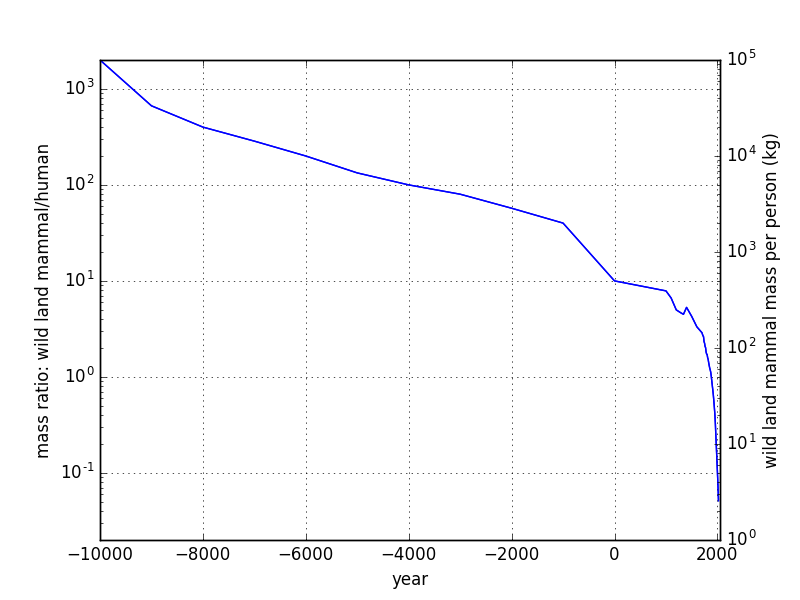
It’s hard to look at it and say “nothing a few solar panels can’t fix.” The predicament is far more serious—and older—than that. (Return to conversation)
More Sustainable?
I visualize the plot above whenever I hear the words “more sustainable,” which translates to a slightly gentler slope toward oblivion. Only a reversal of the sign of the slope is sustainable. Anything less is not “more” sustainable. A boat sinking in three hours is ultimately no more sustainable than one that takes two. Once on the bottom for decades and centuries, one boat is not “more sunk” than the other because the brief sinking episodes had slightly different durations. (Return to conversation)
Call to Close?
Dave may have sought to terminate the exchange on the basis that pre-analytic biases on my part (alone?) would prevent any meaningful convergence. I can’t say he’s wrong in identifying an impasse, even if not for reasons according to the model he suggests (see next point). The implication is that I am asserting (rather than listening to the material world assert) the inevitable failure of modernity, and thus no better than a brick wall as a conversational partner. (Return to conversation)
Pre-analytic Assumptions
There’s certainly value in pointing out self-imposed cognitive limitations, such as pre-analytic biases. Not represented in Dave’s analysis is that I journeyed through precisely the camp that I am charged with excluding by never having considered that framework.
But as early Do the Math writings attest, I once was enthusiastic that we could stave off collapse by getting ahead of the energy transition and establishing a steady-state economy. Dave and I were both tuned in to the same peak oil discussions, and I took seriously recommendations like those in the Hirsch Report that we needed to act fast on new infrastructure: decades before the downside. In effect, the combination of renewable energy and steady state economy was my pre-analytic starting point. It took twenty years of exploration to shed one after another biases implanted by having grown up in modernity. I address a bit of this in my response, but can’t emphasize enough that I only got to this surprising destination by a long road of dismantling embedded assumptions: I’m nowhere near my “pre-analytic” starting point!
In short, there’s a difference between collapse as a starting assumption and collapse as a reluctant conclusion after decades of torment. I was once terrified by the prospect of collapse, agitating for its mitigation. I have since switched from Team Modernity to Team Life. (Return to conversation)
Monstrous Misanthropy
This gets a lot of people. Me: “8 billion people are not sustainable; human population might need to be lower by 2–3 orders-of-magnitude.” Others: “Who do you propose to eliminate: yourself?”
The fundamental disconnect is imagining/assuming/fabricating a timescale I never articulated. It should not come as a surprise that every single one of the 8 billion people on the planet will die. I don’t need a proposal for who the “lucky” ones are. Every last one gets the shove, eventually. Ideally, people die reasonably happy after a satisfying life. But they do die, without any monstrosity required. The question is one of replacement, and that’s actually an area of good news, for a change: global fertility declines are poised to initiate this most important transition, totally unplanned in any centralized way! (Return to conversation)
Equal Importance
As to “Everyone is of equal importance and deserves life,” this statement is presumably confined to human animals. It’s part of the human supremacist trap: if every human life is valuable beyond measure, then ecology always takes a back seat by default and we all lose. Real, functioning ecology never makes the mistake of putting a premium on any individual life. That’s a fast way to break the entire edifice. Such constraints are not tolerated. Sacrifice may be necessary. Balance requires give and take. We can’t expect to take anything we want (500 quadrillion precious humans on Earth, anyone?) without devastating consequences. Some things truly are bigger than a human life, if that’s conceivable from within our culture. (Return to conversation)
Pointless?
Dave indicates that he will “never submit to nihilism and defeatism,” no matter how dire the situation. Perhaps I’m wrong to assume that he ascribes my views to having succumbed to a sense of pointlessness. If that is the insinuation, then I would chalk it up to a limited scope of imagined futures. If the only valid goal is preservation of some form of modernity, then, yes, I am defeatist on that narrow score.
But it sure doesn’t feel like defeat to me (which surely counts for something), because I don’t value modernity above the Community of Life. In fact, modernity is the number-one threat to ecological health on this planet. To me, it would be more defeatist to say we’re stuck with modernity in some form (inexhaustible solar?), and will go down with the ship if that’s what it takes. No! Other possibilities beckon, if we are open to a broader range of possibilities. (Return to conversation)
Misunderstanding Metaphysics
Back when this exchange took place, I was fuzzy on what constituted metaphysics, and some of the examples I use are not great matches. Today, I would say that my metaphysical foundation is one of material monism, from which a number of other positions flow (like humans and their brains being subsets of a larger physical world). (Return to conversation)
Reflection
Dave and I finished our conversation (in early 2024) with closing reflections that we did not include in the “official” version. Ben may have synthesized some points in his conclusion, but in any case Do the Math seems an appropriate forum for sharing my original reaction.
I value this dialog, which has served to expose an important range of perspectives in confronting our predicament. Dave and I share not only a last name, but a history of several years working together to launch the Planetary Limits Academic Network. I think it’s fair to say that we respect each other as academics and as people. Initially, I was excited by the prospect of a convergence involving “aha” moments on both our parts, but that did not happen. Neither of us seemed to generate new awareness in the other or find overlooked gaps in our perceptions of the predicament.
At times it felt like we did a lot of talking past each other—me often sounding like a broken record. Perhaps a similar dynamic played out between Europeans and Indigenous Americans: each could not understand the other, each thinking the other to be missing something big or to be incapable of understanding the obvious. For example, European concepts of property rights and money were not conceptually difficult, but to Indigenous folks ran counter to deeply-held values and would only be embraced by madmen. Conversely, speaking of all life as having immeasurable value may have sounded like gibberish to market-driven Europeans, even if such attitudes contributed to long-term sustainable living.
In the case of this conversation, each thought the other was missing something: Dave that I was too locked into certainty about the future—trapped by a pre-analytic view that did not permit less doomer-ish outcomes. Granted, we can’t know the future, and I understand Dave’s desire to not prematurely give up on modernity. But I started my journey immersed in the view that we would save modernity via technology (solar, wind, EVs, etc.) and a steady-state economic model. If anything, that was my pre-analytic view. Given this, I feel I should have done a better job bridging the divide, as it’s a journey I have taken myself.
I deem that I was ineffective at landing my concerns about the techno-track. It’s not enough to want something to happen: the biophysical basis must be there to support it, and for the very long term. I kept trying to raise awareness on basic questions like: How can an energy transition work long-term given materials limits? And even if that were to somehow succeed, what is it that we use energy to do, if not exploit ecological resources? How will mounting ecological loss be directly addressed (rather than exacerbated) by “transition” ambitions? How can we expect to survive ecological collapse and a sixth mass extinction? Dave often focused on ethical responsibilities to today’s humans, which I can certainly understand, but I kept getting caught on ethical entanglements among a much broader audience, including millions of other species and billions of future humans. Unlike Dave, I do not have kids of my own, which admittedly may underpin a differing vantage when it comes to the scope of responsibility. I have, perhaps, the luxury of thinking very long term, and more bio-inclusively.
Despite not converging ourselves, we did manage to lay bare a number of key differences in perspective, which I very much hope can help others to achieve the reconciliation—or at least clarity—that we could not.
Views: 1575
I thoroughly enjoyed the debate. I want Dave to be right about a possible energy transition to a just, steady state future. ( I, too, have a couple of kids growing up here and I want them to have a future.) However I fear, after following your writing for a few years, and looking into the technology etc myself, that your analysis is basically the correct one.
It is disheartening to come to this conclusion and requires a kind of daily double think about all sorts of aspects of my lifestyle.
Perhaps Dave and people like him *need* the energy transition to be possible in order to stave off nihilism?
I appreciate the comment. I feel sorry for those whose meaning derives from modernity, because they're ultimately sunk, in my view. The best antidote for nihilism is to switch what you value most. Fall out of love with modernity: even though it says nice things to us and gives us flowers, it's a monster carrying out a sixth mass extinction. Long term, it can't be loved, as it erodes the foundation for life.
Love that antidote.
Thank you so much for all your thoughtful work, that you generously share. It restores my sanity.
"Unlike Dave, I do not have kids of my own, which admittedly may underpin a differing vantage on the scope of responsibility…"
Same here. Does anyone remember the tragedy of Harimbe the gorilla (around a decade ago, when an unsupervised child snuck into a zoo exhibit and Harimbe was shot and killed to save him)? It resulted in the most vitriolic discourse to ever grace my personal Facebook – from women who were otherwise friends but differed in their status as parents or not. I suspect that's what's behind Dave's "NOW we're getting somewhere…" and one reason why so many discussions on population get ugly fast, because it threatens our culturally limited view on what constututes family and kin, not to mention the notion that if you want something, whether it's offspring or a new iphone, you're entitled to it. This may be the crux of the debate here, and where the pronatalist pedal meets the strip-mined metal, so to speak.
I agree with Dave that control measures aren't the way to go – there's a horrific racist and classist history behind most such efforts, which is why this is a topic that's typically avoided like the plague by the political left. But he also glosses over the potential of other efforts to challenge commonly held assumptions about what "family" is, under the guise that's it all about biology and reproduction. I had zero desire for children, same with one sister, the other was ambivalent and decided against, and that isn't as unique as society would have you believe. I'm glad his children personally bring him joy, but i can assure you that's not the case for everyone, and the choice, when there actually is one (not the case for many people in the world), is shaped by far more than that. States and religions encourage as much reproduction as possible, as they always want to increase their numbers in the growth-based dominance hierarchies of civilization – consumers, cannon fodder, souls in need of saving for the afterlife. In service of this, they'll use any carrots they can, from all the sentimental tropes about nuclear family "fulfillment" and "legacy", to implying children will fix your problems and unmet needs, to straight up offering cash payments, to playing on fear, with "who will take care of you when you're old" – seems an awfully selfish reason to create another human life to me – or panic about birthrates. They count on citizens and family members carrying on this work – in some countries, it's a status seeking strategy to have as many as possible. I've been shocked by the comments perfect strangers have made to me about my (happily) childfree status, though I've had at least as many make offhand remarks about how lucky I am to not have them. I have to wonder if Dave is pushing for grandchildren, even while claiming to care about ecological devastation, as so many do?
When that doesn't work, as it hasn't been in many countries, here come the sticks (abortion bans, trying to deny voting rights to the childfree, etc)
The fact that some human family *lines* out of hundreds of millions may have to come to an end may be tragic for some (I personally was happy to not perpetuate the dysfunction for any more generations), but often is inaccurately treated as if it's the equivalent of a species extinction – even Ian McGilchrist, famed right brain advocate, implied as much on a recent interview, that the West must continue for the sake of his offspring! In any case, those declining birth rates may force our hand, to create bonds beyond bloodlines, with the billions of beings, human or otherwise, that already exist. Doesn't sound so terrible to me.
I'll absorb what Iain McGilchrist says about hemispheric differences any day of the week. The Master and His Emissary (first half) was an important piece in transforming my perspective, and I owe him much for this. What's disappointing is that he pivots to lean so heavily on left-brain constructs/fabrications in his Matter with Things tome. Also, the second half of The Master and His Emissary reveals a deep love of many elements of modernity (art, music, science, human innovation). I would guess his left hemisphere (he does possess one, I can only assume) sees no reason that we can't keep all those lovely elements without being hitched to the sixth mass extinction—despite no evidence in support. Presumably, he falls victim to Hobbesian views of pre-civilizational humans (as most in our culture do), and would deem it a tragic loss to return to authentic ecological living. I actually felt a bit sorry for him on the recent interview with Nate Hagens.
Yes! That was the interview (though it felt more monologue to me by the end) I was referring to. I only got halfway through TMAHE, and wasn't familiar with the rest of his body of work, so I was just really surprised and frustrated by the conclusions he was drawing, especially as he seemed to be doubling down on nuclear family, strict childrearing, women should stay home with kids cause his mom did, etc. This is an impasse I've run into with the religious before, and I suppose I should know at this point that human supremacy and modernity infatuation runs very deep.
Thanks again Tom, it was a frustrating, but enjoyable, conversation to read! I felt that the pre analytical part was a little bit gaslighty(!) on Dave's part. Like he was diagnosing an obvious issue in you that he's seen many times before, from a position of rightness. I've had similar, when people call me narrow minded, or not open to others' points of view. When in fact, the opposite is true. It is noticeable that Dave didn't diagnose himself with pre analytical thought. It only came to him after he was unable to fully answer the problem of sustainability.
Because that's the thing. What you are proposing is very straightforward. Define sustainability. Have a broad idea of how that might look, based on points in time where that definition of sustainability was met. Measure your plans against that definition. If those ideas don't meet the definition of sustainable then they cannot be more or less sustainable than existing measures. They're just unsustainable. The phrase "more sustainable" almost always means unsustainable, it's a term that should be called out for its sleekit nature every time its thrown up. You can be "working towards sustainability", and you can "further along the path to sustainability", but you need to define what sustainable means first.
More sustainable is just a more fashionable version of economic growth. Things that are utterly meaningless and purposeless. They don't measure anything.
I suspect Dave would castigate climate change deniers. As many people I speak to on this subject do. To me, Dave's position is just climate change denial, but with the fence moved slightly so that he denies ecological overshoot instead. Like you, it's a position I took a decade or so ago, and I also broke down that fence of denial. It makes very little sense that I, or you, would have gone beyond that barrier and stopped, but Dave has kept going further in his analysis and found that it circles back round to modernity being sustainable again! It'd have been interesting to hear how Dave's analysis evolved over time to get to the position he has stopped at. I suspect he has not considered most of your analysis beyond that point. I suspect you have considered all of his.
Anyway! Thanks again.
There's that graph of wild land mammal mass, and then there are a whole suite of other hockey-stick graphs of ecological, climatic and energy trends that show the course we're on, and it's not leading to somewhere pleasant.
In 2000, fossil fuels supplied about 86% of world energy consumption. All of the " renewable "
energy capturing projects built since then have added to total energy use, but fossil fuels still supply around 82 % of w.e.c.
All of that mining and manufacturing was done using fossil fuels. When we start on the downslope of oil availability in the near future, we'll be in a different world.
All of the infrastructure of this civilisation was done during a period of easy energy availability, and the minerals required for building it were more easily extracted, with less energy input required for the mining and processing.
Simon Michaux's analysis shows that we don't have the minerals required to build all
of the necessary build-out to hypothetically change this civilisation from a fossil-fuel
based civilisation to one using human-constructed solar energy-capturing and energy-dissipating infrastructure ,etc.
And all of it has to be rebuilt . None of it lasts forever,and recycling can't supply
the requisite materials forever. Entropy and dissipation never sleeps.
Meanwhile, the CO2 released building it all is making the planet an increasingly
precarious habitat for humans and the rest of life on Earth, and the positive feedback
loops will soon render that trend irreversible.
On and on it goes.
I like the Etch-a-Sketch analogy. It could well take millions of years for all of the perturbed ecosystems to sort themselves out. However, you then suggest that we could intervene again by seeking to restore these ecosystems, as though we know how they should resolve themselves. I don't get this. Still, there is no chance of humans prioritising their immediate needs below the perceived needs of perturbed ecosystems, so maybe the point is moot?
On "more sustainable" I hear you! That phrase really annoys me because it seems the user is completely unaware of what sustainable means. I've seen numerous attempts to redefine the word so that it can be achieved.
The pre-analytic thing seems like a cop-out. A way to convince oneself that one is right but the other guy is mentally unable to see it. It's a shame he didn't take his own medicine.
Yes, the "restoring" bit is just a foil—unexplained as such—but you got through it. Indeed, I have no confidence that humans are up to the task of knowing what's best and assuming control of the levers. But, given our culture that *assumes* humans possess such wisdom, the first sign that we're serious would be prioritizing ecology. Absent that, we can be pretty sure the destruction will only continue.
The pre-analytic bit is a good illustration of cognitive limitations (in multiple senses): the brain doesn't know what it doesn't know. Part of it's job is to assume (pretend?) it has a complete picture. It's related to the Dunning-Kruger effect, and to the difficulty in convincing someone they're crazy: to *their* addled brain, everything checks out. It's a pervasive failure mode: how many people think they're wrong? Pretty great, huh? My main defense is trusting less the products of brains (mine or others) and relying more heavily on what the universe and deep-time success stories have to say. Then, I hope, I'm less prone to fabrications/fictions.
Dr. Murphy, have you ever read "The One Straw Revolution" by Japanese natural farmer Masanobu Fukuoka? I wanted to mention it as you may be interested it it. Cheers!
Some statements from Fukuoka that might be relevant:
"…Some scientists believe that, if nuclear energy dries up, then we should turn to solar energy or wind power, which are non-polluting and do not engender contradictions. But these will only continue the decline in energy efficiency and, if anything, will accelerate the speed at which man heads toward destruction."
– The Natural Way of Farming, pg. 134
"It takes 200 square yards of land to support one human being living on grains, 600 square yards to support someone living on potatoes, 1,500 square yards for someone living on milk, 4,000 square yards for someone living on pork, and 10,000 square yards for someone subsisting entirely on beef. If the entire human population on earth were dependent on a diet of just beef, humanity would have already reached its limits of growth. The world population could grow to three times its present level on a diet of pork, eight times on a milk diet, and twenty times on a potato diet. On a diet of just grains, the earth's carrying capacity is sixty times the current world population."
– The Natural Way of Farming, pg. 46
"Man does not know nature; he is like a blind man without any idea of where he is headed. He has had no choice than to take science's cane of knowledge and tap out the road at his feet, relying on the principle of yin and yang to set the direction of his travels, like the stars in the night sky. Whatever direction he has taken, he has thought with his head and eaten with his mouth. What I wish to say is that he must stop eating with his head and clear his mind and heart."
– The Natural Way of Farming, pg. 260
I would not put stock in the second assessment: exceedingly narrow "analysis" after decontextualizing almost everything (non-uniformity; water; nutrient cycles; climate). Most egregiously, it is ecologically divorced and short-term. On relevant ecological timescales, grain farming quickly "uses up" land: effectively a mining operation. Disappointing, given the kernels of wisdom in the first and third.
I see. What I can say is that Fukuoka likely meant grain farming practiced not in the conventional way, but rather via his "natural farming" approach which is much better for the environment.
Masanobu Fukuoka is considered to be an influential figure in the organic agriculture movement as he was one of the first to show the West that grain farming can be done without depleting the soil. He cultivated rice on unplowed, no-till fields, which after 3 decades without plowing recovered from the previous damage caused by tilling and became rich topsoil similar to that of natural grasslands. Furthermore, despite not tilling and doing much less laborious work compared to conventional rice fields, his total yield, surprisingly, was comparable to that of conventional tilled and pesticide sprayed fields.
Fukuoka's farming and worldview have also been compared to that of indigenous peoples. As one of his main biographers put it, "Although Mr. Fukuoka grew up in an agricultural society, his outlook and practices were more closely aligned with those of Indigenous people whose traditions and way of life encompass the entire span of human history." He himself refers to his farming as farming the way it was meant to be, so to speak.
I just wanted to provide clarification that when Fukuoka referred to grain farming in that statement, he probably meant his style rather than the tractors/pesticide/plowing approach.
Thanks for sharing this Tom! I will be 70 tomorrow, and was a young eco-freak in high school. Our high school "club", The Green Earth Society, started one of the very first community recycling centers in Illinois. We felt like we were doing great things, even though recycling many materials was almost impossible, even back then. We were labeled by some as communists, as recycling was then considered an anti-capitalist endeavor.
I find that those of my friends that have genetic emissaries (kids, grandkids, greats, etc.) almost BY NECESSITY have to keep a blinder they call "hope" at least partially on, because realizing the reality of the current nosedive situation is just to hard for them to mentally digest.
[ The reproductive imperative and a concern over the long-term well-being of the genes we propel forward in time is strong for we bipedal primates!! ]
I have one final observation to make on this day before my birthday, and that is the Etch-a-Sketch example. The genetic diversity we are losing every day as the 6th Great Extinction progresses is essentially like draining most of the material out of the Etch-a-Sketch tablet we 'hope' to shake again at some later time. Sure, something will happen, some form of life will perhaps go on. But we are basically draining the insides of our sketching tablet of what will be left to sketch with. I'm certainly guilty of Biophilia. Shaking an ol' busted up Etch-a-Sketch is not too appealing to me. Guilty as charged . . .
Happy birthday!!!!
Tom, you sometimes refer to the demographic "decline" we are seeing almost everywhere barring parts of Africa as good news. Elsewhere all I hear is what a disaster it will be for the world's societies, mainly due to the ratio of workers to retirees declining.
Have you ever dug into these numbers (done the math…) to see what a future in which very low birth rates are maintained to see what an inverted population pyramid society looks like and how it could function in reality.
The reason I bring this up is that I often hear tacit self-congratulatory posturing from thoughtful people about not having children for ecological reasons (fair enough), but taken to the extreme we're going to end up with societies where health care services are unaffordable for most, and those without family will end up with no one to look out for them as they age. A prospect that is rather sad, no?
No doubt: the demographic decline will be painful for economies, and stand to topple modernity—which will bring pain to many, I'm sure. The alternative would appear to be a sixth mass extinction (6ME): painful for a far greater number of humans and other species. Sure, we can quite easily pretend in our meat-brains that modernity and the 6ME are separable, but based on zero evidence against a pile of ominous truths and tangle of interconnections.
Economies will suffer and likely die. But economies destroy ecologies, upon which economies ultimately—unwittingly—depend (thus die anyway, but take more with them). I'll side with Team Life over Team Economy (Team Extinction), and regrettably tolerate the pain for a better ultimate global outcome. We got ourselves into a real pickle, with no easy way out. Demographic decline could be the gentlest of all possible exit paths, if transpiring over generations.
Fundamentally I don't think the only two choices in the medium term (next 500 years) are modernity or total collapse to a hunter gatherer existence. In fact the latter is the least likely outcome in my opinion, and lives in the fantasy realm. You can't un-invent subsistence agriculture, and when it's done right humans can actually increase net biodiversity in some instances. Compare a beech woodland to a small mixed organic farm with hedgerows and meadows for example. Sometimes ecological disturbance can be good.
I'm interested in how demographics will change the shape of societies over that medium term, and what outcomes that might lead to.
Indeed, the medium term is too messy to predict. But the institutions you spoke of originally (retirement; health care services) are among the more fragile constructs (compared to agrarianism that you bring up later). I'm not sure how sad to be to lose elements of a grossly unsustainable enterprise, since the Likes are only separable from the Dislikes in our heads (not in full contextual reality).
You might be interested in another view :
https://www.sciencedirect.com/science/article/pii/S0016328719303507
A hunter-gatherer existence is the most likely outcome, in my view. It is the only sustainable way of life, and is practiced by all other species. Other ways of life are artificial. Some may be able to be sustained for various periods of time but are always battling nature, in some way, so cannot last.
However, rather than a final outcome, it may persist until a species as capable as humans (possible future humans themselves) decide they can do better. Then there will be another rise and fall of a supposedly intelligent species.
Thanks for taking the time and effort to share these debates and your follow up clarifications. These will help me in my conversations to try to build shared hearts and minds for a sustainable future
Good conversation, looking forward to reading more of your thoughts in the final two sections.
As a hypothetical future scenario, if the world’s fertility rate were to fall to 1.7 by mid century, then remain there for a millennium, then the global population might shrink by two orders of magnitude over that period of time. If the ecological footprint of each person per capita were also to shrink tenfold, then by the 3000s the total footprint of humanity might shrink by the 3 orders of magnitude. But this would still be ‘modernity’, as the global population would still be where it was about millennium or two ago, and the per capita footprint might still be higher than it was a century or two ago.
What would you make of this? Is it sufficient, or is a 3 orders of magnitude reduction in humanity’s footprint not sufficient? Or is it sufficient but only if it is carried out much more quickly than in several centuries or millennia? Is a 1.7 global fertility rate too low to support economic systems, and/or too high to support the necessary ecological changes?
In a sense, we've already done that experiment: life 300 years ago was many orders-of-magnitude less damaging than life today, but the trend was still one of global degradation on timescales that are rapid compared to ecological/evolutionary processes. Doubling time of human population dropped by an order-of-magnitude or more 10,000 years ago to 2,000 years, which is patently unsustainable (given a short 10^4 years or so).
It is somewhat pointless for me to muse about how a "sustainable modernity" might be fashioned, because there's absolutely no way I (or anyone) could assess the full context and all the ecological consequences. The only thing we *can* do is look for examples of sustainable (steady) ecological existence, and none of those are cognitively-contrived (e.g., agriculture and beyond). Musings don't stack up to evidence, and the only evidence we have is that hunter-gatherer modes can persist in approximate ecological balance for relevant timescales. Anything else is a highly dubious wager.
I agree, this is a wager/musing. I’m still in the bargaining phase, obviously. I started reading your site back when you were in that phase too.
But even for you now, you’ve mentioned a number of times that a future non-modern system might not look entirely like what those of the past have looked like; they might retain or build upon some elements that have arisen during modernity. I am curious to hear you muse about what that might actually look like, even if you do think it is somewhat pointless for you to do so.
Thank you Tom for posting this discussion. As to truth or correspondence with reality, you clearly win hands down, but I am less convinced that these have much bearing on our beliefs and actions. To an extent, the impression that you and D Murphy were talking past each other results from a difference in perspective, yours being one of ecological deep time and the demands of biophysical reality, while Dave’s being one of perhaps decades or a century or two and what can be sold to a (modern) populace. (Capacity to be “sold” does not, of course, say anything about a capacity to be implemented, which may well be nil for a “green”, “circular“ modern economy.)
A little thought experiment might help here: Suppose by some miraculous means it was conveyed to us that a planet somewhere out in the depths of space with its community of life comprising quadrillions of organisms was to be obliterated in a cosmic catastrophe, but that this could be averted by one human being sacrificing a child or beloved family member: how many volunteers would one get? My hunch is that it would be a miniscule number, and that this would remain the case if the separation was a temporal rather than a spatial one. In other words, taking actions for the sake of our earthly community of life more than a couple of generations into the future does not compute for the vast majority of us – and given our evolutionary programming this is entirely to be expected. What is perhaps more surprising is the extent to which our survival instincts have been “hijacked” into contemplating issues beyond our immediate concerns.
This is essentially a valuing problem: how do we assign values to things which are (relatively) remote versus those that are near at hand. You, Tom, are assigning a high value to global biological diversity and long-term survival (tens or hundreds of thousands of years.) For most of humanity this does not register: we focus on immediate needs and desires, and possibly extend these out a few years or decades into the future when it comes to major purchases or commitments, and the same holds for institutional and governmental decision-making. Hence I find it difficult to see how the promise of a longish-term quasi-HG future, even if it held out the hope for a total human population an order of magnitude higher than what homo sapiens have achieved to date, is going to be very inspiring. The case might be slightly different if one was being offered an indefinite or infinite future – ie. the religious or utopian vision – but in the absence of these the outlook for humanity (or its successor) and for life on earth as a whole is essentially bleak. While one might argue that, given that the collapse of modernity is inevitable, one should reconcile oneself to this and prepare oneself for it, I suspect that denial and bargaining will remain more popular stances.
I find the assessment that you're "farsighted" (implication being "too" farsighted) betrays a misunderstanding of you and your ideas. Modernity is failing people now, and failing the larger Community of Life now. RIGHT NOW. People are disconnected, struggling to make sense of the world, and generally unhappy (see amount of drugs taken, amount of compensating behaviors like gambling, online addictions, purchasing unneeded things, etc.), in "developed" nations, and so many humans are living in absolutely horrific conditions (particularly women). Your plot illustrates how the natural world is struggling, and even aside from the deaths, the similar abject immiseration enforced on so much of the Community of Life by us humans is horrific to contemplate. Your assessment of the future also takes into consideration the current conditions–at least as I have read and understood many of your posts. Dave seems to not get any of that (neither does the moderator).
It's ironic that so many folks who rail against climate change denial are guilty of a much larger denial around the sixth mass extinction. The scientific consensus is established. Climate change is an inconvenience for modernity (demands transition from fossil fuels), but the 6ME is an absolute stake to the heart. It exposes where true affinities and loyalties lie: usually with modernity.
I would venture that Ben gets more than he exposes in a role of neutrality that he takes seriously and at which he is talented. Or, he's talented at having me believe so! 🙂