
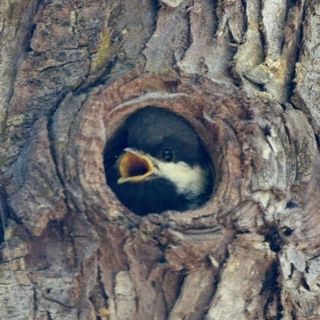
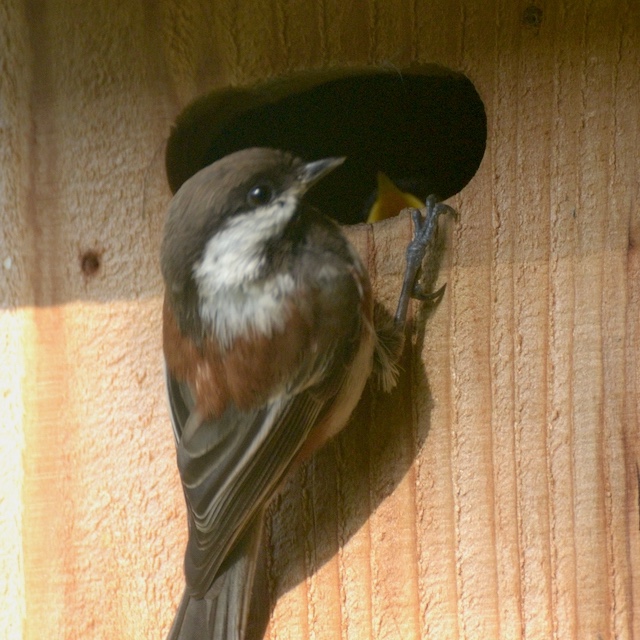
As I’ve brought up before, when contemplating the pros and cons of low infant mortality for humans, chickadees invariably come to mind. Part of the reason for this is that I have made and installed a number of nest boxes tailored for tiny birds. The most frequent tenants during breeding season are chestnut-backed chickadees, but I also get violet-green swallows, red-breasted nuthatches, and less often black-capped chickadees and Bewick’s wrens.
In fact, a recent article in the New York Times—in questioning the overall value of feeding birds in the UK—cites the apparent chick-rearing “success” of one of their chickadee equivalents (blue tit), boosted by bird-feeding practices. The article indicates that the tit’s “success” is upsetting biodiversity by displacing other woodland cavity-nesters, thereby leading to decline and threatening the survival of other species. I had already planned to write a post on a hypothetical chickadee explosion, and this article reinforced that impulse as a real-live case-in-point.
In this post, we’ll explore the absurd consequences that would obtain if medical intervention somehow eliminated fledgling mortality among chickadees, so that all the birds in a brood reached reproductive age. The results become disastrous in a shockingly-short time. Go ahead and make a guess as to how long before chickadees overwhelm the entire Community of Life. I may have biased you already by saying it’s shockingly short. But given that I call the 10,000 year period since agriculture began “a flash” on ecological scales, who knows what I even mean by “short.” Ignoring my characterization, then, what does your intuition say?
Bird Math
Chickadees begin breeding in the months leading up to their one-year hatch-day. Each clutch of eggs numbers approximately 6–8. The male-to-female ratio is essentially one to one. Chickadees can live beyond 10 years, but attrition is high—as we will see it must be—so that those who make it to reproductive age might be expected to raise 1–5 broods in their lifetimes. We’ll take three as the typical number, although the end result is not super-sensitive to changes in this parameter.
Thus, a typical female chickadee will produce an average of 7 chicks per year for three years, leading to the introduction of approximately ten females in her lifetime of chick-rearing (about 3.5 female chicks per year).
Estimated chickadee population in North America is approximately 40 million for just the black-capped species, and perhaps a comparable number distributed among six other species for a total of 80 million. They’re tiny, though, coming in at around 12 grams apiece. Still, that’s a total of one million kilograms (1,000 tons) of chickadee mass! Total wild bird biomass in North America is estimated to be approximately 600,000 tons, making chickadees about one-six-hundredth of the total. For comparison, North America is home to approximately 600 million humans, amounting to 30 million tons and thus outweighing wild birds by 50 times (1 kg of wild bird per human; I hope nobody’s hungry).
But all this is about to change in our hypothetical intervention.
Without deaths and no limit to reproductive age, the math is exceedingly simple: the population of females (half the total) expands by the factor (1 + FBR)y, where FBR is the annual female birth rate and y is elapsed years. For a rate of 3.5 females per clutch, the sequence of multiplicative factors goes 1, 4.5, 20.25, 91.125, etc. in geometric purity. Given our assumed three-year reproductive window, attrition of would-be mothers begins to eat into the sequence beginning in year four, but a pretty-darned reasonable approximation appends the prior sequence with 405.56×4.4604y−4. The “base” rate is reduced by limited-lifetimes from powers of 4.5 to powers of 4.46: not a gigantic change. Years four through seven then multiply the year-zero population by 405.56, 1809.28, 8070.89, and 36000.07.
Consequences
Okay, now that the math is out of the way, what does it mean? A population starting out at one-six-hundredth the biomass of all birds is almost at parity after year four—having multiplied by over 400 times the original population. By year five, chickadees would have three times the present mass of all North American birds (1,800 times vs. the initial one-six-hundredth). And they’re just getting started in global domination. I need to get busy building more nest boxes!
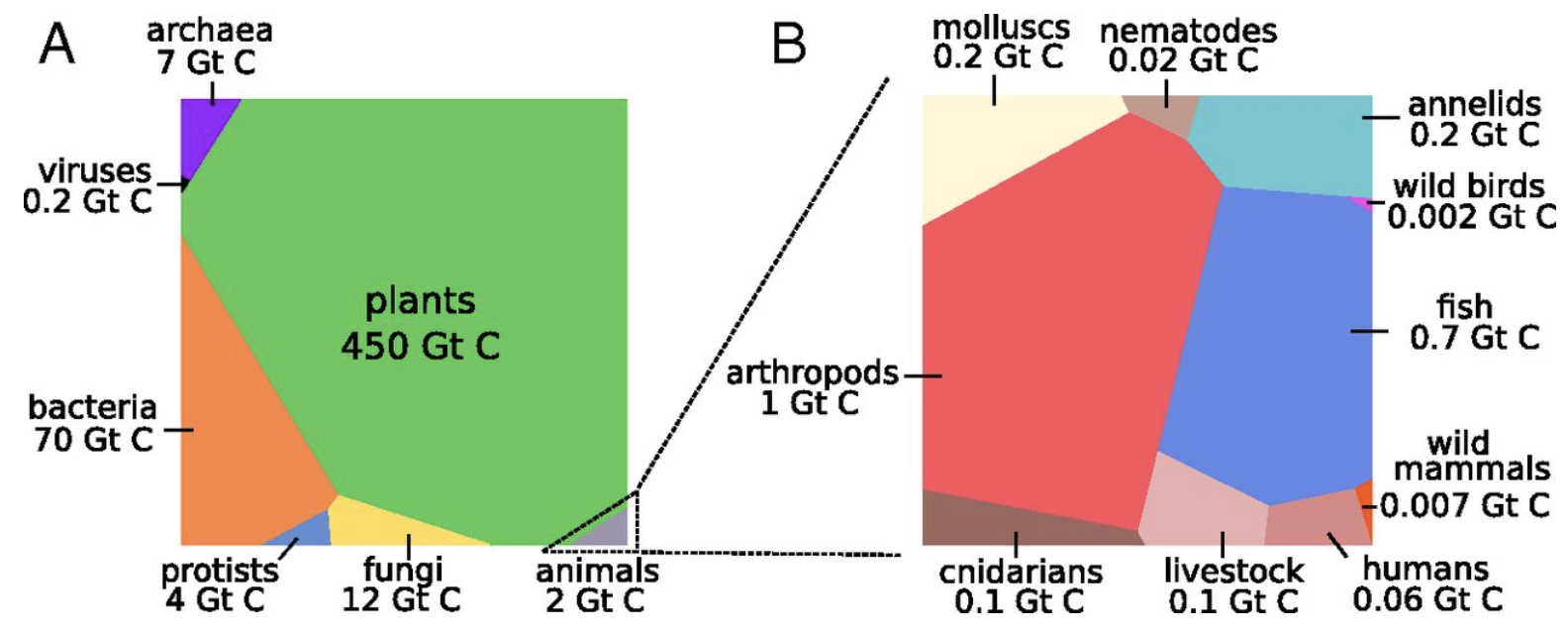
Jumping to numbers for dry carbon mass of various groups of living beings on Earth (Bar-On et al.; see figure above)—which can be multiplied by approximately 6–7 to get “wet” mass—the initial 1,000 tons of North American chickadees meets the 400 mega-tons of global humans (a factor of 400,000) within 9 years. Chickadees outweigh all animals on the planet (13 Gton wet) in 11 years. All life—including plants, bacteria, fungi, etc. (4,000 Gton) is exceeded in 15 years.
That’s right: ignoring, you know, actual ecological realities, in a short 15 years, the removal of “childhood” mortality in chickadees would lead to essentially all present biomass converted into chickadee form! When, exactly, does adorable become abominable? Therefore, we ought to thank our lucky stars that fledgling mortality in chickadees is as severe as it is, or we would be suffocated by overwhelming cuteness.
The same goes, of course, for every living being on the planet. Attrition of the young is a vital part of functioning ecologies. Of course, the rate of offspring is essentially tuned to compensate typical mortality rates as part of a larger feedback arrangement—dialed to work. Humans came into existence in approximate ecological balance: 50% childhood attrition offset average fertility rates of roughly four children per female. Incidentally, 50% childhood mortality means that a 30 year life expectancy at birth translates to something more like 60 years for those who make it past age ten—once removing the statistics for early attrition. Living to ripe old ages is/was far from rare among hunter-gatherers, as explored in another post.
The recent nosedive in child mortality among humans has played an obvious role in our present overshoot and initiation of a sixth mass extinction. Sure, one could imagine aiming for zero infant mortality together with replacement-level fertility (in the neighborhood of two children per woman, on average). But timing is everything. Prioritizing a reduction in infant mortality before lowering the fertility rate just leads to a biosphere-threatening population surge. Since human population is arguably three orders-of-magnitude larger than what is ecologically sustainable—at least based on hundreds of thousands of years of data—the cat is out of the bag. Mistakes were made.
Also, when I say “one can imagine” above, alarm bells should go off. Imagination is wholly incompetent in such matters. So what if a puny brain somewhere (all brains are puny: not claiming any superiority, here) can imagine low infant mortality, fertility at replacement, and a total population size that is ecologically acceptable? The universe has granted zero evidence that such a state is at all possible. If humans number in the millions instead of billions and live in ecological reciprocity, is it at all feasible to maintain the high-tech infrastructure necessary for the battle against infant mortality? Enjoy the fantasy, because that’s all it is. Things inside the brain can look a lot different (tidier; more pleasing) than the actual universe outside the brain-case.
The Experiment Gone Awry
The New York Times article referenced above muses about unintended consequences of feeding birds. In the quote that follows, the bracketed word is my own suggested insertion.
It seems we have been running a Great British Bird Ecological Experiment for over a century with no control and no plan. We have been helping [select] birds to survive harsh winters, but in the process, we may have exported wild bird decline to our own woodlands, farmlands and to countries that supply our vast appetite for bird seed.
Yes: now keep going! Think bigger… Might a similar sentiment be applied to modernity as a whole? How about this edit:
It seems we have been running the Unauthorized Global Leviathan vs. Ecology Experiment [an ugly acronym] for centuries or even millennia with no control and no plan. We have been helping humans alone to survive at all costs, but in the process, it appears that we have initiated a sixth mass extinction that could end it for us all.
Yeah, that tracks. Any time we make a cognitively-based (thus bone-headed, open-loop) alteration to how we interact with the larger ecology, of course we have no idea how the fully-interactive complex set of relationships will change! Ecological complexity is far beyond our pay-grade. How likely is a toddler—having no piano experience—to improve on a Beethoven sonata? But we can all imagine the toddler expressing confidence that they can do it, right? That’s what we’re up against, here. By the way, is your imagined toddler also male? That also seems to track.
Boring Appendix
I am compelled to include a spelled-out example of chickadee math to accompany the conclusions above. Please skip unless you’re a nerd (or other category that rhymes with bird).
To make things more compact, I’ll start with a case wherein each female chickadee produces two females per year, rather than 3.5. For numbers, I start year zero with the birth of a single chickadee, but this number (1) can represent any (larger) number we like, such as the initial female population. The numbers that follow year by year can then be thought of as multipliers of the initial population.
I’ll also track individuals using a letter-based labeling scheme that encodes lineage. Our original female is A0 (the zero indicates she was born in year zero). Her daughters in year one are A0A1 and A0B1, in year 2 A0A2 and A0B2, and in year three A0A3 and A0B3. Then the “mother of all chickadees” is done herself (three years of production in our model).
In year two, chicks A0A1 and A0B1 each produce their first daughters to join same-aged “aunts” A0A2 and A0B2 (the second batch of offspring from mother A0). We name these A0A1A2, A0A1B2, A0B1A2, A0B1B2 (I suspect that if one slowed down chickadee vocalizations sufficiently, we’d find them chattering these exact names to each other). The convention is to build lineage from left to right, each mother having daughters A and B in year N. So let’s get started.
Year zero has 1 female bird: A0. She herself does not produce chicks in her first year on the planet.
Year one has 3 female birds: A0, and her two daughters A0A1, A0B1.
Year two has 9 female birds: A0, A0A1, A0B1, A0A2, A0B2, A0A1A2, A0A1B2, A0B1A2, A0B1B2.
Year three has 27 female birds: A0, A0A1, A0B1, A0A2, A0B2, A0A1A2, A0A1B2, A0B1A2, A0B1B2, A0A3, A0B3, A0A1A3, A0A1B3, A0B1A3, A0B1B3, A0A2A3, A0A2B3, A0B2A3, A0B2B3, A0A1A2A3, A0A1A2B3, A0A1B2A3, A0A1B2B3, A0B1A2A3, A0B1A2B3, A0B1B2A3, A0B1B2B3.
Yes, we could drop the common ‘A0’ from the leading edge of all these names, but then where did our respect for elders go? I tell ya…
So far the numbers grow in a simple geometric sequence: (1 + FBR)y, or 3y: 1, 3, 9, 27. Next would be 81, but alas, great-grandmother A0 drops out, and also does not produce the two chicks (would be A0A4, A0B4) that would be necessary to make 81. So it’s 78 instead. If you want to expand to get the year-four list, just remove A0 from the list above, repeat all other entries, and for each, add two more ending in A4 and B4. In year 5, the birds ending in 1 are also gone, along with their expected offspring (no 1/5 combinations). Instead of 243 (35), we’re shy 15 at 228 once we add up missing birds and the birds they no longer produce. Then it’s 666, 1944, 5676, 16572, 48384… A good approximation for year y for year four and up is 78×2.91964y−4.
When we move to 3.5 females per year, the numbers become fractional, but that’s fine as simple multipliers of a larger initial population.
Views: 1267
What I'm getting from this, is that we urgently need to educate our female chickadees, and campaign for their reproductive rights. I'll get the placards.
Welcome back Tom, I hope you had a lovely break.
Your statement in 'MM #4: Evolution', is very profound: If you think you’re winning, it’s probably a sign that you’re engaged in the slower and larger process of losing.
Since winning involves efficiency and proficiency, nature should avoid them. That is precisely what Olivier Hamant found in his studies of natural systems. He explains it very well in his conversation with Nate Hagens as well as in the book 'Antidote to the cult of performance'.
In my opinion, the best example for inefficiency is RuBisCO, the enzyme that fixes carbon dioxide. Although all life on earth depends on the reaction it catalyzes, it is slow – turnover of 3-5 per second, and it confuses oxygen for carbon dioxide.
Goodness!! Does all of this mean I have to remove and stack and burn the > 100 Bluebird boxes that I have in my Black walnut plantation?? My observation(s) have been that many other itti-bitty birds also enjoy the boxes.
If rabbits were allowed to reproduce without restrictions, the resulting rabbit ball would be expanding faster than the speed of light after about 6.7 years (according to Gemini).
what a harebrained experiment !
Two of my environmental philosopher science information feeds collapsed like raindrops on a window. Alan Kirk posted an article which linked back to dothemath. The topic of discussion seemed to come back to the "human overpopulation is the problem" mantra often wielded by modernist colonial apologists with guns/fingers pointed East and South. Your chickadee article seemed connected to this idea.
However, in both articles, I feel that the real causal variable in this entire mess is modernity. Modernity causes overpopulation, Modernity causes exponential resource extraction. Overpopulation is not a root cause, it's an effect, and its not the biggest thing affecting climate change and environmental destruction. A quick calculation shows a typical American's carbon footprint to be 50 times that of a person from Papua, and I am sure an even larger gap emerges if we look at other metrics of environmental collapse and planetary boundaries.
I hate to get all Macklemore on here, but this does seem to come down to colonial mindsets which have the secret exponential destruction instruction somewhere in their DNA.
What is goal for sentient beings? to "exist", to "thrive", or is there no purpose and its all just a giant game with no apparent Nash equilibrium in sight since some of the monkeys decided they could win more of the pot.
I really appreciate your blog, it is the most sense I have read in a long time, I just find the overpopulation discussion misses the entire point and is almost always used as a racist/colonial weapon to expand the greedy monkey empire.
Indeed, it's always worth appreciating that root causes go far deeper than we tend to imagine. I hope I have not given the impression that I think overpopulation is the root problem. This post argues that infant mortality is part-and-parcel of authentic ecological living: it wasn't meant to primarily hem and haw about overpopulation per se. Also, many do Do the Math posts have emphasized the raft of distortions that accompany agricultural practice—unchecked population growth being one of many consequences/symptoms that emerge. But it goes even farther, to our cognitive "talents" when applied outside of established ecological relationships. It could well be that humans are a bridge too far: an evolutionary adaptation destined to fail the ecological game (via modernity) by merely having the capacity. How would one propose to prevent its arrival? Well, some human cultures have/had practices to suppress aggrandizement, power concentration, surplus, etc. and stated within ecological bounds for hundreds of thousands of years. That's important. Is it enough? Not presently! But maybe someday again? One can only hope, for what little that's worth.
Oh: and a post from way back in 2013 (The Real Population Problem)—and later chapter 3 of my Energy Ambitions textbook—echoes your point about American consumption. A much fatter finger points at "Western" births as being far more serious than high birth rates in less affluent places.
I can recommend Murimba Ani's excellent book "Yurugu" for an exposition of the ethos driving Western culture to destroy the biosphere. It is a fantastic analysis. Professor Murphy would probably enjoy it as well.
Unfortunately it's out of print and the few second hand copies available are pretty expensive but there are free PDF scans to be found:
https://www.scribd.com/document/667401478/Yurugu
Thank you very much.
Thanks Matthew, for the tip. A thought provoking perspective, indeed.
Hey Tom, I recently listened to people discussing longevity(eternal live etc,) on a podcast. The host stated that: "this is the only area where progress is only positive".
Majority of people never ask themselves, why a replicating organism must die at some point? It needs to die so the ecological balance is kept in tact, otherwise the progeny would quickly run out of resources.
Do you think this holistic understanding might relieve some people from their "fear of death"? It certainly made the passing of my grandparents easier to accept. Hope you are doing well, this blog has really evolved my thinking!
Yes: it seems our culture has what might even be called a childish fear of death, and it's probably no coincidence that this manifests in a culture that is profoundly ecologically ignorant. From what I've read, it seems people who live authentic ecological lives (overtly embedded in reciprocal relationships as a major theme of daily life) tend to hold less fear of death.
And yes, immortality must be accompanied by zero reproduction if ecological sanity is to hold. It seems that the ignorance in many people is to the point where it's not at all obvious to them that we live only by the grace of ecological health—rather than by words in any book.
I don't think I've ever known anyone who lived an authentic ecological life. And perhaps the only thing I've read about people who might have was in Jared Diamond's book "The World Until Yesterday". Interestingly, in his book I remember a couple of specific examples he described where those people held a greater fear of death than modern people. But in most ways I do think he depicted them as having a greater acceptance of death.
I assume by a "childish" fear of death you are meaning in the sense of having a child's lack of understanding of our place in the universe, the incomprehensible vastness of space and time and our insignificance therein, the inability to understand the outcome of immortality in a reproducing organism and the resulting effects on ecological health that we all depend upon, or the fact that our existence even depends on ecological health.
But I also assume you are not saying that people that live(d) authentic ecological lives do/did so out of deliberate choice or because they were less ignorant on such matters or because they had a holistic ecological understanding, rather than that they just had no other option than to live an authentic ecological life.
“The greatest shortcoming of the human race is our inability to understand the exponential function.”
— Albert Bartlett
https://quoteinvestigator.com/2021/02/01/understand-exponential/
I'm not sure that even if people truly and instinctively grasped the results of exponential growth, that the knowledge would actually change their behavior. From an evolutionary perspective it seems like a Prisoner's Dilemma type of problem.
When I first read this post my initial thought was that it could be summarized as yet another example of how people fail to appreciate the result of exponential growth. Today I listened to a news story on a financial topic where financial experts were referring to "the miracle of compound interest", implying that this is beyond normal intuition. But the story also reminded me of a different aspect of the situation that no one mentioned: that being the zero-sum game nature of many systems. Perhaps this is a another, or better, way to think of the topic of mortality or infant mortality. On a finite planet that has been brimming with life for hundreds or millions of years, an increase in the biomass of any one population seems very likely to mean a decrease in the biomass of other populations. I don't know if this would be an easier way for most people to grasp. I know that people tend to overlook (or not comprehend) the zero-sum nature of many problems, so maybe not.
This post definitely highlights exponential math, but its larger context is that a healthy, functioning ecology goes hand-in-hand with death and infant mortality. Cleaving one from the other—as our brains are good at doing—is not dealing with reality.
As for zero-sum game; I'd say it's not a simple one-parameter (mental) model. For one thing, total mammal mass shot up due to humans and domesticated animals. Ecology doesn't care about the sum: if new ways of energy acquisition are exploited, the total can grow. But perhaps a more troubling aspect of the zero-sum mindset is that most humans in our culture would shrug and say to the sixth mass extinction: more for us. In other words, it ignores the interdependencies, mutualisms, relationships woven into ecology. It's not a math game obeying a sum rule, but a mind-boggling set of interconnections forged over deep time.
True enough that if new ways of energy acquisition are available, then the total biomass can grow (within material limits). Certainly that has been the case over the history of life on earth, as Peter Brannen relates as an underlying theme in his book "The Story of CO2 Is the Story of Everything". But within whatever the energy and material limits are at the time, it would seem that a sizable increase in the fractional biomass of any one species would likely be accompanied by a corresponding fractional decrease in the rest of life on a finite planet. Perhaps not immediately or in a precise way, but I would think by 11 years into your example, once chickadees out-weigh all other animals on the planet, other animal (and perhaps some non-animal) populations will have to have crashed. Maybe this is just another idea my mind can entertain that isn't consistent with reality?
As I see it, the exponential math approach explores what can't possibly happen because it leads to absurdity. It focuses on the chickadee side of the equation (exponential growth). The zero-sum consideration is really just about what happens to the other side of the equation (an equally absurd, exponential crash in other species if chickadees undergo exponential growth). You make a very good point that it ignores the interdependencies and "mind-boggling set of interconnections forged over deep time." On the other hand, I would expect that the history of life is replete with examples of various species or populations undergoing radical (orders of magnitude) growth without concern for any of the interdependencies or interconnections. The difference today seems to be the extreme scale, number of, global extent, and near simultaneity of the radical changes being brought about by one species, perhaps leading to 6ME.
As always, I'll be looking forward to your future posts. It's really amazing where this blog has gone and how enlightening it has been since I first stumbled across it.
Certainly in the short term no dramatic changes in total biomass are likely to manifest. So in the context of the insane thought experiment on chickadees, yes: they chickadees would effectively "eat" the rest of the living world. Of course, this is also why it could never happen in an actual ecological context, and why math is only as good as the contextual limits permit.
On the posts… I'm going to slow down a bit as I focus on a few other projects—including a pair of books I'm drafting.
Hi Tom
If you have the opportunity to have your message about the eventual end of modernity be seen and heard by a lot more people… Would you take that opportunity?
For example, would you do like a two or three hour conversation with someone more “ famous”? Joe Rogan or Tucker Carlson or Stephen Pinker come to mind.
I would happily make cold calls for you to help make it happen
A lot of what you have learned on your road to self discovery will not be perceived well by the general public as you know, but your message is an important one, because it seems like the one that is most likely to have the most truth to it
If you would be interested in having your message be seen by more people, I would happily try to make it happen… I’m a nobody and have no connections… But I understand that cold calls to these people can sometimes get you on the show… You certainly have the education, experience, and self-awareness to know what you are talking about… And to share your message with the general public.
I see your YouTube content has thousands of views… But given your message… It ought to have millions
It probably won’t change anything in the end… If it’s anything I’ve learned about humans and where we are currently… We are really, really really selfish… We are going to burn every last drop of fossil fuels we can get our hands on.… For vacations, pointless war, Botox, NASCAR, SUVs, Super Bowl parties, political conventions, cute cat videos, etc. etc.… But if you are doing this blog… I would have to assume that you would prefer to have it seen by more people and not less… So might be at least an entertaining conversation?
Thank you! 🙏🏻
Normally, I'd say: go for it. But I have a plan. I'm starting work on a book about why we aren't going to colonize space. The book will also have a Trojan Horse aspect in that it will point out the primacy of ecological consideration (and how modernity doesn't really "do" that). It's possible that this book will generate attention and get the message on the radar of prominent podcasters, etc. Given this plan, it would probably damage the book's success to get "out there" ahead of it and come off as unhinged.
not exactly relevant to this essay but rather to the blog in general. https://www.nber.org/system/files/working_papers/w35809/w35809.pdf?utm_source=substack&utm_medium=email