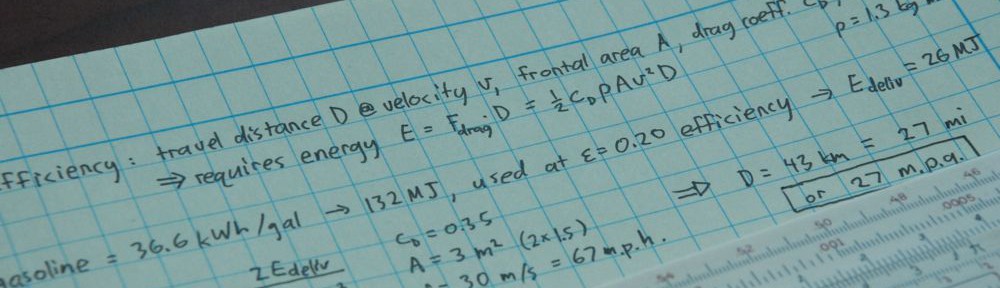

As I’ve brought up before, when contemplating the pros and cons of low infant mortality for humans, chickadees invariably come to mind. Part of the reason for this is that I have made and installed a number of nest boxes tailored for tiny birds. The most frequent tenants during breeding season are chestnut-backed chickadees, but I also get violet-green swallows, red-breasted nuthatches, and less often black-capped chickadees and Bewick’s wrens.
In fact, a recent article in the New York Times—in questioning the overall value of feeding birds in the UK—cites the apparent chick-rearing “success” of one of their chickadee equivalents (blue tit), boosted by bird-feeding practices. The article indicates that the tit’s “success” is upsetting biodiversity by displacing other woodland cavity-nesters, thereby leading to decline and threatening the survival of other species. I had already planned to write a post on a hypothetical chickadee explosion, and this article reinforced that impulse as a real-live case-in-point.
In this post, we’ll explore the absurd consequences that would obtain if medical intervention somehow eliminated fledgling mortality among chickadees, so that all the birds in a brood reached reproductive age. The results become disastrous in a shockingly-short time. Go ahead and make a guess as to how long before chickadees overwhelm the entire Community of Life. I may have biased you already by saying it’s shockingly short. But given that I call the 10,000 year period since agriculture began “a flash” on ecological scales, who knows what I even mean by “short.” Ignoring my characterization, then, what does your intuition say?
Bird Math
Chickadees begin breeding in the months leading up to their one-year hatch-day. Each clutch of eggs numbers approximately 6–8. The male-to-female ratio is essentially one to one. Chickadees can live beyond 10 years, but attrition is high—as we will see it must be—so that those who make it to reproductive age might be expected to raise 1–5 broods in their lifetimes. We’ll take three as the typical number, although the end result is not super-sensitive to changes in this parameter.
Thus, a typical female chickadee will produce an average of 7 chicks per year for three years, leading to the introduction of approximately ten females in her lifetime of chick-rearing (about 3.5 female chicks per year).
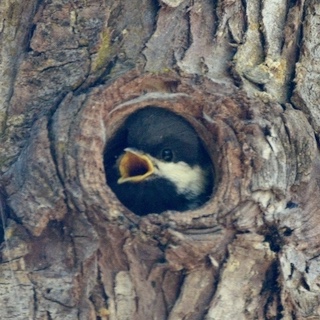
Estimated chickadee population in North America is approximately 40 million for just the black-capped species, and perhaps a comparable number distributed among six other species for a total of 80 million. They’re tiny, though, coming in at around 12 grams apiece. Still, that’s a total of one million kilograms (1,000 tons) of chickadee mass! Total wild bird biomass in North America is estimated to be approximately 600,000 tons, making chickadees about one-six-hundredth of the total. For comparison, North America is home to approximately 600 million humans, amounting to 30 million tons and thus outweighing wild birds by 50 times (1 kg of wild bird per human; I hope nobody’s hungry).
But all this is about to change in our hypothetical intervention.
Without deaths and no limit to reproductive age, the math is exceedingly simple: the population of females (half the total) expands by the factor (1 + FBR)y, where FBR is the annual female birth rate and y is elapsed years. For a rate of 3.5 females per clutch, the sequence of multiplicative factors goes 1, 4.5, 20.25, 91.125, etc. in geometric purity. Given our assumed three-year reproductive window, attrition of would-be mothers begins to eat into the sequence beginning in year four, but a pretty-darned reasonable approximation appends the prior sequence with 405.56×4.4604y−4. The “base” rate is reduced by limited-lifetimes from powers of 4.5 to powers of 4.46: not a gigantic change. Years four through seven then multiply the year-zero population by 405.56, 1809.28, 8070.89, and 36000.07.
Consequences
Okay, now that the math is out of the way, what does it mean? A population starting out at one-six-hundredth the biomass of all birds is almost at parity after year four—having multiplied by over 400 times the original population. By year five, chickadees would have three times the present mass of all North American birds (1,800 times vs. the initial one-six-hundredth). And they’re just getting started in global domination. I need to get busy building more nest boxes!
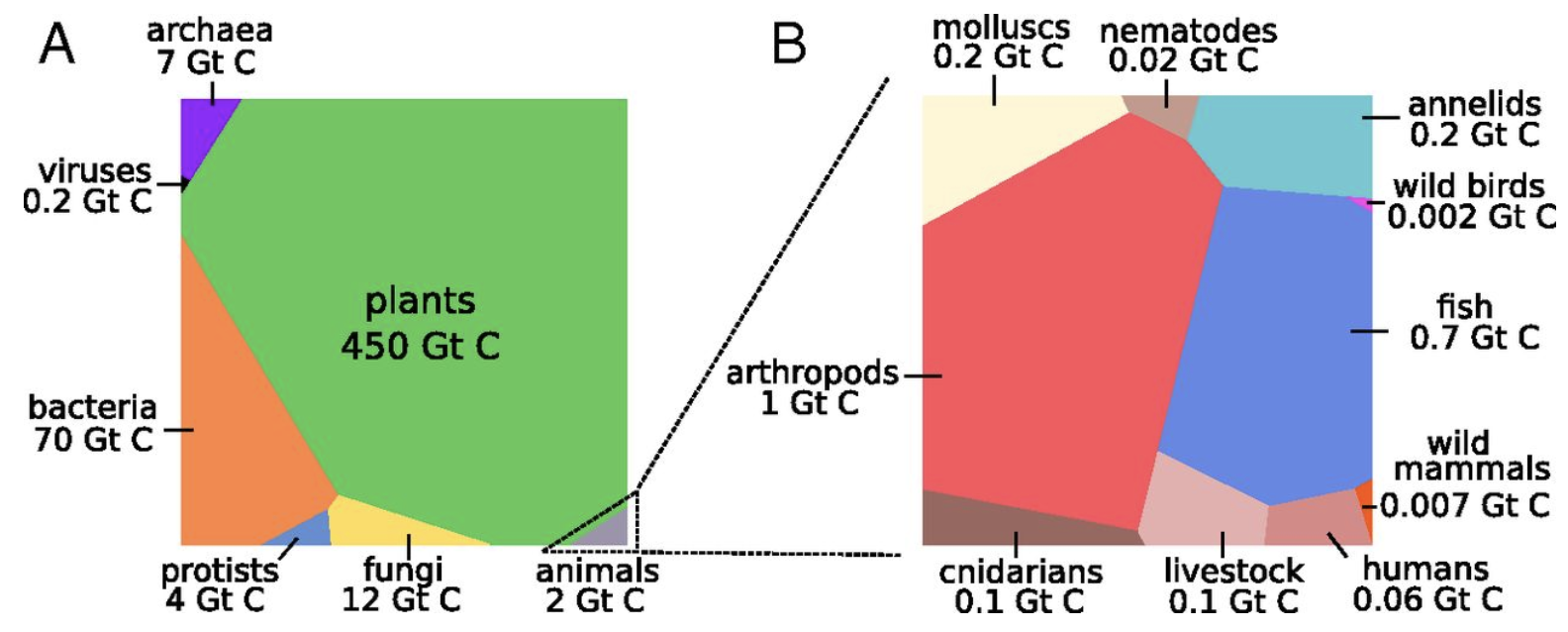
Jumping to numbers for dry carbon mass of various groups of living beings on Earth (Bar-On et al.; see figure above)—which can be multiplied by approximately 6–7 to get “wet” mass—the initial 1,000 tons of North American chickadees meets the 400 mega-tons of global humans (a factor of 400,000) within 9 years. Chickadees outweigh all animals on the planet (13 Gton wet) in 11 years. All life—including plants, bacteria, fungi, etc. (4,000 Gton) is exceeded in 15 years.
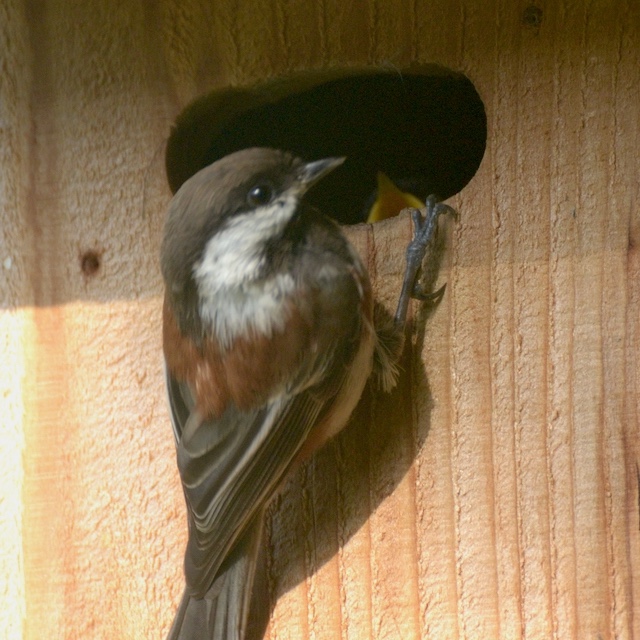
That’s right: ignoring, you know, actual ecological realities, in a short 15 years, the removal of “childhood” mortality in chickadees would lead to essentially all present biomass converted into chickadee form! When, exactly, does adorable become abominable? Therefore, we ought to thank our lucky stars that fledgling mortality in chickadees is as severe as it is, or we would be suffocated by overwhelming cuteness.
The same goes, of course, for every living being on the planet. Attrition of the young is a vital part of functioning ecologies. Of course, the rate of offspring is essentially tuned to compensate typical mortality rates as part of a larger feedback arrangement—dialed to work. Humans came into existence in approximate ecological balance: 50% childhood attrition offset average fertility rates of roughly four children per female. Incidentally, 50% childhood mortality means that a 30 year life expectancy at birth translates to something more like 60 years for those who make it past age ten—once removing the statistics for early attrition. Living to ripe old ages is/was far from rare among hunter-gatherers, as explored in another post.
The recent nosedive in child mortality among humans has played an obvious role in our present overshoot and initiation of a sixth mass extinction. Sure, one could imagine aiming for zero infant mortality together with replacement-level fertility (in the neighborhood of two children per woman, on average). But timing is everything. Prioritizing a reduction in infant mortality before lowering the fertility rate just leads to a biosphere-threatening population surge. Since human population is arguably three orders-of-magnitude larger than what is ecologically sustainable—at least based on hundreds of thousands of years of data—the cat is out of the bag. Mistakes were made.
Also, when I say “one can imagine” above, alarm bells should go off. Imagination is wholly incompetent in such matters. So what if a puny brain somewhere (all brains are puny: not claiming any superiority, here) can imagine low infant mortality, fertility at replacement, and a total population size that is ecologically acceptable? The universe has granted zero evidence that such a state is at all possible. If humans number in the millions instead of billions and live in ecological reciprocity, is it at all feasible to maintain the high-tech infrastructure necessary for the battle against infant mortality? Enjoy the fantasy, because that’s all it is. Things inside the brain can look a lot different (tidier; more pleasing) than the actual universe outside the brain-case.
The Experiment Gone Awry
The New York Times article referenced above muses about unintended consequences of feeding birds. In the quote that follows, the bracketed word is my own suggested insertion.
It seems we have been running a Great British Bird Ecological Experiment for over a century with no control and no plan. We have been helping [select] birds to survive harsh winters, but in the process, we may have exported wild bird decline to our own woodlands, farmlands and to countries that supply our vast appetite for bird seed.
Yes: now keep going! Think bigger… Might a similar sentiment be applied to modernity as a whole? How about this edit:
It seems we have been running the Unauthorized Global Leviathan vs. Ecology Experiment [an ugly acronym] for centuries or even millennia with no control and no plan. We have been helping humans alone to survive at all costs, but in the process, it appears that we have initiated a sixth mass extinction that could end it for us all.
Yeah, that tracks. Any time we make a cognitively-based (thus bone-headed, open-loop) alteration to how we interact with the larger ecology, of course we have no idea how the fully-interactive complex set of relationships will change! Ecological complexity is far beyond our pay-grade. How likely is a toddler—having no piano experience—to improve on a Beethoven sonata? But we can all imagine the toddler expressing confidence that they can do it, right? That’s what we’re up against, here. By the way, is your imagined toddler also male? That also seems to track.
Boring Appendix
I am compelled to include a spelled-out example of chickadee math to accompany the conclusions above. Please skip unless you’re a nerd (or other category that rhymes with bird).
To make things more compact, I’ll start with a case wherein each female chickadee produces two females per year, rather than 3.5. For numbers, I start year zero with the birth of a single chickadee, but this number (1) can represent any (larger) number we like, such as the initial female population. The numbers that follow year by year can then be thought of as multipliers of the initial population.
I’ll also track individuals using a letter-based labeling scheme that encodes lineage. Our original female is A0 (the zero indicates she was born in year zero). Her daughters in year one are A0A1 and A0B1, in year 2 A0A2 and A0B2, and in year three A0A3 and A0B3. Then the “mother of all chickadees” is done herself (three years of production in our model).
In year two, chicks A0A1 and A0B1 each produce their first daughters to join same-aged “aunts” A0A2 and A0B2 (the second batch of offspring from mother A0). We name these A0A1A2, A0A1B2, A0B1A2, A0B1B2 (I suspect that if one slowed down chickadee vocalizations sufficiently, we’d find them chattering these exact names to each other). The convention is to build lineage from left to right, each mother having daughters A and B in year N. So let’s get started.
Year zero has 1 female bird: A0. She herself does not produce chicks in her first year on the planet.
Year one has 3 female birds: A0, and her two daughters A0A1, A0B1.
Year two has 9 female birds: A0, A0A1, A0B1, A0A2, A0B2, A0A1A2, A0A1B2, A0B1A2, A0B1B2.
Year three has 27 female birds: A0, A0A1, A0B1, A0A2, A0B2, A0A1A2, A0A1B2, A0B1A2, A0B1B2, A0A3, A0B3, A0A1A3, A0A1B3, A0B1A3, A0B1B3, A0A2A3, A0A2B3, A0B2A3, A0B2B3, A0A1A2A3, A0A1A2B3, A0A1B2A3, A0A1B2B3, A0B1A2A3, A0B1A2B3, A0B1B2A3, A0B1B2B3.
Yes, we could drop the common ‘A0’ from the leading edge of all these names, but then where did our respect for elders go? I tell ya…
So far the numbers grow in a simple geometric sequence: (1 + FBR)y, or 3y: 1, 3, 9, 27. Next would be 81, but alas, great-grandmother A0 drops out, and also does not produce the two chicks (would be A0A4, A0B4) that would be necessary to make 81. So it’s 78 instead. If you want to expand to get the year-four list, just remove A0 from the list above, repeat all other entries, and for each, add two more ending in A4 and B4. In year 5, the birds ending in 1 are also gone, along with their expected offspring (no 1/5 combinations). Instead of 243 (35), we’re shy 15 at 228 once we add up missing birds and the birds they no longer produce. Then it’s 666, 1944, 5676, 16572, 48384… A good approximation for year y for year four and up is 78×2.91964y−4.
When we move to 3.5 females per year, the numbers become fractional, but that’s fine as simple multipliers of a larger initial population.
Views: 83
What I'm getting from this, is that we urgently need to educate our female chickadees, and campaign for their reproductive rights. I'll get the placards.
Welcome back Tom, I hope you had a lovely break.