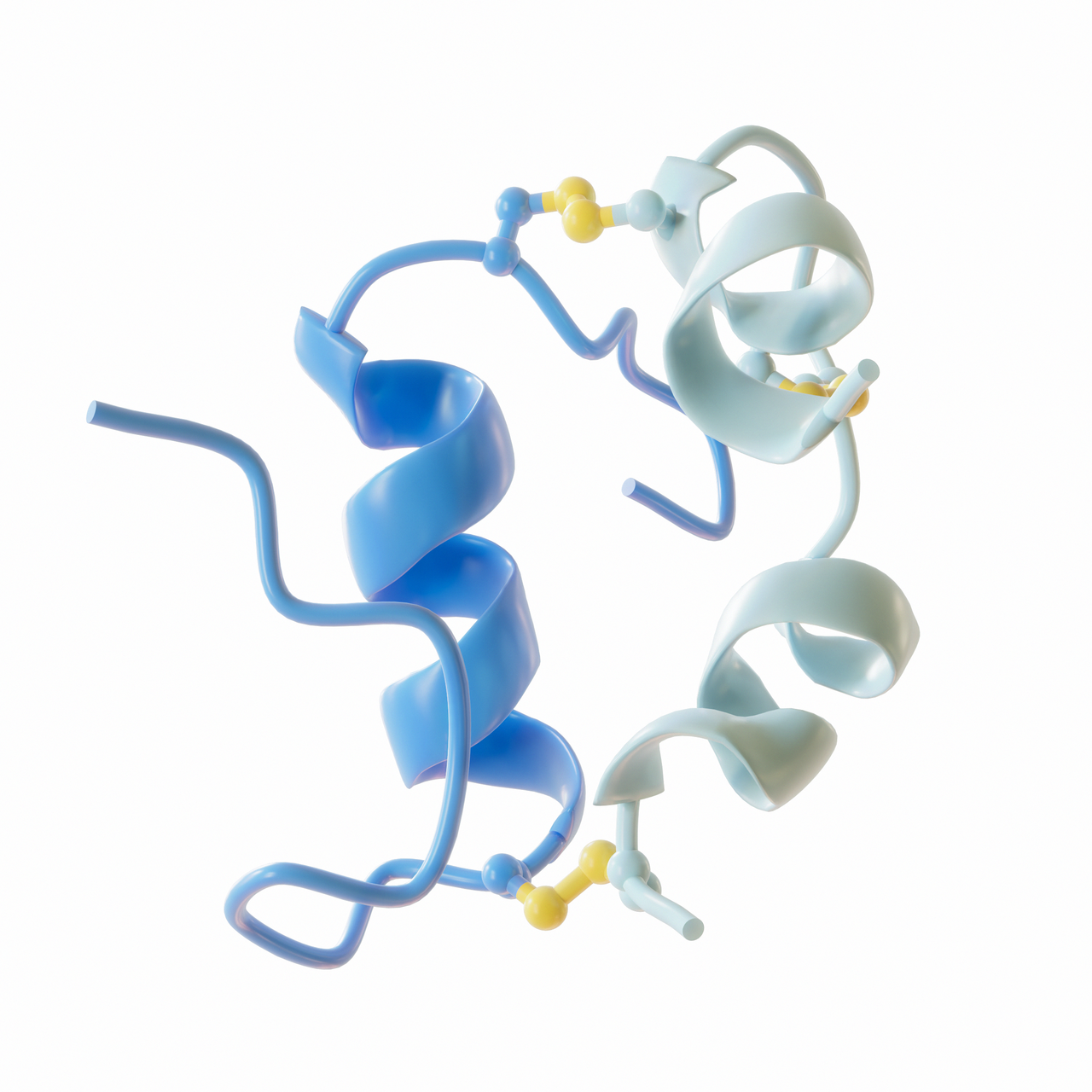
This graphic could either represent insulin or the two Murphys. Do these curls make me look fat? (By AtikaAtikawa on Wikimedia Commons.)
Reslience.org is publishing a series of posts capturing a conversation between me and Dave Murphy facilitated by Ben McCall (three of the five co-founders of the Planetary Limits Academic Network). Here, I repeat the original content, and provide additional commentary [linked within the document inside brackets] on points that I did not fully address in the dialog. Clicking on the [additional content] links will send you further down this same post, where you’ll also find a link to return to the paragraph of origin (or use “back” navigation on your browser). Thus, you have the option to read commentary as you go, or save for later once reading the captured exchange. Either way works. Okay: here we go!
A Tale of Two Murphys: an interview, conducted in 2023–2024, by Ben McCall of two founders of the Planetary Limits Academic Network (PLAN): Dave Murphy, a prominent scholar of the energy transition movement, and Tom Murphy, a physicist who focuses on how fundamental principles can be applied to the Earth system as a whole. In this interview, we explore the continuum of perspectives within PLAN along a spectrum that might be labeled “doomer” on one end and “techno-utopian” on the other. Neither of the conversation’s participants could be labeled as either of these extremes, although it will be clear that they each lean more toward one side than the other.
Scanning the comments on the YouTube posting of my conversation with Nate Hagens and DJ White on the subject of space fantasies, one finds some familiar reactions. For the most part, comments expressed appreciation for the refreshing push-back against prevalent space hype. But a few, predictably, intoned that it is we naysayers who are delusional: of course we’re going to space, and those like myself saying otherwise will join the embarrassing heap of vision-challenged fossils littering history.
This post offers a framework for evaluating levels of faith in future projections. A tremendous asymmetry enters, which merits some awareness.
A new video from Ze Frank is out, this time about Geckos. True to form, Frank masterfully illustrates ze genius of other life forms. One amazingly-intricate evolutionary adaptation after another leaves us grasping to make sense of the various superpowers manifesting in the living world. If Ze Frank’s videos don’t leave your mouth agape, there might be something wrong with your jawe (the anatomical feature best suited for expressing awe). I admire his skilled and unabashed use of anthropomorphism to imbue these characters with personality and desire. He’s not wrong, and our culture could use a great deal more appreciation for the shared engagement of all Life.
Now, it does pain me to see the torture that animals are subjected to in laboratory environments just so that we might attempt a deeper understanding. Admittedly, part of my sense of amazement is enhanced by partial scientific understanding of the phenomena. Yet, it would still be possible to put superpowers on display without the clinical Nazi part. As is true for so many things in modernity, the act of scraping some veneer of “good stuff” leaves devastation in its wake. It’s seldom worth it, in the full analysis.
But the main point of this post is to reconcile the genius of microbes, fungi, plants and animals (of which we are part) with their obvious “dumb” qualities as well. To wit: a spider can weave an elaborate web I’d have no hope of replicating, yet when stuck in a sink will repeatedly try—and fail—to climb the steepest wall. Clinging to spider webs for a moment (they’re like that), birds also weave nests using spider webs and other bits of fluff, moss, twigs, spit, and many other seemingly random elements. I know I couldn’t pull it off, even allowed unlimited spit. But a bird in a garage with the door wide-open can exhaust himself trying to fly into the ceiling, never realizing he can fly right out the enormous opening. A honeybee has many jobs in her lifetime: rearing; feeding; storing food; cleaning and maintaining the hive; patrolling and defending; foraging and finding new nest sites—communicating by both dances and chemicals. Yet trying to escape a house, she will bump into a window until she dies—never “getting” the whole glass concept. In the opposite direction, ants innovate in their foraging strategies so that they find ways into (and back out of) a house that would never occur to us—often repeatedly outwitting us as we try to block one route or anther. But their brains are tiny, and they’re not even on social media.
I could go on, of course, but the idea should be clear enough. What I want to briefly explore is this contrast between genius and dumb-as-a-brick (a recent post explored human dumbness). How are both true at once, and how might we, as humans, be both different and basically the same?
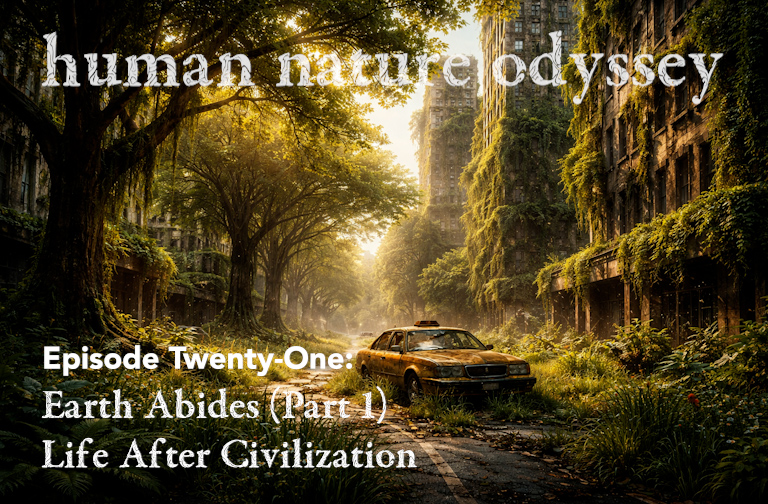
Have you read the 1949 book by George R. Stewart called Earth Abides? Have you seen the recent television series that mangles the thrust of the story beyond recognition? Maybe you’d like to read it before listening to the podcast episode(s) in which Alex Leff—creator of the excellent Human Nature Odyssey podcast series—and I discuss the book and what we might learn about generational adaptation to modernity’s eventual up-ending. Spoiler alert: we make no effort to protect future readers from core developments.
This is a two-part conversation, the first of which was released yesterday, and the second on April 23.
This book was recommended to me by legendary astrophysicist Frank Shu, and while pretty hokey in some ways—exercising the cringe muscle group—it offers deeply valuable lessons in other respects that have stuck with me. Anyway, it was fun to chat about the themes in the book with Alex, and I hope you enjoy the conversation as well.
Yesterday, news blasts announced the triumph that four humans have now traveled farther from Earth than ever, passing the previous record set by the crew of Apollo 13 on April 15, 1970.