Recent discussions on the roles of oral language, fire, stone tools, horticulture, agriculture, metal use, and written language in shaping the road to a sixth mass extinction motivated an attempt to capture key elements influencing the ecological impact of deviations from well-worn paths.
The idea is that living beings try new stuff all the time—and not mostly by cognitive eureka moments, but by stumbling onto new genetic or behavioral tweaks. No conductor needs to sit at the helm for this to just happen. The process is impossible to stop, in fact. Obviously many—or most—ideas/mutations/novelties fail. Usually, any harm is suffered primarily by the species itself. Occasionally, the deviation has a serious impact on many other species.
Ecology can take a very long time to pronounce a verdict. Evolutionary adaptation (speciation) tends to operate over (sometimes many) thousands of generations, and all the interactive ripple effects can reverberate for far longer. As a measure of relevant timescales, the age of Homo sapiens is (logarithmically) halfway between 100,000 and 1 million years old (∼300,000). Typical species longevity is in the range of 1–10 million years, also indicating the pace of ecological adjustment through evolution. Climate varies on faster scales, but life has an answer to that: phenotypic variation. Pre-vetted modalities can be activated and de-activated. Most species have been around long enough to possess a library of adjustments that can be accessed as conditions demand, so-long as the changes are part of their historical cycles—or even those of their ancestral species. Truly novel conditions are another story: no library entry for coping.
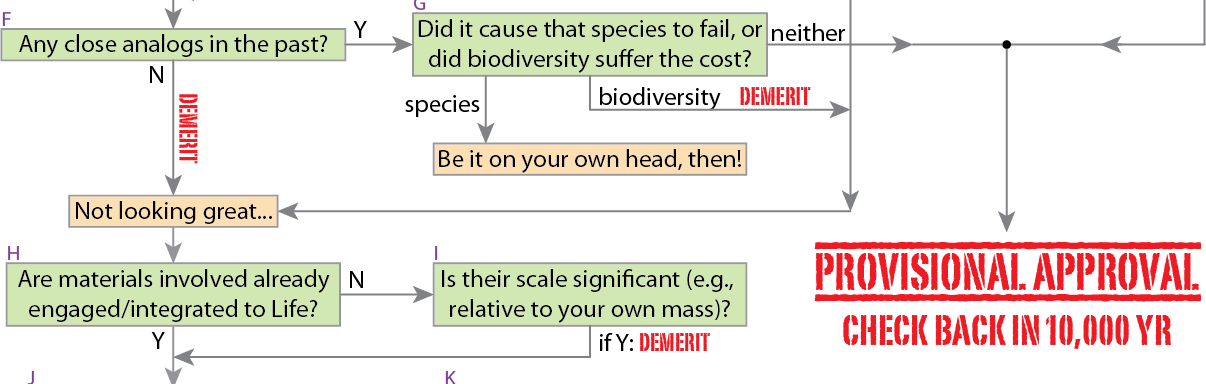
Because many of the human deviations from ecological norms are indeed novel and operate on a much faster scale than evolutionary adaptation (e.g., cultural/cognitive rather than genetic mechanisms), it sure would be handy to have a sneak peek on what ecological judgment is likely to say on the matter in the fullness of time. So: introducing the Ecological Deviation Application.
Continue readingViews: 2520