In Breach of Contract

Image by Edar from Pixabay

Evolution is like a lengthy job application process. Each new species endures a long and harsh vetting procedure to judge what role it plays in the ecosystem, how prepared it is to deal with lean years, predators, disease, climate variations, and anything that might reasonably be expected to arise even once in a thousand generations. Those species not able to satisfy the impartial judges of nature are voted off the island. It’s a tough crowd.

The successful species—the ones that have held on for many thousands of generations—essentially have signed a contract with nature. The contract is implicitly a “common law” arrangement: if you’ve stayed with us this long, you’re (indifferently) accepted as part of the family.

The terms of the contract are also implicit: as long as you continue to operate within the parameters by which you were judged to be adequate members of the ecosystem, you enjoy the built-in protection of that same ecosystem to continue survival, having carved out a role integrated into the rest by a complex web of interdependencies.

Humans signed our contract with evolution based on a primitive lifestyle that persisted for hundreds of thousands of years. We also inherited clauses from ancestor species, whose capabilities we incrementally altered, thus extending the vetting span to millions of years.

Humans today stand in gross violation of our pact with nature. We are egregiously in breach of contract. Our protections are thereby revoked.

Continue reading →

Views: 8291

Earth's Real Treasure

Image by Gordon Johnson from Pixabay

A 2018 paper by  Bar-On, Phillips, and Milo in PNAS contains a fascinating figure (Figure 1) that bears staring at for some time. It shows the dry carbon biomass distribution of various forms of life on Earth. Plants account for 450 Gt (giga-ton; 1012 kg) of mass, while the sum of all animals adds to 2.5 Gt. Humans comprise only 2.4% of animal mass on the planet, but that’s almost ten times as large as wild mammal mass. Add human livestock (outweighing human mass) and wild mammals are only 4% of the human-livestock-mammal trio.

But this post is heading somewhere else: lament about the un-wilding of the planet on your own time (kidding aside, please do!). Let’s start by considering the following question. Which do you think is more valuable: the web of living animals on this planet, or all the gold accessible in the ground? If given a choice to eliminate one and preserve the other, which would you choose? Gold, among Earth’s mineral stocks, is used for this question because it has served as a physically-based monetary standard for many cultures throughout time.

What follows has absurd elements to it, but hopefully in forgivable service of a larger point about the value of life on this planet and in shining a glaring spotlight on current human values.

Continue reading →

Views: 7854

Sir David Nails It

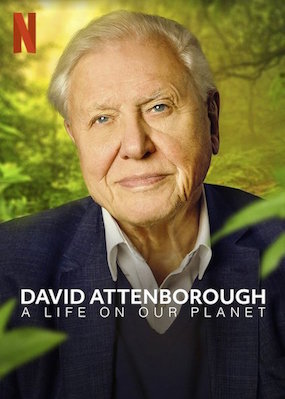
David Attenborough for A life on Our Planet

This is the TV poster for “David Attenborough: A Life on Our Planet.” (CNS photo/Netflix)

If you have not already watched A Life on Our Planet, serving as a witness statement from Sir David Attenborough, please find a way to do so. During his experience-rich lifetime, Attenborough has had a front row seat to the steady whittling down of nature. Any contemporary nature show will justifiably sound the climate change horn, as A Life on Our Planet does as well. But Sir David digs deeper, as few tend to do, and scoops up the essence of the matter.

I have now watched the show three times. The first instance resonated strongly with recent revelations and writings of my own, and I gladly watched it a second time with my wife. The third time, one hand hovered over the pause button while the other scribbled notes and captured key quotations. This post delivers said quotes and connects them to themes dear to my heart. Note: the quotes in the show are delivered verbally, so any formatting emphasis is my own.

Continue reading →

Views: 13881