Dream Presentation

Image by Mari Smith from Pixabay

I found myself having agreed to travel to a technical/astronomical conference on Maui—the same one I attended during the passenger-jet attacks of 9/11 decades ago. This time my wife traveled with me. When initially invited, I begged off: my interests now are very much misaligned to the type of audience at such a conference. But the organizer seemed to be a follower of my work, and said, “Nah: come anyway: give it your best shot. Many of us could use a shock.”

The trip itself was long and tiring, involving many strange twists that aren’t worth the burden to elaborate. Other exhausted people—many familiar faces from my astronomy days—trickled into the venue in time for the conference to start.

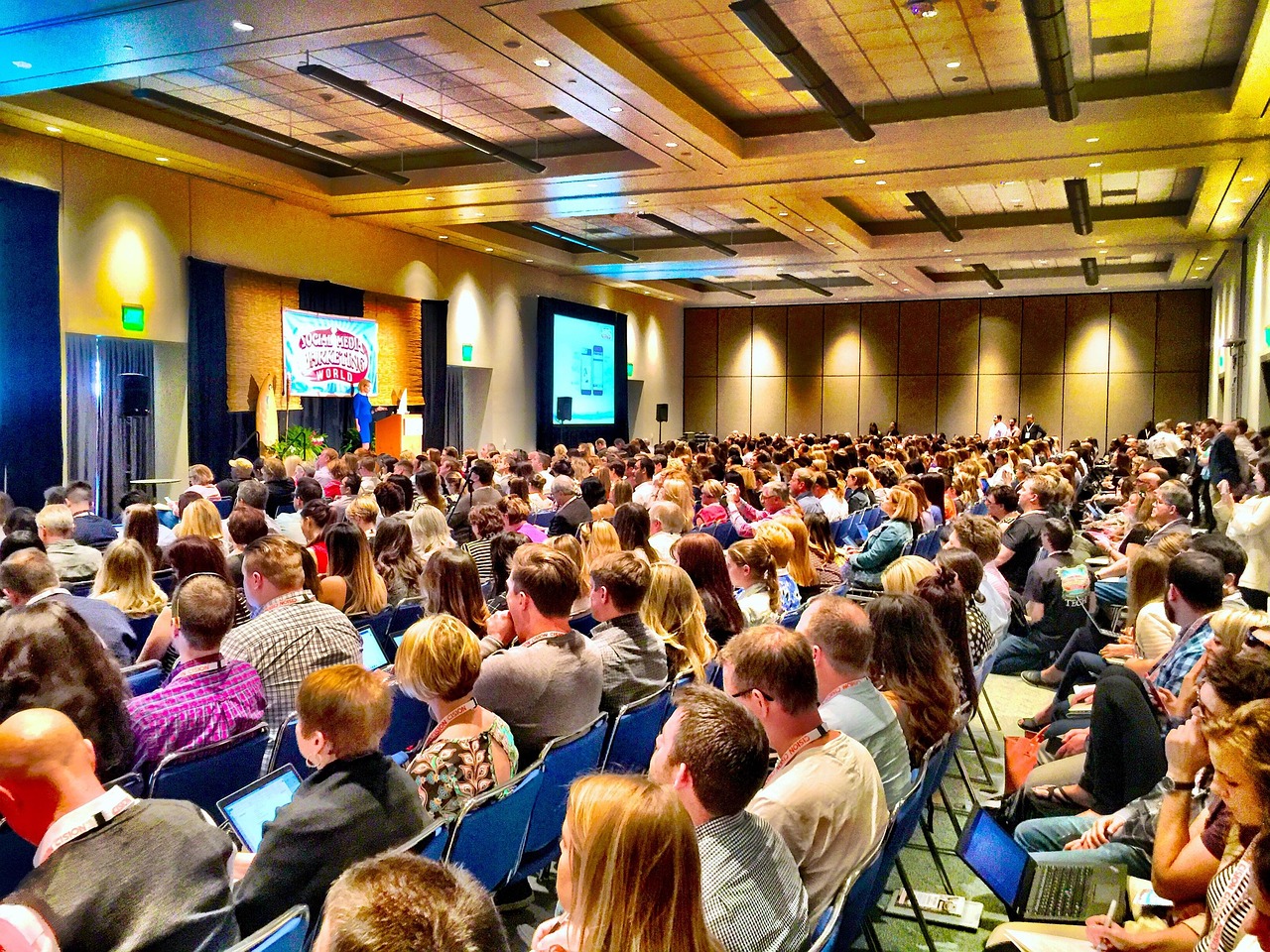
My talk was scheduled for 10:25 on the first morning of the five-day conference: the second substantive talk, after introductions and preliminaries. My wife and I found seats in the auditorium along the back wall, but the air conditioning unit was dripping water on us at an accelerating rate, so we moved to the side near the front, where the angle to the screen wasn’t great. During an intro video that showed many photos of past scientists and engineers at blackboards and the like, my wife turned around (we were not able to sit side-by-side) to excitedly say that she saw her father in one of those photos (which I had missed).

Around that time, the organizer who had invited me started introducing the conference goals to the audience—throwing in a mention of the challenging talk coming up by Tom Murphy. Enough heads tilted my way to alert the guy next to me that I must be this Tom Murphy character. Intrigued, he asked in a whisper if I could give him a one-sentence synopsis of my talk. I won’t spoil the rest of this post by repeating what I said, but his response was a bit of a chortle and something about how impressive software was. Irked by the confident but—in my view—ignorant dismissal, I muttered that my message would probably sail right by most people in the audience.

At this point, my wife picked up on the tension and asked what I meant by the synopsis sentence I had offered. My clarification made her squirm as well, essentially saying that I was being ridiculous. At this point, I realized I shouldn’t let these local interactions derail my focus, and that I really ought to polish up the talk slides in the short time remaining. Reaching into my backpack to pull out the laptop, I worried about how much charge remained, and had to dig past all kinds of highly-uncharacteristic junk-food wrappers accumulated during my travels to finally retrieve the computer. Then I woke up.

Continue reading

Views: 908

The Magic of Feedback

This young macaque learns to employ negative feedback to keep it safe (Image by Anne-Ed C. from Pixabay).

What we don’t or can’t comprehend might be called magic. By this measure, most of the universe is—and always will be—magic. That’s okay. The faith of a materialist monist is that the universe “knows” what it’s doing, and expresses itself in astoundingly diverse ways using an elegantly small number of particle and interaction types: more than compensating via breathtaking emergent complexity. We needn’t grok it all for everything to still work splendidly.

Often, the universe—or an element within it—appears to our naïve eyes to express intent. Organisms seem purposeful. Some aspects of our existence appear to be tuned just-so; self-referential; tautological; teleological. A star perches right on the edge of fusion, sipping its fuel as slowly as it effectively can. Earth finds thermal balance because a 1% departure from normal (absolute) temperature results in a 4% change in the rate of heat loss in the opposite direction (hotter amps up cooling; cooler curtails it substantially). The cell membrane of an egg yolk—or an egg shell, for that matter—is as thick as it needs to be to maintain integrity, but no thicker. Bones are as big as they need to be, and no bigger. Plants and animals tend to exercise sound judgment on the when, where, and how of the actions they take. It’s a world full of Goldilocks scenarios.

The result really is amazing and can easily seem magical. In such cases, ask whether the circular just-so nature might be attributable to feedback, which is also loop-like, and holds more power than is apparent. This post attempts to teach a bit of electronics before returning to how feedback performs effective magic in the real world. While it might seem a diversion, a grasp of feedback in the (much simpler/tidier) electronic domain can bolster appreciation of its power (magic) in the wider world.

Continue reading

Views: 1440

Why February?

An old calendar (by Vreijs from Wikimedia Commons)

In a bit of a break from heavy topics, we’re going to look at why February is so weird. The average month is 30.4 days, sensibly splitting into either 30 or 31. A seven-to-five distribution of 30-day months and 31-day months would get most years right, or an even split gets leap years. Why, then, does February jump the shark to 28? The weirdness doesn’t stop there, because in every year divisible by four February has 29 days: still unique among months. Yet this special treatment does not apply to century years. Except every 400 it does. February is the month that takes up all the slack in trying to fit a rigid integer-based system onto a more nuanced reality. And the choice of February is not entirely arbitrary. It would make less sense to abuse June or August in the same way, for reasons we’ll address.

All of this was inspired by equinoxes (thus the timing of the post: equinox happens Friday). More viscerally, all this was inspired by lengthening days. Living at latitude 48°, the days here go from just over 8 hours long to just over 16 hours long through the course of the year. Around this time, it’s quite dramatically noticeable how quickly day length is changing—by almost a half-hour per week at my latitude.

Continue reading

Views: 1632

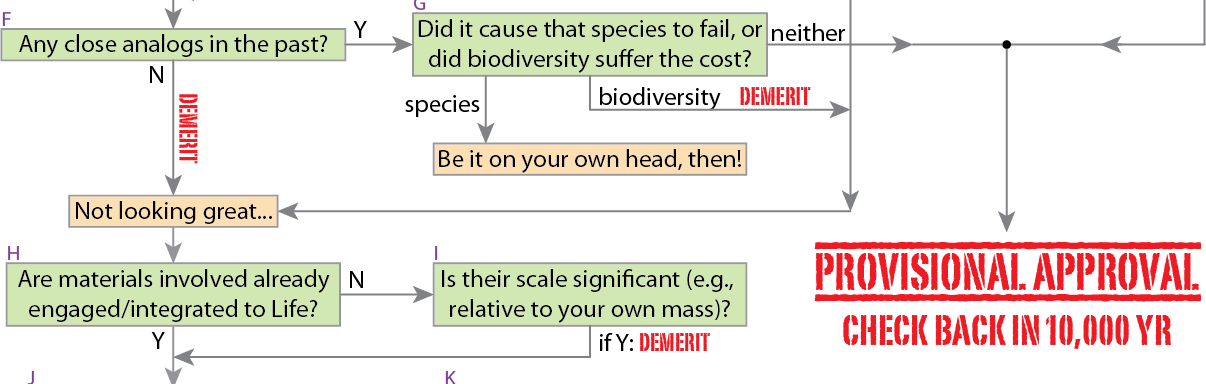
Ecological Deviation Application

Recent discussions on the roles of oral language, fire, stone tools, horticulture, agriculture, metal use, and written language in shaping the road to a sixth mass extinction motivated an attempt to capture key elements influencing the ecological impact of deviations from well-worn paths.

The idea is that living beings try new stuff all the time—and not mostly by cognitive eureka moments, but by stumbling onto new genetic or behavioral tweaks. No conductor needs to sit at the helm for this to just happen. The process is impossible to stop, in fact. Obviously many—or most—ideas/mutations/novelties fail. Usually, any harm is suffered primarily by the species itself. Occasionally, the deviation has a serious impact on many other species.

Ecology can take a very long time to pronounce a verdict. Evolutionary adaptation (speciation) tends to operate over (sometimes many) thousands of generations, and all the interactive ripple effects can reverberate for far longer. As a measure of relevant timescales, the age of Homo sapiens is (logarithmically) halfway between 100,000 and 1 million years old (∼300,000). Typical species longevity is in the range of 1–10 million years, also indicating the pace of ecological adjustment through evolution. Climate varies on faster scales, but life has an answer to that: phenotypic variation. Pre-vetted modalities can be activated and de-activated. Most species have been around long enough to possess a library of adjustments that can be accessed as conditions demand, so-long as the changes are part of their historical cycles—or even those of their ancestral species. Truly novel conditions are another story: no library entry for coping.

Because many of the human deviations from ecological norms are indeed novel and operate on a much faster scale than evolutionary adaptation (e.g., cultural/cognitive rather than genetic mechanisms), it sure would be handy to have a sneak peek on what ecological judgment is likely to say on the matter in the fullness of time. So: introducing the Ecological Deviation Application.

Continue reading

Views: 2552

EcoSphere Lessons

EcoSphere, from Wikimedia Commons

Try guessing the common glue that connects the following topics often covered on this blog in recent years:

  1. The Sixth Mass Extinction is a scary prospect
  2. Space colonization is a fantasy
  3. Agriculture and subsequent inventions spell bad news
  4. Meat-brains are not all that impressive
  5. Dualism drives a sense of separateness

A clue to the glue is that one word will do. And it’s not in the title, exactly. Have I spoiled the challenge with too many hints? Well, in any case, the word is: ecology.

Obviously, the first item is an ecological concern. The second is borne of total ecological ignorance. The third marks a turning point in our ecological relationships—from embedded participants to would-be masters. Our most consequential mental shortcoming is believing we can invent replacements for ecology that have long-term sustainable potential. And the last gets at the philosophical (metaphysical) underpinning that accompanies our ecological estrangement.

This post highlights yet another failure on the ecology front that has overlap bearing on these themes. That failure is the EcoSphere aquaria. An EcoSphere is a desktop curio containing a small, sealed community of life meant to sustain itself for long periods. And it does, sort-of: for a whole hundred-thousandth of timescales relevant to ecology and evolution. Yay? Only 99.999% more to go! You’re almost there!

Continue reading

Views: 2507