
What is Life?

By Conselleria de Medi Ambient, from Wikimedia Commons.

No doubt about it: Life is truly amazing. I mean, the things it gets up to far exceed our imaginations! (Just watch a few dozen Ze Frank “True Facts” videos to scratch the surface.) It hardly seems necessary to invest in a post to elucidate what constitutes Life, when a small child will correctly identify instances almost every time. Living beings demonstrate awareness about their surroundings, taking actions broadly in service of goals to thrive and reproduce. An amoeba marks itself as alive because we witness its purposeful mobility to secure food and evade danger.

Yet, living beings are undeniably made of atoms—atoms that do not appear in any close investigation to operate outside the usual rules of physics. Our sensation of awareness, experience of color perception, etc. seems so far removed from physics that the intractable connection is obvious to neither child nor adult. How could this awareness (what we label “consciousness”) possibly arise out of inanimate particles obeying physics without some “special sauce” unavailable to mere “machines” like computers or robots? It seems prima facie absurd, so it requires an unusual suspension of disbelief to submit to the baffling prospect.

How is it even possible, though, that inanimate matter can constitute Life? In a word: feedback. Life is feedback. The sun is of huge importance to Life, but we would not say that it is alive itself even though it actively engages with the universe and is a critical contributor to living beings on Earth. It’s continuance as a star is not contingent on these interactions. No feedback loop makes fusion in the core care what happens in Las Vegas. As an aside, I resist dividing lines and include the Sun (and everything else) in a living whole: just try doing without it!

Continue reading

Views: 3390

Decisions, Decisions

Which way will the coin decide to land? Image by ICMA Photos.

In my continuing pursuit of humility as an antidote to modernity’s human supremacy illness, the atoms that constitute who I am take issue with lofty and self-aggrandizing concepts of idealism, dualism, and free will—replaced by the unflattering material world and its staggering wealth of emergent complexity. I have argued that opposite of lacking imagination and being reductionist, such a view far exceeds our imaginative capacity and is in fact rather expansive and open-ended next to facile short-cut cop-outs that sweep mind-boggling complexity under the rug by pretending that constructs like mind, consciousness, soul, God, or Santa Claus are real.

One stubborn sticking point is the beguiling illusion that “we” are separate from “our” corporeal bodies, owning and controlling them, somehow. This notion is prevalent, despite zero evidence that we are anything but corporeal, and heaps of evidence to the contrary. A less supremacist variant allows that all life, down to microbes, are endowed with this material override to exert control and autonomy over their environments, but still demand a line of separation between life and inanimate collections of matter. An amoeba suddenly changing course in reaction to its environment is, in this view, ontologically different than a hurricane changing course in reaction to its environment.

Granted, life is amazing and exhibits unambiguous behavioral differences compared to, say, rocks (hint: check the complexity of internal structure). A materialist, mechanistic basis does not in any way diminish life, although that’s often the regrettable reaction from someone who takes it on faith that transcendent mystery accounts for life’s splendor—rather than intuition-busting eons of emergent material fabulousness. Well, it turns out that life is incredible no matter what inconsequential thoughts we form about it. In any case, the point that I will develop in this post is that “decisions” are carried out at every level from electrons to ants, but are at no point fundamentally operating on a different basis.

Depending on how one defines “decisions,” either electrons and bats carry them out by the same rules, or neither can be said to be making “free” decisions. Whatever the case, electrons and bats are on similar footing when it comes to “decisions,” albeit at vastly different scales of complexity. Given enough information and background, the decisions by either are not surprising, even if not precisely predictable. Now, I do identify a difference between living decisions and inanimate decisions, importantly, but it’s a subtle one that I’ll wind my way toward.

Continue reading

Views: 16933

What's the Point?

Time for a new paint job on the house?

Having developed a perspective that modernity is fated to fail, and that many of our culture’s current pursuits and institutions are misguided efforts to prop up temporary structures, I often encounter the reaction that I am being defeatist. If what I am saying is true, then what’s the point? Yeah: what is this point that others believe justifies all the craziness? Whatever they think “the point” is could well be based on unexamined and incorrect beliefs.

I will attempt in this post to explain what I mean by this, in multiple passes. A starter example may seem a little patronizing, but could still be helpful. If your world only makes sense and has meaning on the premise that Santa Claus exists, then you’ve put yourself in an unfortunate place. Others have found ways to appreciate life without that requirement based on a falsehood.

Let’s also try generalizing the concept before getting to specific examples.  We start with something I present that happens to be essentially true (or indeed comes to pass in due time), whether or not we can say so with absolute certainty. Then imagine that the reaction is: “well, if that’s true, then what’s the point of living?” Well, we obviously are living, and if we do so in the context of this truth, then it makes little sense to say there’s no point in living. The problem must then lie in what the person believes “the point” to be, and therefore must be wrong about that. In this sense, a “what’s the point” challenge might be taken to signal a flawed worldview.

Okay. That’s the template. Let’s do a few practice cases (optional if you want to cut to the chase), and work our way toward the main event regarding modernity.

Continue reading

Views: 5571

The Game of Life

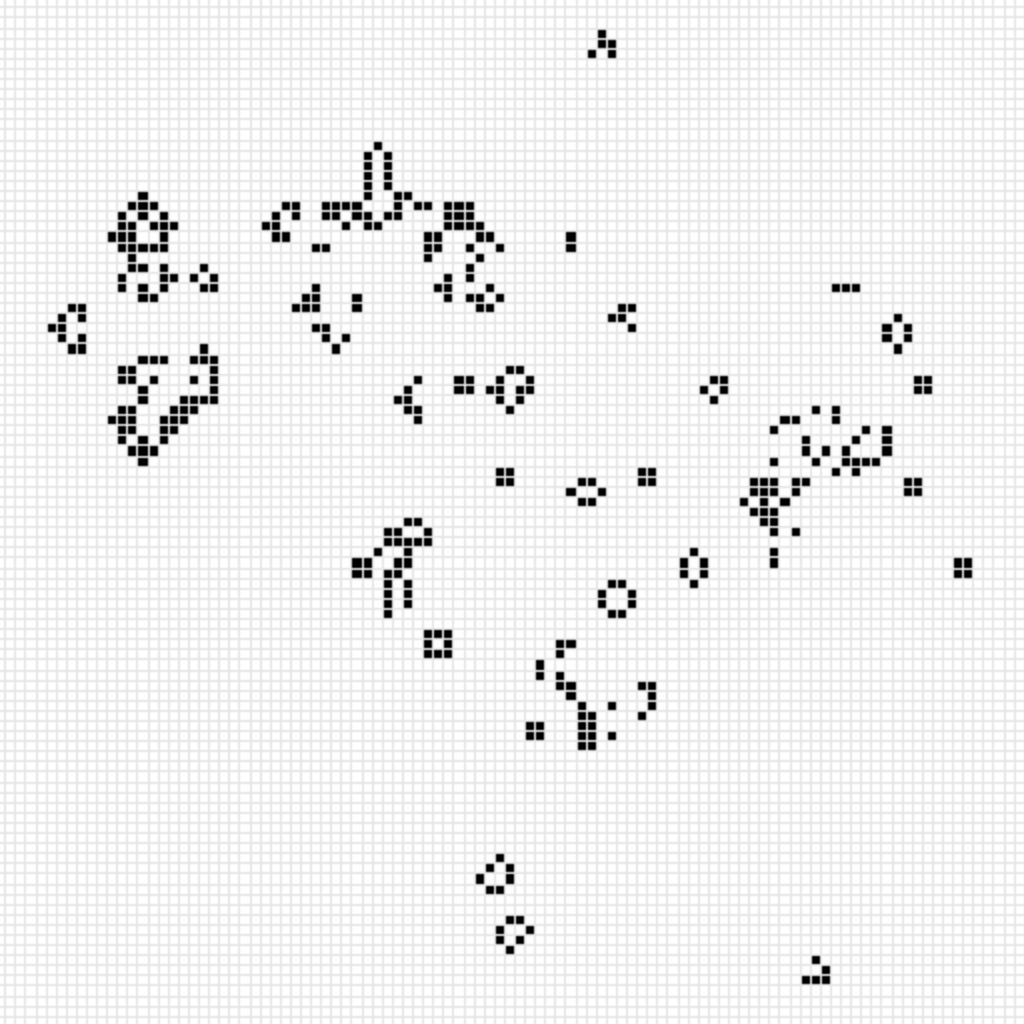
Step 400 of the acorn methuselah.  Gliders exit at 12:30 and 5:00.

Despite a lifetime of overlap, and many opportunities to cross paths, I am only now learning of the Game of Life, introduced by John Conway in 1970—the same year that I was introduced to the world. After a few exploratory hours, I knew I’d have to share the insights I gained from it relating to how we react to the present predicament.

What is it that I mean by The Game of Life? Aren’t we all caught up in it? I refer, here, to a zero-player “game” taking place on a two-dimensional grid of square cells (pixels) that can either be alive (on; black) or dead (off; white). Only two simple rules govern whether a cell will live or die in the next time step of the game:

  1. Only “live” squares having two or three adjacent live neighbors (out of 8 possible) survive to the next step.
  2. An empty (“dead”) square having exactly three live neighbors will be “born” into living status on the next step.

The first rule captures a sense of balanced population density: too sparse and survival is hard; too dense and overshoot kills. The second rule is a sexy three-way approach to procreation. Settle down, people.

A surprising degree of complexity emerges from these simple rules, whose deterministic prescription nonetheless leads to essentially unpredictable outcomes. The lessons and parallels to real life—and even breakdowns in the comparison—are highly instructive, I find.

Continue reading

Views: 7564

Mysterious Materialism

Image by Kerstin Herrmann from Pixabay

My recent posts have suggested that our world, in all its magnificence, needs nothing beyond physics and emergent complexity to still be mysterious and inspiring, which in turn can lead to being better, humble ecological partners in the community of life. While many human cultures have gravitated toward beliefs in gods, human transcendence, or a higher purpose, I point out that the billion-year timescales of evolution offer plenty of room for unfathomable results that defy our cognitive capacities to grasp. What if all it takes is physics (particles in uncountable relationships) and lots of time for amazingness to emerge? Are you not entertained?

Such a view might predictably be denigrated as reductionist, materialist, and lacking imagination. It’s ironic, because from my point of view it seems to require a super-human amount of imagination: so much that I don’t possess nearly enough on my own—nor has any other human been able to put it all together for us. The very same “failure” of complete end-to-end explanation that causes many to reject the premise leaves me in awe, wonder, and appreciation. One might say that it’s a more challenging concept than the alternatives.

Our recent trajectory has been one of serial demotions, each perhaps more insulting than the last. Earth is not at the center of creation. Nor is the sun at the center of the galaxy. Our galaxy is not at the center of the universe. Our universe may indeed be one among countless others (we can probably never know). Closer to home, we learn that humans evolved from apes, tracing back to slime in our distant lineage. As a corollary, humans are not, in the end, exempt from the laws of life: we are physical beings still subject to—and dependent on—biological and ecological constraints. The proposal I discuss takes the demotion series another step: removing imagined transcendent properties of free will (mind, or soul) and divine favor—instead establishing us as compulsory actors in an extravagant production of physics. It all makes for a rough day, unless your expectations are unusually low.

What could be more humbling than to accept ourselves as piles of atoms executing the interactions of physics? Note that we could use heaps and heaps more humility in our world. Perhaps this is one route to get there: a principle that also more closely binds us to all other life—to our collective benefit.

Continue reading

Views: 3214

Free Will: Good Riddance

This baby violet-green swallow faces the first big decision of her life: should I stay or should I go, now.

I never cared much for arguments about free will, one way or the other. I put free will into a similar category to other wastes of time in philosophy, like the Great Deceiver concept or the trolley problem. Angels on the head of a pin, anyone? It seemed like one of those unresolvable debates that has persisted for centuries: a tar baby that one would be foolish to punch.

If an opinion was demanded of me, I would say without particular conviction that I leaned toward a position that free will was an illusion, but that I was happy to behave as if I had free will, and then get on with life. My leaning toward illusory free will stemmed from a sense that our decision center is no more than a bolus of interconnected neurons, shaped by many influences in the physical universe.

After listening to a podcast featuring Robert Sapolsky based on his new book Determined (which I have not read yet), I found my position coming into focus. A large majority of people in our society—over 80%—believe in free will. Indeed, it is often pointed out that our criminal justice system is predicated on the concept. Some folks (called compatibilists) adopt a squishy compromise position that attempts to assess how “internal” a decision is (good luck with that). Few members of modernity reject free will completely, but that’s where Sapolsky landed, and I found his arguments to be persuasive.

A recent article by Richard Heinberg explored the interaction between belief in free will and our response to the meta-crisis: can we save the world if we don’t have free will as a motivating engine? Although I am somewhat reluctant to weigh in on the pernicious free will topic, what the hell. I find myself compelled to do so.

Continue reading

Views: 11605