Bus Driver on Mars

I was recently on a medium-haul bus ride, sitting within earshot of the driver—but not the closest passenger to him. I’d encountered him a few times before: a somewhat chatty middle-aged fellow given to telling the occasional joke into the microphone for the whole bus. He is, on the whole, a friendly and likable guy, who does his job well.

The passenger sitting in front of me obviously had talked with him before, because at one point he asked the driver for an update on his ion drive. It took three tries to have his question heard correctly: “eye-on drive?” But once clear, ho boy did the conversation take off!

This post is partly for entertainment value, but also serves to highlight delusions about space. Granted, some people might judge this character to be a little “out there,” but to my ears all space talk is at a similar level of crazy.

Continue reading

Views: 94

Ditching Dualist Language

Language built around the soul (Wikimedia Commons).

In the aftermath of surviving the construction of a mono-syllabic blog post—as an exploration of language’s inherent limitations—it is perhaps time to attempt a post in which the dualist underpinnings of modern language are examined and minimized. As an aside, perhaps “Aftermath” would be a better name for this blog, given its shift of focus from quantitative energy analysis to a broader condemnation of the consequences of modernity.

How is the English language a Trojan Horse for dualism? Several major constructs preserve and promote dualistic thinking. Foremost is personhood: first-, second-, and third-person framings emphasize the primacy of individual agency and ownership. Ownership receives its own possessive pedestal in language construction—present even in this sentence. Pronoun choice then serves to establish possession of personhood—or, significantly in the context of a dualist mindset, lack of personhood denoted by “it” (see this fun solution by Robin Wall Kimmerer). Also looming large, subjects and objects serve to promote a clear duality of agency: something or someone does something to something or someone else. The framing promotes humans as subjects having subjective experiences involving instrumentalized objects. Even the use of “something or someone” two sentences back nurtures a dual classification scheme.

This post will explore some of these pernicious dualistic influences in modern language. Throughout, every attempt is made to use non-personed language—mainly via avoidance of “I”, “we,” etc. Some experimentation will also appear toward the end attempting to break subject/object dualism. Don’t expect too much. It is English, after all, and thus a flawed starting point.

Of course, most people in our culture—imprisoned by dualist convictions and thoroughly steeped in dualist language—would struggle to make any sense of the objections and work-arounds contained herein. Presumably, readers of this blog are more amenable to questioning pervading metaphysical foundations.

Continue reading

Views: 1268

On A Lark

Prose for Neanderthals (Wikimedia Commons)

A few times now I have played a game with friends in which you try to get your team to guess a word on a card by way of hints/words you come up with. What makes it hard is that you may not use long words that need more than one “sound” to speak (yes, there is a word for that, but if I used it here, I would break the rules). If you slip up and use a “big” word, you get bopped on the head with a club (a soft one that is blown up with air from your lungs).

What I found was that my style is not the same as that of my friends. They tend to speak one word at a time, each one picked as a key hint that might—on its own—help close in on the word to be guessed. An example might be that hints for the word “soup” would be words like “hot,” “slurp,” “bowl,” “cup,” “broth.” It gets the job done.

But I tend to speak whole thoughts as a string of words that have nouns and verbs and all the bits that join them—the way we tend to speak in real life. And for the most part, I seem to keep up a pace close to what I can do in day-to-day speech—if not just as fast. In the “soup” case, I might say “It’s a type of food made with broth that you eat or slurp from a bowl or cup: best on a cold day or when you’re sick.” I can tell you that it works well. My friends are so quick to guess the right word when I use this scheme that I don’t make it to the end. It turns out that our brains are well-tuned to this style of speech.

On a lark, I thought I would try to write based on these rules, to see where it might go. So far, so good—sort-of. A few times I have had to go off on a strange path to make my point, when a key thought seems to have no short word that can do the job. But as I wrote more, things took a turn that I had not guessed would come to pass when I set out. The lark took the shape of a post!

Words do not make the world. They can’t catch all that is real. Words can’t give a full sense of how red does not look like blue, or what light is, or how quarks move, or why some things are charged or what charge is, in fact. Words are not up to the task. The world has been here for far more time than words have, so does not and can not work based on them. Words can give no more than a poor, pale sense of the truth of things.

What I want to do in this post, just for fun (well, more than that), is use the rules of this game to show how hard it is to make a strong and clear case for a point that would still be tough to make if I could use all words. I think/hope we can learn from it. When bound to a small set of words, all kinds of wrong views can be spawned in the cracks that are left. But this is true as well when the full set of words can be used, which is—let’s face it—still a small set in the grand scheme of things. In each case, words have no choice but to fall short of the full deal.

Continue reading

Views: 1454

Babylonian Banter

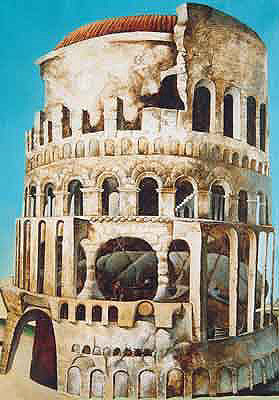
Tower of Babylon (by Jankaka on Wikimedia Commons).

In November I gave a seminar talk for the Planetary Limits Academic Network about why I believe modernity to be a dead-end, while also touching on underlying attitudes that drive us in this destructive direction. When presenting the narrative that sequential development of agriculture, writing, money, science, and fossil fuels collectively constituted a decisive trap leading us to the current state, I got pushback from a few in the audience over the notion of determinism. See my Time on the River post for a flavor of this narrative.

Fans of Graeber & Wengrow’s Dawn of Everything (and there are many, especially in the left-leaning academic circles from which I hail) tend to be—like the authors—allergic to suggestions of determinism. They find the notion very appealing that we could just as well have designed and conjured the ideal technological society: egalitarian, global, peaceful, prosperous, clean, and all the rest. See Abundance as recent example of such eco-modernist fantasy. I was honestly stunned by the gross simplifications in Graeber & Wengrow’s book, which elicited a sharp critique from me.

The moderator of the seminar prodded Chris Smaje, in attendance, to comment on my negative portrayal of agriculture. Chris has written, among other books, A Small Farm Future, runs a blog of the same name, and is generally an advocate of a small-scale agrarian response as a path to exit modernity—which in itself I believe is a fine (transitional) strategy.

The discussion prompted Chris to draft a blog post, which he passed by me to avoid misrepresentation and to solicit comments. We had an engaging e-mail exchange for a bit, and last week his post (By the Rivers of Babylon: debating agrarianism with Tom Murphy) went live. This post offers my follow-up response on the subject.

Continue reading

Views: 2983