
Textbook Tour

Energy Ambitions textbook coverLast week, in the first Do the Math post in years, I kept the post brief, only pointing out the new textbook: Energy and Human Ambitions on a Finite Planet, and giving a brief account of the backstory.

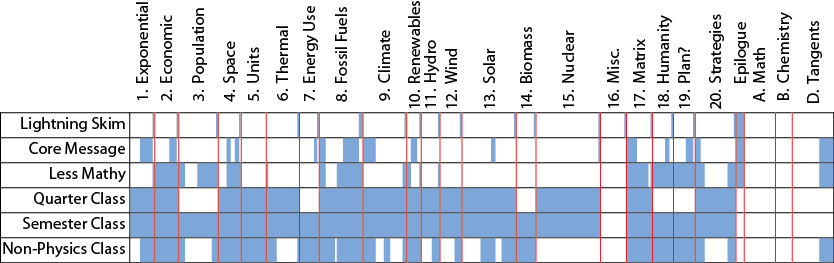
In this post, I take a bit more time to introduce new elements in the book that Do the Math readers have not seen represented in some form in earlier posts. In other words: what new insights or calculations lurk within the book?

The following is organized into three sections. The first takes a brief tour of the book, pointing out large, new blocks that are not already covered by Do the Math in some form. The second highlights the results of new calculations or figures that bring new context to our understanding. Finally, I summarize some of the new big-picture framing that emerges in the book.

Rather than laboriously inserting associated graphics into this post, my intent is that you treat this as a companion to be used side-by-side with the downloadable PDF of the book.  References are to sections, figures, boxes, etc. rather than page numbers, which vary between electronic and print forms. So go ahead and get a version of the PDF up, and let’s jump in…

Continue reading

Views: 4135

Textbook Debut

Energy Ambitions textbook coverHello, all, and welcome (me) back! After years of radio silence, I am popping back up and have more to say in the coming months as I re-engage on topics relevant to this blog.

The first thing is to announce the launch of a textbook at eScholarship that is free to access electronically (can download PDF), or is available in paperback form for the cost of printing (royalty-free; at Lulu). Over the years, I received a number of encouragements to write a book collecting the ideas and analysis from Do the Math posts. I appreciated the sentiment, but given the substantial effort required to produce something that was already available for free on this site never rose to a high priority in the competition for limited time.

Continue reading

Views: 9326

Eclipsed, Lately

HDR composite of eclipse (Tom Murphy)In the event that anyone still checks this site for new posts (not sure whether to be proud or concerned), here’s an update. But mostly it’s a pointer to some photos I think some may enjoy.

While I remain concerned about the collision course between growth and resources, I have found ample distraction these past few years: research, teaching, administrative duties, bike commuting, and starting a company to make aircraft detectors. Oh, and politics. What a spectacle!

Speaking of spectacles, ever since traveling to Mexico in 1991 to see my first total solar eclipse, I’ve wanted another one. Just afterwards, a consultation of upcoming events suggested that the next one I was likely to see would have me waiting until 2017! As a 21-year-old, I wondered if I would even still be alive in that distant year, inconceivably old. I made it. And what was I thinking—old?!

So after much anticipation and preparation, I traveled north with a college friend, remote-camping/mobile and ready to pounce on the best weather prospects. We ended up in far eastern Oregon, on BLM (our) land. The experience was amazing: I automated my cameras so that I could largely just gawk. It was all too short: I needed a pause button to really take it all in. I’ll have to settle for future eclipses. And to that, I say Mexico (not the U.S.) in 2024—based on likely weather. Besides, it’s unclear whether the eclipse shadow will be able to get past the wall we keep hearing so much yakking about.

But you can see highlights of my photos from the recent glorious event here.

In other news, my Nickel-Iron batteries seem to be holding up well (I owe a post on some real analysis of these). I am “living the dream” in my daily commute. After 12 years off a bike (obvious routes are dangerous; hilly profile would require time-inefficient shower), I finally solved the problems: (longer) trail route and an e-bike (off-grid-solar-charged). Purists would say I’m cheating, but I say I’m back on a bike and working plenty hard. The rough-hewn route exposes me to wildlife (the occasional coyote or bobcat, even), has a few stream crossings, and enriches my life by offering a daily connection to the natural world. My propulsion energy is now free of direct contributions from fossil fuels, which I find to be rewarding—even if the materials/manufacture are still utterly dependent.

So that’s it for now. I haven’t given up on Do the Math, but have not had much new to say, and little available time in any case. I hope all is well with you all.

Views: 2497

You Call this Progress?

One of the prevailing narratives of our time is that we are innovating our way into the future at break-neck speed. It’s just dizzying how quickly the world around us is changing. Technology is this juggernaut that gets ever bigger, ever faster, and all we need to do is hold on for the wild ride into the infinitely cool. Problems get solved faster than we can blink.

But I’m going to claim that this is an old, outdated narrative. I think we have a tendency to latch onto a story of humanity that we find appealing or flattering, and stick with it long past its expiration date. Many readers at this point, in fact, may think that it’s sheer lunacy for me to challenge such an obvious truth about the world we live in. Perhaps this will encourage said souls to read on—eager to witness a spectacular failure as I attempt to pull off this seemingly impossible stunt.

The (slightly overstated) claim is that no major new inventions have come to bear in my 45-year lifespan. The 45 years prior, however, were chock-full of monumental breakthroughs.

Continue reading

Views: 15301

My Chicken of an EV

Yes, that's my chicken atop my car.

Yes, that’s my chicken atop my car.

A little over two years ago, my wife and I entered a new phase of life in two respects: we got three chickens, and we got a plug-in hybrid vehicle. They have more in common than I would have thought. We see flagging performance in both (egg-laying and battery capacity). We knew the chickens would only last/live for something like 4 years. It’s looking like the EV battery may be similar! Both are happiest pipkining around: plodding about at a leisurely pace. And perhaps like some children, they both disappoint us at times, but we are fond of them all the same. They’re good girls, we tell ourselves.

It may come as no surprise to you that I’ve been collecting data (yes, on both “experiments,” but I’ll spare you egg masses and laying schedules). It takes a little time to do, but recording/resetting the trip meter for every charge, noting charge time and energy delivered, and convincing the wife to go along does pay off, as you will hopefully be convinced.

From the data, I see that the battery capacity is at about 85% of its original condition. While extrapolation is highly risky, it would seem that I can expect zero capacity on the scale of six years, based on its accelerating decline. At this point, we have put about 500 full-cycle-equivalent charges on the battery in about 700 charge events (just shy of one per day, typically about 70% depth). So perhaps it’s not surprising: few batteries can withstand more than 1–2000 charge cycles before giving out.

Want to see some data?

Continue reading

Views: 3976

Global Perspective

For some light summer amusement, I thought I would share a map I made a while back to satisfy my curiosity. I’ve had the plot in my office for several years and occasionally think to pull it out for visitors I suspect will enjoy it. I usually just hand it to them and let them puzzle over its meaning before I explain anything. It’s not meant to be an IQ test—although doubtless some feel that way—but rather a chance to delight in self discovery. I “discovered” the 7-24-25 Pythagorean triangle the other day quite by accident while constructing a relativity problem and was delighted by the find—even though Wikipedia has an exhaustive list of other sets wholly unknown to me. Likewise, I “discovered” Saturn as a 15-year-old on a summer night with a small telescope just poking around an unfamiliar sky. I danced around the yard in delight. My point is that discovery is personal, even if not original.

So here’s a chance to discover what the map is meant to convey. I’ll naturally explain later.

wmap-0

Continue reading

Views: 1342

Programmed to Ignore?

[An updated treatment of some of this material appears in Chapter 18 of the Energy and Human Ambitions on a Finite Planet (free) textbook.]

640px-CognitiveFunctions

I started Do the Math in 2011 as a way to reach a larger audience than a handful of students every year or two in an energy course at UCSD. I had (and still have) deep concerns about the assumptions we make as a society based on our fossil fuel trajectory over the last century or so. Trying to steer policy from the top seemed a losing proposition: feckless politicians hew to their constituents’ desires via a mechanism we call democracy, so why not try to get people on board directly?

I never imagined creating a blog that would get millions of pageviews, although this by itself falls well short of having an impact on a grand scale. But I figured I owed it to myself to reach as many as I might. What I have found is that a select few seem to share my concerns. And some vocal contributors to comments strongly disagree that we need to worry (why then make the seemingly wasted effort to respond to—in their eyes—doomsaying kooks if in fact we need not be concerned?). But most people simply don’t care enough to tune in. They’ve learned to ignore prognostications of any flavor, perhaps. Lately, even fewer people are entertaining ideas of resource limits owing to increased global oil production (led almost entirely by U.S. shale oil) and a recovering economy.

But I think there is something more fundamental going on here. I think we’re dealing with personality traits cooked into human nature. Are we capable of mitigating a far-off potential calamity via proactive efforts decades ahead of a putative crisis? In this post, I’ll use some survey data suggesting that we may be in trouble.

Continue reading

Views: 16445

Okay: Three Question Survey for DtM Readers

I should have done it right the first time.  I now realize that I’m hungry for a tiny bit more information in relation to personality type.  I have had almost 500 responses to the previous query (see previous post, below).  The results are fascinating.  I have added two quick questions that will give me a fair bit of insight into some key systematic issues.

Even if you have answered the poll already, I would appreciate a quick moment of your time to answer two additional questions (click here).  It requires very little time: especially if you responded to the first survey request.

If you did not respond to the first survey, please do this one.

Instructions appear on the survey page for how to determine your Myers-Briggs type, if you do not already know it.  Thanks for your patience, and look for a post in mid-April with the jaw-dropping results.

Views: 955

One-question Survey for DtM Readers

I have a new post written up, but thought that before I release it I should get some delicious new data.

To that end, please take this single-question bare-bones survey (link decommissioned; see this post) about your personality type.  There are sixteen choices in a drop-down menu according to the Myers-Briggs personality type indicator.  If you do not already know your type, you can find free online versions.  While I have no particular affinity for this specific one, it may be good for the sake of uniformity that you go take this one.  It’s 72 yes/no questions (should take 5–10 minutes).

Just remember to be honest and answer for the person you are, rather than the person you may aspire to be (if different).

And don’t forget in your excitement to indicate the outcome on my lighting-fast survey (link decommissioned; new survey here).

I’ll let you know what it’s all about shortly.


Views: 975

BBC Questions Indefinite Growth

Theo Leggett of the BBC interviewed me in late January as part of a program asking: “Can the World Get Richer Forever?”  You can listen to the show here.  My part begins about eleven minutes in.

I was also asked to contribute some short text for the write-up (same as first link above), but apparently Theo was unable to get contributions from all participants, so wrote the piece himself.  But here is what I sent him.  I was asked to answer the question:

Can the World Get Richer Forever?

Shame on you for even asking.  Of course not.  At present population levels, we are putting unprecedented pressure on finite resources.  We are conducting a grand-scale, unauthorized experiment on the 4.5 billion-year-old planet.  The fact that we have not hit the bounds in a few generations of outrageous growth should not be taken as evidence for our long-haul prospects.  We live like kings today, on the backs of roughly 100 energy slaves each (human metabolism is 100 Watts, but Americans enjoy 10,000 W of continuous power).  Our richness is very much tied to surplus energy availability, and that so far has been a story of finite fossil fuels.  But even under solar power, we can’t continue our track record of 3% energy growth per year for even several hundred years!  Global physical limits—thermodynamic, energy return on energy invested, finite arable land, water, fisheries, climate change, etc.—are all asserting themselves to remind us that nature doesn’t care about our dreams.  The other point to make is that even if we capped physical growth due to finite resources, we cannot expect to continue getting richer indefinitely.  This would necessarily take the form of non-physical exchanges of utility/worth, but to keep growing these activities would have to eventually utterly dominate the economy—rendering the finite and essential resources effectively free.  And tell me how that makes sense.


Views: 2186