On A Lark

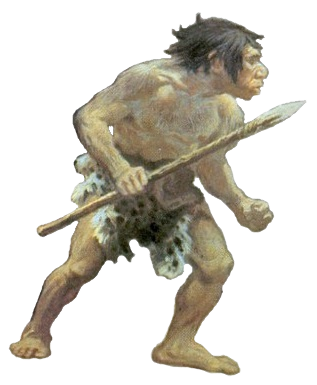
Prose for Neanderthals (Wikimedia Commons)

A few times now I have played a game with friends in which you try to get your team to guess a word on a card by way of hints/words you come up with. What makes it hard is that you may not use long words that need more than one “sound” to speak (yes, there is a word for that, but if I used it here, I would break the rules). If you slip up and use a “big” word, you get bopped on the head with a club (a soft one that is blown up with air from your lungs).

What I found was that my style is not the same as that of my friends. They tend to speak one word at a time, each one picked as a key hint that might—on its own—help close in on the word to be guessed. An example might be that hints for the word “soup” would be words like “hot,” “slurp,” “bowl,” “cup,” “broth.” It gets the job done.

But I tend to speak whole thoughts as a string of words that have nouns and verbs and all the bits that join them—the way we tend to speak in real life. And for the most part, I seem to keep up a pace close to what I can do in day-to-day speech—if not just as fast. In the “soup” case, I might say “It’s a type of food made with broth that you eat or slurp from a bowl or cup: best on a cold day or when you’re sick.” I can tell you that it works well. My friends are so quick to guess the right word when I use this scheme that I don’t make it to the end. It turns out that our brains are well-tuned to this style of speech.

On a lark, I thought I would try to write based on these rules, to see where it might go. So far, so good—sort-of. A few times I have had to go off on a strange path to make my point, when a key thought seems to have no short word that can do the job. But as I wrote more, things took a turn that I had not guessed would come to pass when I set out. The lark took the shape of a post!

Words do not make the world. They can’t catch all that is real. Words can’t give a full sense of how red does not look like blue, or what light is, or how quarks move, or why some things are charged or what charge is, in fact. Words are not up to the task. The world has been here for far more time than words have, so does not and can not work based on them. Words can give no more than a poor, pale sense of the truth of things.

What I want to do in this post, just for fun (well, more than that), is use the rules of this game to show how hard it is to make a strong and clear case for a point that would still be tough to make if I could use all words. I think/hope we can learn from it. When bound to a small set of words, all kinds of wrong views can be spawned in the cracks that are left. But this is true as well when the full set of words can be used, which is—let’s face it—still a small set in the grand scheme of things. In each case, words have no choice but to fall short of the full deal.

Continue reading

Views: 992

Ditching Dualism #10: Determinism

This driver is free to do anything with the steering wheel and gas pedal, at any time…or is he, really? (Photo by Szymon Kochański.)

One major hangup in subscribing to a physics-based universe of material monism is that it appears to remove human agency as typically conceived in our culture. If atoms and their interactions are making everything happen, abiding by rules they (or we) cannot violate, is there any room left for human intervention or free will? As obvious as it is to us that we can weigh decisions and do things when/as we want, this disconnect alone is often enough to cause categorical rejection of materialism—retreating instead to the more comforting and self-promoting metaphysics of dualism. This is quite understandable: the notion that physics, not “soul” is the master of all “our” actions is an exceedingly challenging prospect for meat-brains to square—especially when modern language is constructed around first-person ownership of “ourselves” as subjects. Even if able to make intellectual sense of the matter, it’s still a tough pill for anyone to swallow. It sure doesn’t feel right, for what very little that’s actually worth.

Determinism also rubs people wrong in the context of history: suggesting that only one path was available to the present, precluding any potential counterfactual fantasies that are all-too-easy and entertaining to imagine (by leaving out almost the entire, actual universe in meat-brain models). It also might imply to some (erroneously) that humans played no role in shaping events, if there’s only one way said events could have played out.

Many react to determinism with a “then what’s the point, if everything is pre-determined” sort of response (another fallacious framing). Determinism seems to lay out railroad tracks to the future, leaving nothing for us to do. Why even get out of bed, then?

I’ll try to address these issues here. Perhaps I’ve said it all scattered across other posts and comments, but here it is all in one place, with a few new twists and perspectives. Bear in mind that I am presenting (advocating) the case against dualism and for materialist monism. Please forgive the fact that I do not couch every statement with “In the materialist monist view…,” the repeated absence of which may come across as laying claim to ultimate truth, which of course I cannot do.

Continue reading

Views: 1827

Ditching Dualism #9: Reductionism

Atoms get up to phenomenal self-organized arrangements (adapted from a photo by warrenski on Wikimedia Commons).

Two posts back, we discussed common objections to the materialist (monist) perspective, before visiting the idea of material sentience. Another form of objection is to label such views as “reductionist.” The thinking is that claiming Life to be “nothing but” matter is not only a staggering simplification, but also reduces the amazingness of life to mere “dead” physics.

But see, not only is the “dead” part dead wrong (animated interactions never rest!), the objection itself requires a fundamentally dualist perspective: asserting/fabricating a hierarchy and division between Life and matter as a non-negotiable starting point. If the concern is that Life is devalued by comparing it to (or even further, saying it fundamentally is) “just” matter, the problem is in concocting a dual valuation in the first place. Why not say the entire singular phenomenon is amazing? Maybe the problem is in denigrating matter. What’s the equivalent of “racist” when it comes to matter? I guess “dualist” will do.

Thus, we may appreciate how “sticky” dualist beliefs are. Without truly inhabiting a non-dualist viewpoint, any materialist approach seems reprehensible from within that biased framework. Lots of belief systems feature similar mechanisms to quell questioning or discourage straying far enough from the path that the path begins to seem janky.

Continue reading

Views: 1590

Ditching Dualism #8: Sentience

These animated little guys know what they’re about: sensing and responding (sentient). Adapted from Wikimedia Commons.

Now we turn to one of the more perplexing aspects of materialism: one that prevents many from abandoning dualist beliefs. How can sentient living beings possibly arise from matter alone? Dualism asserts a sharp ontological divide between animate and inanimate (mind and matter as a parallel aspect), categorically prohibiting animate beings from being wholly composed of inanimate matter. The last post addressed the flaw in characterizing matter as being “inert” in the first place.

But even once past this barrier, our inability to connect all the dots from atoms to conscious experience (which no one has managed to do, and likely never will), strongly tempts us to declare—assuming phantasmic authority—that no such route even could exist, or that failure to map it means it may as well be declared non-existent (a reaction worthy of the Ravenous Bugblatter Beast). Where’s the adventure in that?

As an aside, allusion to “phantasmic authority” above may elicit the reflexive charge that advocating materialist monism is an equivalent assertion devoid of authority. Not so fast. Materialist monism amounts to being satisfied that matter/interactions can plausibly form the entire basis of reality even if we don’t understand how. It is in claiming materialism to be insufficient—without evidence—that meat-brains seize more authority than they are due. Materialist monism cedes authority to the universe as we find it, rather than presuming to fabricate comforting alternatives.

Anyway, lacking a complete map, how does materialism deal with our experience as sentient beings, or other sentient life? We find a significant clue in the etymology of sentient. The root word is “sense.”

Continue reading

Views: 2410

Ditching Dualism #7: Objections

Why is strict materialism a hard sell for many in our dualist-dominated culture? Okay, so some are understandably pulled by the attractive idea of an immortal soul. Others just feel that there has to be more to all this than the interplay of matter and energy in a vast, unblinking universe. But attractions aside, what are typical objections to a material-only existence?

It may be instructive to ask why people objected to the idea of a round Earth, to the prospect that Earth orbits the sun, or to the concept of evolution (see Daniel Quinn’s “three dirty tricks“).

Part of it, we must recognize, is good-old-fashioned ignorance. If unaware of the observations in conflict with the stale stance, or insufficiently observant, there would seem to be no need to switch trains. The old view serves quite well enough, and even engenders a certain fondness or comfort. Also contributing is that incomplete grasp of the new idea (perhaps poorly delivered or too unfamiliar) favors its premature rejection—after which entrenchment more likely obtains. But then again, most changes in worldview at the cultural scale happen via generational replacement rather than by changed individuals.

Continue reading

Views: 2757

Ditching Dualism #6: Maybe Monism?

Blurring into one, without boundaries (see details for creating this graphic).

Okay, we needed to go on a long two-post detour in order to better understand how manifestly-imperfect mental models trap many of us in a self-centered dualistic mindset, and how we might recognize the pattern and move past it. For some, it may be tempting to focus on the division between humans and animals as the crux of dualism, but the more fundamental divide as articulated by DayKart [my gesture of disrespect] is between mind and body (matter). As long as we hold minds to be transcendent phenomena apart from matter and proclaim without evidence that “mind” could not possibly derive entirely from vanilla physics and atoms, we risk elevating ourselves to holy status—justifying the savaging of mother Earth as a collection of commodified resources. Perhaps more importantly, there’s also a very good chance it’s just plain wrong.

To be clear, I am not claiming to have the right answer. No one can (or should) make such a claim. But I will make the case for what it seems the universe is trying to tell us. It’s not necessarily the most appealing framework (even for me), but what is that to the universe?

Relatedly, here’s what I think really gets the goat of those who cringe at the suggestion that mind is not apart from matter, and that it is in fact “just” an arrangement of matter: such a stance would seem to relegate us and all living beings to mere “machines,” echoing DayKart’s disregard for animals as unfeeling automata. As vile as the implications were in his case (vivisections), why “demote” not only animals but ourselves (gasp) to similar lowly status? It’s demeaning—if one derives meaning from a sense of supremacy, as many in our culture do. If we (and animals) were just machines, all sorts of atrocities would seem to become fair play, and we would wish to avoid this at all costs.

We need to pause and take a breath, here. The reaction spelled out above is burdened with hasty reflex and all sorts of mental-model baggage (and only makes any sense in a recalcitrant dualist framing). We’ll have to unpack all this, slowly. We’ll eventually get there—not all in this post—but for now I’ll just point out that it is abundantly clear to us (and is also true, I would say) that we and other living beings are far more amazing than any machine we might imagine when restricting the comparison to our technological gizmos.

We’ll revisit the central “machine” objection a few times in posts to come, but for this post it’s time to outline basic metaphysical options to help guide our discussion.

Continue reading

Views: 3060

Ditching Dualism #5: Revolutions

Early depiction of evolution (Wikimedia Commons).

In this quest to move past dualism, it may be useful to examine a few key revolutions that corrected erroneous and sometimes damaging perspectives in the past. I hope to cast dualism in a similar mold: eventually to be abandoned as an embarrassing, destructive, and self-centered phase of adolescent excess.

We’ll consider common elements of past beliefs (flat earth, geocentric, creationist) that most eventually moved beyond, and see that dualism shares many of the same traits of anthropocentrism and missing context.

Past Prevailing Paradigms

We’ll start with Flat Earth beliefs, as touched on in the previous post. In all likelihood, more than one human over the hundreds of thousands of years prior to the agricultural period imagined the sun and moon to be spheres (illumination of lunar phases as a pertinent clue), and assumed the same to be true for Earth. The Greeks convinced themselves that Earth was round, and even estimated its circumference based on shadow lengths at the summer solstice. Astute sailors knew something fishy was afloat well before the voyage of Columbus, based on how ships and land reliably sink below the horizon as distance increases. Yet Flat Earth belief prevailed until recently. Part of the point is that adoption is not monolithic or simultaneous. Most people still had no need for anything but a Flat Earth model. Restricted to a small locale, the larger truth was neither evident nor relevant. That’s what counts for effective mental models. A Flat Earth model is not at all inappropriate, in a limited context. All mental models are incomplete and wrong in some way(s), after all.

Continue reading

Views: 2773

Ditching Dualism #4: Going Mental

Since this series aims to confront dualism in its primary form as a mind/matter split, we should devote some time to mental matters. What are the central arguments for mind—or associated consciousness—as a phenomenon unto its own, not “reducible” to mind-numbingly complex material interactions (just reducible to a label of “mind,” apparently; simpler!). What is it, in fact, that we do with our brains, and how much of it depends on matter (i.e., physiology)?

Subjectivity: What it’s Like

At its core, belief in mind rests on the truth that one individual can’t experience another’s “inner” experiences. Language helps tremendously in providing a foggy window into others’ experiences. And while clumsy, language does at least help to confirm predominantly-similar sensations among humans. Yet even via language, how can we really know what another’s pain feels like? How can we know that seeing blue feels the same to them as it does to us? We can’t, really. And since individual life-experiences create differing associations within each of us, the full impact of seeing (or imagining) the color blue is surely a bit different from individual to individual. To my dad, it meant the Kentucky Wildcats, for instance.

Continue reading

Views: 3402

Ditching Dualism #3: The Divorce

Dualists have a foot in each camp, precariously.

Having prefaced this series on dualism with a clarifying exaltation and a grounding in animism, we’re ready to roll up our sleeves and trace the origins of dualism.

Animist tendencies have to be stamped out of children in our culture, who display a natural proclivity to treat the entire world around them as alive and full of potential friends. They soon learn from acculturated adults the sin of anthropomorphism. “Stop talking to that stool and inviting it for tea! Don’t dare project human greatness onto mere ‘things’—or even animals. No, not even Boots, the family pet. Yes, technically humans are animals, but that’s just a quirky fact, not how we should act.” Indeed, we do a number on our kids, molding them into fine little human supremacists.

Viewing rocks and weather and rivers as part of a single, unified co-dependent Web of Life, animists are somewhat allergic to both supremacy and hierarchy. Humility is the watchword. We don’t and can’t understand enough to call ourselves superior, voiding any case for ranking. Many cultures recognized humans’ newbie status and explicitly looked for wisdom in our elder relatives: the plants and animals, who knew how to live in “right relationship” with each other and with the planet—tested over eons.

This aversion to hierarchy went hand-in-hand with “fiercely egalitarian” social practices—wherein everyone had essentially equal access to food and its means of procurement. Various “leveling mechanisms” were employed deliberately and explicitly to prevent the emergence of instability resulting from power concentration. Demand-sharing and jocular meat-shaming were common practices in this vein, all the way to banishment or death for dangerous aggrandizers (see also earlier, related work from Hayden). As Christopher Ryan phrases it in Civilized to Death, “There’s plenty of ferocity in the ‘fierce egalitarianism’ of foragers.”

So, what happened to upset this long-standing social order?

Continue reading

Views: 3384

Ditching Dualism #2: Animism

Tell this rock it’s not alive! From Wikimedia Commons.

In this second part of our journey to dump dualism, we peek at the ancient worldview of animism. Why this additional detour before getting to dualism itself? Two answers come to mind. First, it’s valuable to know what pervaded long before dualism swept in. Second, some aspects of animism might provide an appealing alternative—and in so doing might stave off the sense of nihilism and lack of meaning that can accompany the contemplated abandonment of an entrenched worldview. In other words, it’s nice to have another lifeboat at the ready—especially one as time-tested as animism—before asking someone to step off their current, familiar platform.

Rather than being a religion, animism is a mindset that had common purchase around the globe prior to modern times. Not only is it important to appreciate how we used to be when the planet’s ecological relationships were more “normal,” but it offers a worthy alternative to dualism that has much overlap with an astrophysical perspective.

Animism is contrasted with the prevalent scala naturae, or Great Chain of Being, as fabricated by Greek philosophers during modernity’s early adolescence. This ladder-ranking schema places humans awkwardly straddling the domain of superior angels/gods and that of “lower” animals and plants. Note that this is an implicitly dualist framing, separating the heavenly from the earthly—humans of course having access to both at once: a foot in both camps.

A persuasive argument has it that this perceived separation from the earthly domain took root in agricultural practices, whereby cultures began to aggressively manipulate and control “lower” life, as its domesticating masters. Abrahamic (monotheistic) religions explicitly grant dominion of Earth and its lesser inhabitants to a culture of ordained human supremacists.

Continue reading

Views: 3843