When Space Becomes Silly

Transport transfer in 1925: we’ve all done this by now, right? (Wikimedia Commons)

Recent posts have compared belief in a space future to belief in Flat Earth, and also compared living in space to hijinks like keeping a crewed airplane flying for over two months straight. Indeed, a number of insights might be gained by comparing the quest for flight to the space ambitions that followed.

Long before fuel-powered flight was demonstrated in 1903, human-powered flight had been a perennial dream of early inventors. It wasn’t until decades later that the much harder task of human-powered flight became possible—aided by modern lightweight materials. Yes, it can be done, but only if you’re a world-class athlete and content to travel at running speed a meter or two off the surface (remaining in ground-effect). Likewise, supersonic commercial flight is possible but not practical enough to remain an option. And it is possible to keep two people up in an airplane for 65 days.

Just because something can be demonstrated as a stunt does not mean it is destined to become normal practice. In particular—as I pointed out in an earlier post—occupation of a space station shares a lot in common with sustaining people in continuous airplane flight, which was once quite the enterprise. But after 1959, people stopped even trying. The exercise had crossed the line from meaningful to a silly waste of effort.

In the first half of the 20th Century, few (in techno-industrial cultures) would question the merits of attempting to keep people airborne as long as possible. It was exciting—proof of man’s greatness and progress into the novel. Given some degree of technological development since that time, we could presumably beat the 65 day record by a large margin, perhaps even demonstrating indefinite airborne capability—if sufficiently driven and provided adequate funds. But the proposal would likely—and fittingly— elicit shrugs and questions as to what the point would be. From my perspective, similar responses should accompany proposals for living in space. The question, then, is: when will we collectively become comparably dismissive of proposals for humans in space?

Continue reading

Views: 3136

2025: A Space Absurdity

Space is sillier. Howard W. Cannon Aviation Museum (from this site).

I recently connected faith in space colonization to Flat Earth belief, even though these might seem to be on opposite ends of the spectrum—as Flat-Earthers contend that NASA is a hoax and that artificial satellites are not real (wait: because they’re artificial?). What connects these groups is a belief in something that’s not actually real: based more on imagination than fact, and working backwards from what they wish to be true. I’m not saying the groups are equivalent by any stretch, but that they do share something in common, at core.

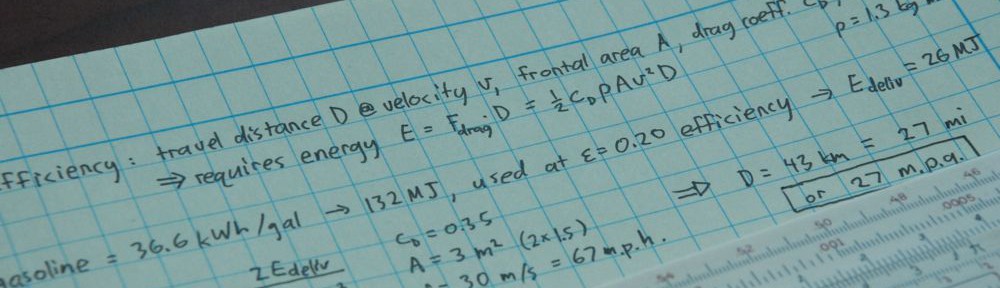
Anyway, this observation sparked a few conversations that prompted me to resurrect old arguments (see Why Not Space and chapter 4 of my textbook), but also add some new ones. Here, I share some of these new perspectives and related calculations.

Continue reading

Views: 4042

A Theory Gone Flat

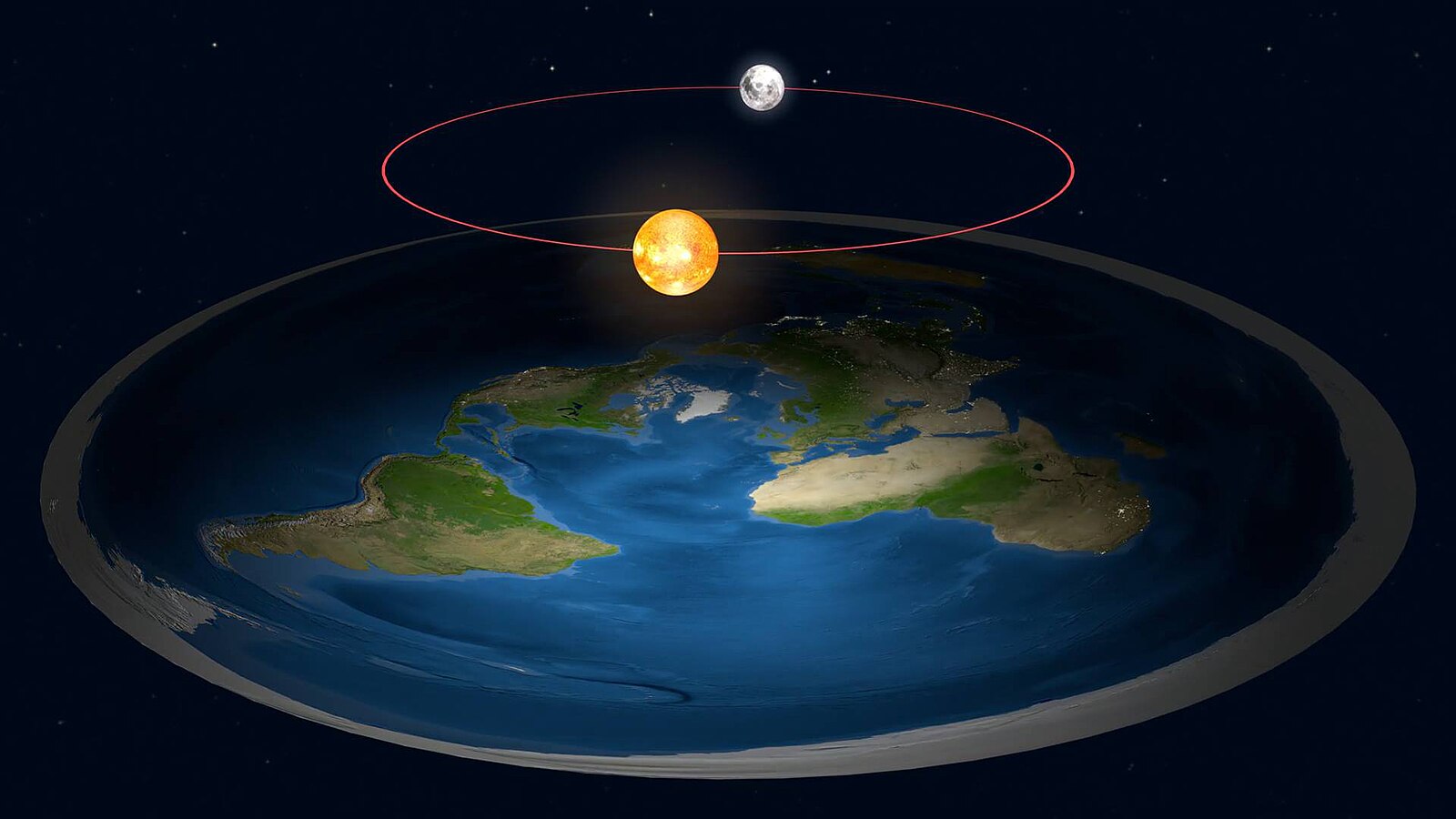
Flat Earth and spotlight sun, by Towarzysz Przewodniczący (Wikimedia Commons)

Am I really going to do this? Am I going to spend time on a topic so far from legitimacy as Flat Earth? Doing so risks affording a tiny bit of credibility to an idea that hasn’t earned it, as if I doth protest too much.

Reasons to bother: 1) illustrate direct observation in action; 2) emphasize the power of listening to what the universe tells us rather than insisting on insufficient mental models as “truth”; 3) provide examples of how mental models go wrong; and 4) I made some graphics worth sharing. While a bit of a tangent from my usual “serious” topics, I figure I can have a little fun once in a while.

The focus will be on conspicuous observations anyone can confirm, personally, without too much effort—even from memory, in fact. I’ll skip the literally dozens of ways I have personally measured and confirmed the spherical Earth, which would make for boring reading. Lots of things break in Flat-Earth scenarios, including GPS navigation (no satellites; broken math), gravity (would crumple a disk-Earth into a sphere in no time; plumb bobs would point more north the farther south one went), and what we’ll focus on here: sunsets. No more sunsets, folks—and any sunsets (or sunrises) you might believe yourself to have seen aren’t what you made them out to be, according to Flat-Earthers.

Rather than denigrating the people who subscribe to Flat-Earth beliefs, I’ll focus on observation. I’m not aiming to convince Flat-Earthers; nothing I say (as an obvious shill for the mega-conspiracy) can replace the sense of community and unconditional support they receive from their FE-family. Any of us might go to extremes of twisted and easily-refuted logic to preserve what’s most important to us. Modernity fails humans in countless ways—loss of intimate tribe being among them. We can forgive those seeking to recapture what’s been lost.

Continue reading

Views: 3360

Death as a Nothing-Burger

Image by LEONSTORETR from Pixabay.

I’ve had two posts in a row about the phenomenon of Life, so it is perhaps fitting to round things out with a post on death. Despite the fact that one cannot enjoy life without the accompaniment of death in its many forms, death is not a suitable subject for polite company in our culture.

Before discontinuing after a few episodes (due to excessive violence), my wife and I started watching the American Primeval show on Netflix. One scene contrasted most members of modernity who—when threatened by Native Americans—blubber and shriek at the prospect of death against one rare individual who showed no fear. While not explicit on this point, I could believe the Native Americans would perceive most members of modernity as being infantilized, pampered, useless, “full-grown children” who had not learned to accept the reality of life—including its requisite, ubiquitous mortality. Or, is that just me, projecting?

Fear of death pervades our culture: many among us cringe at its mention, and indeed structure whole lives around elaborate stories of denial: we can’t really ever be dead, surely!

It’s understandable: having never experienced death ourselves, our brains have no point of contact and cannot conceive what it is like. The vacuum begs to be filled by any fanciful notion that displaces fear of the great unknown.

But, I’ll make a point that many of us actually have experienced something close enough to death to be surprisingly informative. In another sense, all of us have “experienced” our own death state. I’ll explore these “experiences” and why I believe they tell us almost everything we need to know about the state of death. Indeed: if we’re open to observation, we actually already possess a highly probable sense of what happens after we die! As far as I can tell, it turns out to be a nothing-burger—which can be either disappointing or relieving (or just “whatever”) depending on perspective.

Continue reading

Views: 3923

Atomic Humans

Some themes appear to exert a magnetic pull on my attention: I keep coming back to them and often feel like I’m on a treadmill. It’s hard to figure out why: why am I compelled to keep these topics alive? A recent insight ties some of it together.

Years ago, I wrote a post called A Physics-based Diet Plan. The premise is that humans do not create or destroy atoms within their bodies, and that the energetics are too minuscule to register measurable mass–energy conversion. As such, a person’s mass change—as measured on a bathroom scale, for instance—from one day to the next is completely captured by the difference of mass inputs and mass outputs. It’s just atoms in and out.

Now, the human body has many channels for mass loss. Bathroom functions, breathing (net carbon/water loss really adds up!), and perspiration being the main mechanisms. Mass gain is almost entirely through our pie-holes. And entry via that channel is almost always facilitated by a hand delivering food to the mouth under the control of a brain. If you want to lose weight, the directive is simple: eat less and breathe more. In other words: diet and exercise. I know: radical, right? Every successful program for weight loss involves essentially this same advice, in various guises. That’s because it’s just atoms in every single case, at the foundational level. But oh boy, you wouldn’t believe the resistance I get to this framing. Let’s talk about that…

Continue reading

Views: 3820

The Ball Comes to Rest

Surfing YouTube, I came across an interview of Ezra Klein by Stephen Colbert. He was promoting a new book called Abundance, basically arguing that scarcity is politically-manufactured by “both sides,” and that if we get our political act together, everybody can have more. Planetary limits need not apply. I’ve often been impressed by Klein’s sharp insights on politics, yet can’t reconcile how someone so smart misses the big-picture perspectives that grab my attention.

He’s not alone: tons of sharp minds don’t seem to be at all concerned about planetary limits or metastatic modernity, which for me has been a source of perennial puzzlement.

The logical answer is that I’m not the sharpest tool in the shed. Indeed, many of these folks could run cognitive/logical circles around me. And maybe that’s the end of the story. Yet it’s not the end of this post, as I try to work out what accounts for the disconnect, and (yet again) examine my own assuredness.

Continue reading

Views: 5836

Virtual Reality

Image by Sabrina Belle from Pixabay

Our culture is fond of creating virtual realities (make-believe worlds) and then spending much of our time in these alternative worlds. In fact, modernity itself is a type of virtual reality, in that it cannot be a long-lasting way of living on the planet: a temporary retreat from a deeper, broader, and more ancient reality.

In the context of virtual realities, this post compares loathsome modernity to loathsome video games, and the mental miscues they share in common. While brought up on video games and modernity, I have developed allergic reactions to both, and only now made the connection. It’s a single root cause.

Both modernity and video games offer addictive rewards that prove to be empty where it really counts. We can do better.

Continue reading

Views: 3772

What's the Point?

Time for a new paint job on the house?

Having developed a perspective that modernity is fated to fail, and that many of our culture’s current pursuits and institutions are misguided efforts to prop up temporary structures, I often encounter the reaction that I am being defeatist. If what I am saying is true, then what’s the point? Yeah: what is this point that others believe justifies all the craziness? Whatever they think “the point” is could well be based on unexamined and incorrect beliefs.

I will attempt in this post to explain what I mean by this, in multiple passes. A starter example may seem a little patronizing, but could still be helpful. If your world only makes sense and has meaning on the premise that Santa Claus exists, then you’ve put yourself in an unfortunate place. Others have found ways to appreciate life without that requirement based on a falsehood.

Let’s also try generalizing the concept before getting to specific examples.  We start with something I present that happens to be essentially true (or indeed comes to pass in due time), whether or not we can say so with absolute certainty. Then imagine that the reaction is: “well, if that’s true, then what’s the point of living?” Well, we obviously are living, and if we do so in the context of this truth, then it makes little sense to say there’s no point in living. The problem must then lie in what the person believes “the point” to be, and therefore must be wrong about that. In this sense, a “what’s the point” challenge might be taken to signal a flawed worldview.

Okay. That’s the template. Let’s do a few practice cases (optional if you want to cut to the chase), and work our way toward the main event regarding modernity.

Continue reading

Views: 5511

Mysterious Materialism

Image by Kerstin Herrmann from Pixabay

My recent posts have suggested that our world, in all its magnificence, needs nothing beyond physics and emergent complexity to still be mysterious and inspiring, which in turn can lead to being better, humble ecological partners in the community of life. While many human cultures have gravitated toward beliefs in gods, human transcendence, or a higher purpose, I point out that the billion-year timescales of evolution offer plenty of room for unfathomable results that defy our cognitive capacities to grasp. What if all it takes is physics (particles in uncountable relationships) and lots of time for amazingness to emerge? Are you not entertained?

Such a view might predictably be denigrated as reductionist, materialist, and lacking imagination. It’s ironic, because from my point of view it seems to require a super-human amount of imagination: so much that I don’t possess nearly enough on my own—nor has any other human been able to put it all together for us. The very same “failure” of complete end-to-end explanation that causes many to reject the premise leaves me in awe, wonder, and appreciation. One might say that it’s a more challenging concept than the alternatives.

Our recent trajectory has been one of serial demotions, each perhaps more insulting than the last. Earth is not at the center of creation. Nor is the sun at the center of the galaxy. Our galaxy is not at the center of the universe. Our universe may indeed be one among countless others (we can probably never know). Closer to home, we learn that humans evolved from apes, tracing back to slime in our distant lineage. As a corollary, humans are not, in the end, exempt from the laws of life: we are physical beings still subject to—and dependent on—biological and ecological constraints. The proposal I discuss takes the demotion series another step: removing imagined transcendent properties of free will (mind, or soul) and divine favor—instead establishing us as compulsory actors in an extravagant production of physics. It all makes for a rough day, unless your expectations are unusually low.

What could be more humbling than to accept ourselves as piles of atoms executing the interactions of physics? Note that we could use heaps and heaps more humility in our world. Perhaps this is one route to get there: a principle that also more closely binds us to all other life—to our collective benefit.

Continue reading

Views: 3169

Free Will: Good Riddance

This baby violet-green swallow faces the first big decision of her life: should I stay or should I go, now.

I never cared much for arguments about free will, one way or the other. I put free will into a similar category to other wastes of time in philosophy, like the Great Deceiver concept or the trolley problem. Angels on the head of a pin, anyone? It seemed like one of those unresolvable debates that has persisted for centuries: a tar baby that one would be foolish to punch.

If an opinion was demanded of me, I would say without particular conviction that I leaned toward a position that free will was an illusion, but that I was happy to behave as if I had free will, and then get on with life. My leaning toward illusory free will stemmed from a sense that our decision center is no more than a bolus of interconnected neurons, shaped by many influences in the physical universe.

After listening to a podcast featuring Robert Sapolsky based on his new book Determined (which I have not read yet), I found my position coming into focus. A large majority of people in our society—over 80%—believe in free will. Indeed, it is often pointed out that our criminal justice system is predicated on the concept. Some folks (called compatibilists) adopt a squishy compromise position that attempts to assess how “internal” a decision is (good luck with that). Few members of modernity reject free will completely, but that’s where Sapolsky landed, and I found his arguments to be persuasive.

A recent article by Richard Heinberg explored the interaction between belief in free will and our response to the meta-crisis: can we save the world if we don’t have free will as a motivating engine? Although I am somewhat reluctant to weigh in on the pernicious free will topic, what the hell. I find myself compelled to do so.

Continue reading

Views: 11378