Discovering Limits to Growth

After inaugurating the Do the Math blog with two posts on the limits to physical and economic growth, I thought it was high time that I read the classic book The Limits to Growth describing the 1972 world computer model by MIT researchers Meadows, Meadows, Randers, and Behrens. I am deeply impressed by the work, and I am compelled to share the most salient features in this post.

To borrow a word from a comment on the Do the Math site, I’m gobsmacked by how prescient some of the statements and reflections in the book are. Leaving aside remarkably good agreement in the anticipated world population and CO2 levels thirty years out (can’t fake this), I am amazed that many of the thoughts and conclusions I have formed over the past several years are not at all new, but were in black-and-white shortly after I was born. Continue reading

Views: 9129

Garbage In, Garbage Out

How many times have you heard it: if we could tap into the energy embedded in our copious waste streams, we could usher in a new era of energy independence—freeing ourselves of the need to support oppressive regimes who happen to sit atop the bulk of the oil reserves in the world. In fact, these sorts of claims are abundant enough to give the impression that we have a cornucopia of fresh (and sometimes not so fresh) energy solutions to pursue if we got really serious. This is a hasty and dangerous conclusion, so in this case, waste makes haste.

I consider this perceived abundance of technological solutions to be one of our worst enemies in developing sensible solutions to the coming fossil fuel energy crunch. If ideas abound, each claiming some ability to free us of foreign oil, then surely we’ve got the situation under control and don’t need to invest substantial time and energy today to solve what looks like a non-problem of tomorrow. But what if the claims are overblown, hyped, or just plain wrong? At best, this is irresponsible behavior. At worst, the resulting sense of complacency could delay substantive action to our ruin. Continue reading

Views: 2673

MPG for Electric Cars?

A typical efficient car in the U.S. market gets about 40 MPG (miles per gallon) running on gasoline. A hybrid car like the Prius typically gets 50–55 MPG. In a previous post, we looked at the physics that determines these numbers. As we see more and more plug-in hybrid or pure electric cars on the market, how do we characterize their mileage performance in comparison to gasoline cars? Do they get 100 MPG? Can they get to 200? What does it even mean to speak of MPG, when the “G” stands for gallons and a purely electric car does not ingest gallons?

This post addresses these questions. Continue reading

Views: 8840

Recipe for Climate Change in Two Easy Steps

[A considerably expanded treatment of this material appears in Chapter 9 of the Energy and Human Ambitions on a Finite Planet (free) textbook.]

Today, we’re going to make the world less comfortable, in two easy steps that each of you can do at home. Step 1 shows how easy it is to account for the carbon dioxide excess in the atmosphere based on our cumulative use of fossil fuels. Step 2 bypasses intricacies of thermal radiation to put an approximate scale on the amount of heating we would expect the excess CO2 to produce. Serves 7 billion.

Climate Change in Context

I view climate change as a genuine challenge to the stability of our coexistence with the planet. But it is not my primary concern. A far more dangerous threat to the human endeavor is, in my mind, our reliance on finite resources and the difficulty our economic systems will have coping with a decline in the availability of cheap energy. That said, the issues are closely linked—through fossil fuels—and both benefit from a drive toward renewable resources. Continue reading

Views: 5092

Personal Energy Cubes

In this post, we’ll put a physical, comprehendible scale on the amount of energy typical Americans have used in their lifetimes. No judgment: just the numbers.

The task is to estimate our personal energy volume, so that we can mentally picture cubic tanks or bins corresponding to all the oil, coal, natural gas, etc. we have used in our lives—perhaps plunked down in our backyards to bring the idea home. Go ahead and try to guess/picture how big each cube is.
Continue reading

Views: 2913

Does the Logistic Shoe Fit?

U.S. total energy 1650-present (logarithmic)

This is a quick update regarding the first plot shown in the galactic scale energy post. A reader, Chris, called attention to the obvious departure from exponential growth in recent decades. The post required turning a blind eye to many practical issues (like population saturation) in order to entertain indefinite growth, serving to highlight the absurdity of the notion. But Chris goaded me into paying more attention to the departure from the exponential track in the actual data, and here are the results of a logistic approach. Continue reading

Views: 3650

A Nation-Sized Battery

As we look to transition away from fossil fuels, solar and wind are attractive options. Key factors making them compelling are: the inexhaustibility of the source with use (i.e., renewable); their low carbon footprint; and the independence that small-scale distribution can foster (I’ll never put a nuclear plant on my roof, even if it would make me the coolest physicist ever!).

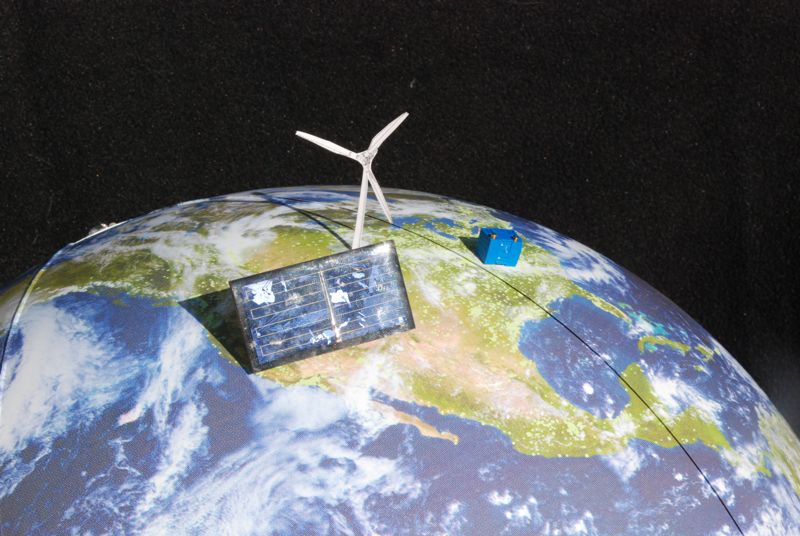
lovely future of solar, wind, and honking-big battery

With full-scale solar in the desert southwest, and wind in the plains states, we're going to need a big battery (items not to scale!).

But solar and wind suffer a serious problem in that they are not always available. There are windless days, there are sunless nights, and worst of all, there are windless nights. Obviously, this calls for energy storage, allowing us to collect the energy when we can, and use it when we want.

Small-scale off-grid solar and wind installations have been doing this for a long time, typically using lead-acid batteries as the storage medium. I myself have four golf-cart batteries in my garage storing the energy from eight 130 W solar panels, and use these to power the majority of my electricity consumption at home.

It’s worth pausing to appreciate this fact. Compare this scheme to the dream source of fusion. Why do people go ga-ga over fusion? Because there is enough deuterium in water (sea water is fine) to provide a seemingly inexhaustible source of energy, and there are no atmospheric emissions in the process. Meanwhile, solar provides a source that will last longer (billions of years), produces even less pollution (no radioactive contamination of containment vessel), and is here today! It’s even affordable enough and low-tech enough to be on my roof and in my garage! People—we have arrived!

Storage works on the small scale, as many stand-aloners can attest. How would it scale up? Can it? Continue reading

Views: 22860

Temporary Lull

Initiating this blog, I wanted to get a few posts out quickly so folks could get a feel for the nature of the content.  On that score, the previous post on 100-mpg cars is probably most representative of future content.

I’ve got dozens of ideas for future posts that I am eager to share, but I will pace myself to about one new substantial post per week (would be hard to sustain more, given demands of my job).  Since the Energy Bulletin is running these posts as a series, I don’t want to get too far ahead of their weekly publication schedule.  As such, I will sit on my heels for a bit until we’re synchronized.  So thanks for your patience, and keep a lookout for the next post sometime around the first week of August.

Views: 1392

100 MPG on Gasoline: Could We Really?

Since I was a teenager, I frequently heard stories that some guy had invented a car that could get 100 miles per gallon (MPG), but that powerful interests (often GM, Chevron, etc.) had bought rights to the idea and sat on it. We suckers were left to shell out major bucks for gasoline, when a solution was in hand and under wraps.

Leaving aside the notion that such a design would bring unbelievable prosperity to its holder (i.e., no real incentive to sit on it), let’s look at what physics says is possible.

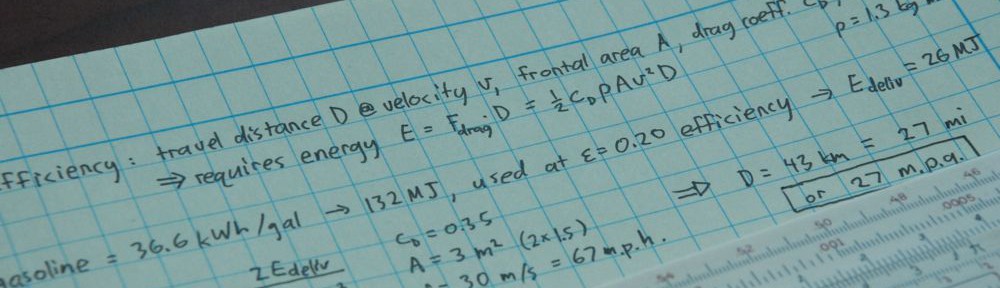
We like cars because we can travel quickly from point A to point B. So let’s evaluate the energy requirements to make that journey at freeway speeds. We will use the somewhat awkward (although appropriate) speed of 67 m.p.h. because it conveniently maps to 30 meters per second. At these speeds, aerodynamic resistance is the dominant energy drain, so we will start by evaluating only this to get a lower bound on fuel efficiency, and find that we do a pretty good job! Continue reading

Views: 14611

Can Economic Growth Last?

[An updated treatment of this material appears in Chapter 2 of the Energy and Human Ambitions on a Finite Planet (free) textbook, and also forms the basis for a 2022 article in Nature Physics.]

As we saw in the previous post, the U.S. has expanded its use of energy at a typical rate of 2.9% per year since 1650. We learned that continuation of this energy growth rate in any form of technology leads to a thermal reckoning in just a few hundred years (not the tepid global warming, but boiling skin!). What does this say about the long-term prospects for economic growth, if anything?

Gross World Product

World economic growth for the previous century, expressed in constant 1990 dollars. For the first half of the century, the economy tracked the 2.9% energy growth rate very well, but has since increased to a 5% growth rate, outstripping the energy growth rate.

The figure at left shows the rate of global economic growth over the last century, as reconstructed by J. Bradford DeLong. Initially, the economy grew at a rate consistent with that of energy growth. Since 1950, the economy has outpaced energy, growing at a 5% annual rate. This might be taken as great news: we do not necessarily require physical growth to maintain growth in the economy. But we need to understand the sources of the additional growth before we can be confident that this condition will survive the long haul. After all, fifty years does not imply everlasting permanence.

The difference between economic and energy growth can be split into efficiency gains—we extract more activity per unit of energy—and “everything else.” The latter category includes sectors of economic activity not directly tied to energy use. Loosely, this could be thought of as non-manufacturing activity: finance, real estate, innovation, and other aspects of the “service” economy. My focus, as a physicist, is to understand whether the impossibility of indefinite physical growth (i.e., in energy, food, manufacturing) means that economic growth in general is also fated to end or reverse. We’ll start with a close look at efficiency, then move on to talk about more spritely economic factors. Continue reading

Views: 34900